
A decision model looks objective until you notice the judgement baked into every input. The weights are chosen. The categories are framed. The confidence score is manufactured. Useful models make those choices visible. Dangerous ones hide them behind decimal places and colour bands.
I have watched a consultant sell a committee a model with 47 inputs, three colour bands and a confidence score rounded to two decimal places. Within minutes the group stopped asking whether the assumptions were sound and started admiring the spreadsheet. That is how a decision model takes over.
A decision model is a simplified representation that converts selected inputs and assumptions into an estimate, ranking, or recommendation.
What a decision model actually does
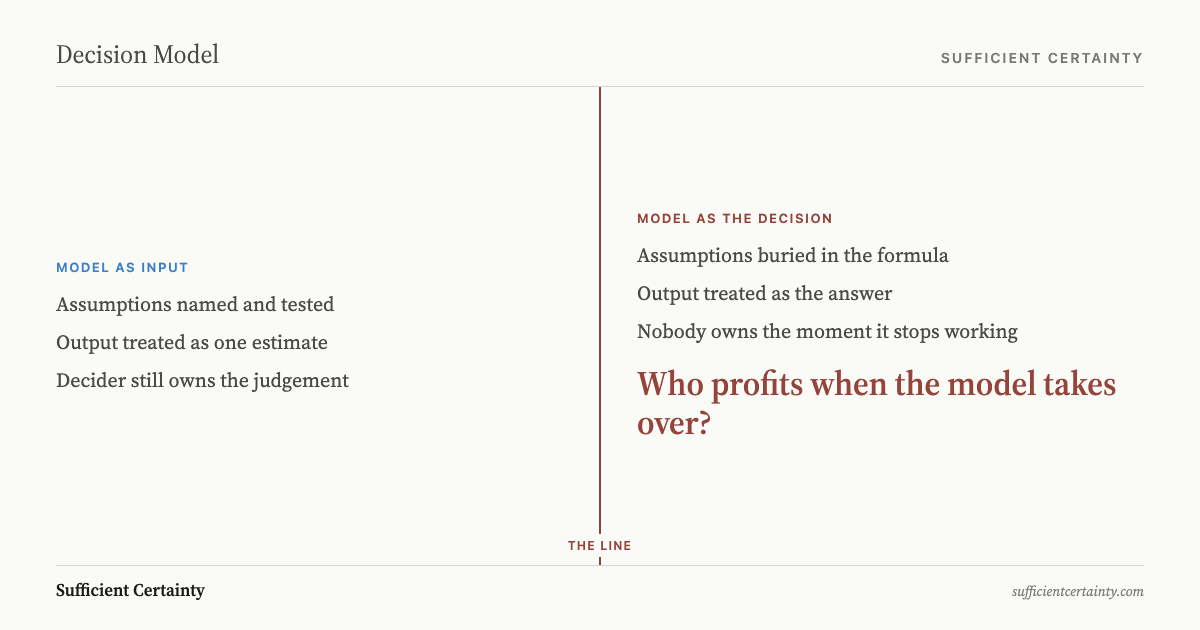
After the financial crisis, the Federal Reserve had to state the obvious in SR 11-7: a model produces an estimate, not a decision. The risk starts when people use the output badly and act as if the calculation settled the matter. The crisis had already shown what happens when respectable mathematics keeps talking after the context has left the room. In my experience, other organisations need that warning just as badly, especially the ones spending good money on precision theatre.
Consultants get paid to sell the apparatus, and model custodians enjoy the status it gives them. Committees like it because shared cover feels safer than personal judgement. I have seen the same dodge in wildfire planning. The spread model can show what follows if fuel and weather behave as assumed. It cannot tell you whether today's conditions justify trusting those assumptions. That is still a human judgement made under uncertainty, however much the room would like to subcontract it.
Google Flu Trends lost the world it thought it understood
Google Flu Trends looked brilliant until the stand-in signal wandered off and the model kept its authority. In March 2014, David Lazer and his colleagues wrote in Science that the system had overfit past data and drifted as search behaviour changed. The hidden bet was that people would keep searching in a way that preserved the proxy. Once a model has won applause, plenty of organisations keep clapping long after the world it was tuned to has moved on.
I have no patience with the line that no model is perfect. The question is whether anyone built a way to notice drift before stale output kept being treated as fact. Most teams resist that test because it threatens months of work and a few tidy reputations. If nobody is watching the live assumption, the model is already running the room.
Run your live model-bound decision through the five steps and expose which input is posing as objective fact. Start the Walk →
A decision model can damage the world very quickly
The flash crash showed how fast this goes wrong. On 6 May 2010, an automated algorithm sold 75,000 E-Mini contracts while paying no attention to price, according to the CFTC and SEC report. The live assumption was simple: if the rule was being followed, the market would absorb the order. In stressed conditions that assumption collapsed long before the machinery surrendered its authority.
What kept the rule running was code wrapped in outsourced blame. Nobody wanted to own the moment when it stopped making sense, so the process carried on and everyone got the alibi they wanted. That arrangement is popular in large organisations, for obvious career reasons. If you will not design monitoring that tells you when to stop trusting the output, you are sheltering behind a model rather than using one.
The useful model is the one that stays provisional
The Thames Estuary 2100 plan is useful because nobody pretended the first output was prophecy. According to GOV.UK, indicators are reviewed every five years and the plan itself every ten. What made it useful was the refusal to worship a flood model for the next hundred years. That discipline mattered more than any neat forecast.
Most organisations do the opposite. They commission a model, celebrate the launch, and treat any call for revision as an insult to the team that built it. I have lost count of the rooms where the model was three years stale, the input data five years old, and the only person who understood the calibration had moved on. Everyone still cited the output as current. The model custodians kept their authority and the room kept its comfort. The Thames Estuary team avoided that by designing revision into the original commission, not treating it as a confession of failure. They wrote down what would trigger a rethink before anyone had a reputation invested in the first answer. That is the difference between a living tool and a monument to the year someone's spreadsheet won a contract.
Roger and I never treated a model as something you are too proud to revise. A model earns its keep only while someone is still willing to change it when the world stops cooperating. Embarrassment is what turns a tool into dogma. If you want to know why one failed, do a decision autopsy on the assumption that shifted, not a pious sermon about better software.
How I keep a decision model in its place
People sometimes ask me for a system that keeps models in their place. I do not have a system. In my experience, one assumption inside the model is carrying most of the answer, and the rest is scenery. I make the room name that assumption, then name the condition that would make us stop trusting the output. If nobody can do both, the exercise is decoration for a decision the room is afraid to own.
That is why, in my overview of decision-making frameworks, I treat a decision model as a tool, not as a verdict. Once the output is treated as the decision, judgement has already been outsourced to a formula and to the people who make their living keeping it respectable. I use models gladly, but I do not worship them.
You could admire the spreadsheet and let your next decision model start deciding for you.
Work through your decisionNo sign-up. Just pick your decision and start.
Grant Purdy is the co-author, with Roger Estall, of Deciding (2020), and the architect of the Universal Decision-Making Method.