
A decision making process model that ends at selection treats the midpoint as the finish. Choosing is one step. Testing whether the choice rests on assumptions strong enough to survive contact with reality, then watching whether they hold, is where the real process begins.
Pick the best option. That is where most decision making process models stop. The textbooks call it "selection" and draw an arrow to an output box. In my experience, that is roughly the halfway point. The option still carries assumptions nobody has bothered to name, the world it was designed for is already changing, and nobody has written down what would force the organisation to reconsider. A process that ends at choice is a process that ends before the decision has been tested.
A decision making process model is a structured sequence for moving from purpose and context to choice, execution, and review.
What a complete decision making process model contains
The Universal Decision-Making Method runs five stages: Frame the decision around Purpose, Develop options, Recognise assumptions, reach Sufficient certainty, and Design monitoring before the decision is implemented. The sequence matters because each stage depends on the one before it. Skip straight to options, which is what most process models do, and the later stages have nothing to test against. You cannot judge assumptions if you never named them.
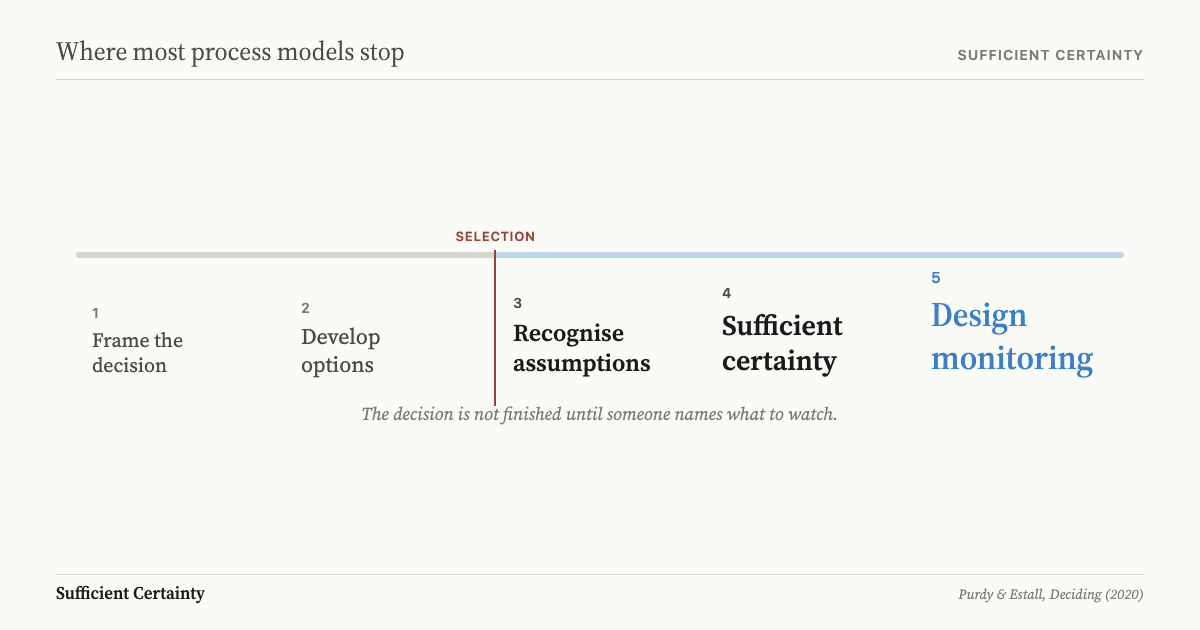
Monitoring gets treated as postscript because nobody wants to reopen an approved decision. Reopening embarrasses the people who signed off. It means the process was not as complete as they said it was. So the monitoring stage gets quietly dropped, the decision drifts unchecked, and the first sign of trouble arrives as a surprise rather than a trigger.
Process models that omit Purpose start in the wrong place
The U.S. Government Accountability Office published a risk-informed decision framework for environmental hazards in 2024. It runs four phases: design the process, analyse the options, decide, then implement and evaluate. That fourth phase gives it more reach than most textbook diagrams, which treat implementation as someone else's job. But the flaw is in the first word. "Design the process" before you have established Purpose means the committee can build a technically elegant procedure that serves the wrong end efficiently.
Purpose is not a mission statement on the wall. It is the reason the organisation exists, and it settles whether an opportunity deserves any process at all. Skip it and you get committees producing elegant options for problems nobody should have been solving, served with a rigour that makes them look like due diligence. The rational decision-making model falls into the same gap: it asks whether every relevant fact has been gathered, not whether the question was worth asking.
Map your current decision onto a full process and see what selection leaves untested before deployment begins. Start the Walk →
What happens when a decision making process model ends at deployment
Knight Capital showed what a truncated process costs. On 1 August 2012, the firm deployed new code to its production servers and left obsolete trading functionality callable on one of eight. Within 45 minutes, 212 incoming orders triggered millions of unintended child orders across 154 stocks. The SEC enforcement order records that Knight accumulated a net long position of approximately $3.5 billion and a net short position of approximately $3.15 billion, losing $460 million before the day was over.
The deployment decision had no written procedure requiring a second-person review and no automated control to halt orders when exposure limits were exceeded. The assumptions were invisible: that every server carried the same code, that monitoring would catch drift before damage spread. None was named and none was tested. Knight Capital's process stopped at "deploy" and the missing stages arrived as a $460 million invoice.
A decision process that kept going
The Glen Canyon Dam Adaptive Management Program does the opposite. Monitoring is built into the approval itself, with specific sediment triggers and collaborative review points that determine whether experiments proceed. In 2024 a supplemental record of decision introduced a year-long sediment accounting period and named the conditions under which a high-flow experiment could be considered. When those conditions were not met, the Bureau cancelled the fall 2025 experiment, partly because a lapse in appropriations would have restricted the ability to monitor it. The approval was never treated as sacred. The Bureau designed triggers that could override it, and when the triggers fired, the decision was revised.
The UK government's ROAMEF cycle follows a similar logic: monitoring and evaluation feed back into the next decision rather than arriving as retrospective paperwork filed six months later. The review asks whether the intervention met its objectives and whether unintended consequences appeared. In my experience, most compliance regimes prefer to skip those questions. The paperwork is tidier, and it never forces anyone to reopen what was already approved.
How the Universal Decision-Making Method differs
Every decision-making framework I have seen in a boardroom ends at selection. The scoring grid produces a winner. The process diagram draws an arrow to "implement." Nobody writes down which assumption the winner is resting on, and nobody designs a trigger that would force the committee back into the room when conditions change. The decision walks out of the boardroom and into the organisation with no supervision at all.
The method Roger and I set out starts before the options and finishes after implementation. It starts with Purpose because the wrong Purpose sends the entire process in the wrong direction, and because without it nobody can distinguish an opportunity worth pursuing from institutional noise. It makes assumptions explicit so the Decider knows which ones are carrying the decision and which are background noise. And it finishes with monitoring designed into the decision, not bolted on when the auditors arrive.
Process slideware sells because it looks complete in 20 minutes. The stages the room can see, options and selection, get automated. The stages nobody wants to see, the assumptions and the monitoring, stay off the chart because they are harder to put on a slide and harder still to defend to a committee that wants certainty. A complete decision making process model would keep the decision under observation. The wider families of decision making models share the same blind spot. The slideware version lets everyone go home.
You could pick the option now and discover the untested assumption after rollout.
Work through your decisionNo sign-up. Just pick your decision and start.
Grant Purdy is the co-author, with Roger Estall, of Deciding (2020), and the architect of the Universal Decision-Making Method.