
Rational decision making is not the absence of uncertainty. It is the discipline of naming which assumptions fill the gaps, testing whether those assumptions hold, and recording what would force the decision back onto the table. Every call is made with incomplete information. The question is whether the gaps have been named.
Every decision is made with incomplete information. That is not a flaw in the process; it is the condition. The question is whether the gaps have been named. I once sat with a board that had eighteen months of feasibility work and could not tell me which assumptions the whole case rested on. The information was incomplete in ways nobody had written down, so nobody could test them, and nobody would know when reality moved past the paper. Decisions do not fail because people lack facts. They fail because the gaps were never surfaced, never agreed, and never monitored.
Rational decision making is the disciplined use of stated assumptions, relevant evidence, and explicit trade-offs to justify a choice.
What the textbook model assumes
Simon saw this fraud in 1955. Herbert Simon’s “economic man” knows more than any real Decider ever will, sees the relevant environment clearly, and calculates the best attainable choice. No human being gets complete information in time, or ranks every option without residue. I have never met that character. I have met plenty of executives who were expected to impersonate him for a board pack.
That fantasy is why rational decision making so often turns into a paid performance. Nobody ever invoices for less paperwork. Advisers get another round of fees, while committee structures and spreadsheet custodians keep their little kingdom because the model still needs one more pass. I have watched this masquerade for years. Until someone asks what we are assuming and how confident we are that it will hold, the process is only laundering uncertainty. In many organisations it slides into analysis paralysis and gets sold as prudence.
The model fails when assumptions stay hidden
Ariane 5 made the point in fire on 4 June 1996. The live assumption, carried over from Ariane 4, was that a reused routine still belonged in a different flight regime. The inquiry found it had stayed alive for an old requirement that no longer made sense. About 40 seconds after lift-off, an overflow shut down the inertial reference system. People fixate on the code. I fixate on the assumption that was never dragged into the light.
That is not a software anecdote. Nobody was made to recognise assumptions before approval, because questioning inherited logic is slower and less flattering than admiring reuse. Every reuse decision carries a hidden bet that the original context still holds. When nobody tests that bet, the institution calls it efficiency and the next inquiry calls it negligence. I want the assumption named before anyone signs, not discovered after the debris falls.
When the output is treated as fact
The Post Office Horizon Inquiry exposed the same weakness with a crueler victim. Horizon was rolled out from September 1999, spread across the branch network by the end of 2000, and then used to support prosecutions and repayment demands into the autumn of 2013 even though Fujitsu staff already knew the system could produce bugs. The institution preferred the machine to the embarrassment of doubt.
That is the part polite accounts soften. Once the machine spoke, managers stopped thinking while model owners and committee structures hid behind the output. In my experience, that is when the real damage starts, because everyone can point to the screen and nobody has to own the accusation. I wrote about the same pattern in decision analysis under uncertainty: I see the same cowardice in business models with lovely decimal places and no human ownership. Models are inputs. They do not carry moral responsibility, however useful that fiction is to the people hiding behind them.
Had anyone written down the live assumption, it would have read: the Horizon system produces accurate branch accounts. That assumption held for roughly a year before evidence arrived that it did not. The evidence was ignored for thirteen more years because testing the assumption would have meant admitting the prosecutions were built on a system nobody had verified. That is the price of treating the output as the decision. Name the assumption first, and you have something to test. Protect the output, and you have nothing but a story that gets more expensive to retract.
Put your fact-heavy decision through the five steps and name the hidden assumption your evidence still cannot close. Start the Walk →
Without a stopping rule, analysis fills every hour available
Louisiana’s 2017 Coastal Master Plan matters because it wrote a stopping rule into a 50-year coastal problem instead of pretending one forecast would save the coast. The planners tested projects across three environmental scenarios and wrote revision into the 124-project plan from the start. It did not confuse planning with prophecy. That is the discipline most boards resist: decide when you have enough to move, then keep watch.
I prefer Louisiana’s honesty to the usual ritual, where people ask for more analysis until the deadline makes the decision for them. The state kept monitoring inside the plan because reality was going to move. Monitoring is not reporting after the event; it is the mechanism that tells you when one of your live assumptions has failed. You decide, then you watch the assumptions that could undo the decision.
What I use instead
Roger Estall and I built the Universal Decision-Making Method, and later wrote it up in Deciding, because analysis needs an ending. The rational model never provides one. I stop at sufficient certainty: enough to act, with the assumptions named and monitoring designed before the context shifts under the decision.
The difference is practical. I make the Decider name the assumptions that could change the answer, and I insist on monitoring before the ink is dry. Analysis stops when it has served the decision, not when the advisers run out of things to model.
Most named frameworks improve one slice of the apparatus and leave judgement in the dark. Every decision making process model I have reviewed ends at selection. I have been saying this since the first edition of Deciding: the person who signs is left holding the consequences while advisers invoice another round and model owners congratulate themselves on thoroughness. I still call it what it is, paperwork with manners.
How to stay rational when the room wants a quick answer
Rational decision making models assume you have time. Time to enumerate options, weight criteria, run the sensitivity analysis, convene the working group. In practice, someone in a budget meeting says “we need an answer by close of business” and the model evaporates. I have sat in enough of those rooms to know that the response is almost never to apply the method faster. It is to abandon method entirely and fall back on whoever speaks loudest or whoever has the most authority in the room.
That is not rationality under pressure. It is capitulation dressed as decisiveness.
The pragmatic version works differently. When the room wants an answer now, I do three things. I name the one assumption that could break this decision. I check whether the evidence I already have supports it or contradicts it. And I commit, with a monitoring trigger attached so the decision does not run unwatched into a wall. That sequence takes three minutes, not three meetings. It is not a shortcut around discipline. It is discipline compressed to the parts that actually protect you.
I once sat with a divisional head during a funding review. Treasury had moved the deadline forward by a week. The team wanted to pull the submission and ask for more time. The divisional head asked me what to do. I asked him one question: what is the assumption this case depends on that you are least confident about? He thought for perhaps ten seconds and said the demand forecast for the second year. I asked whether any evidence in the room contradicted it. He said no, but the sample was thin. So we wrote a monitoring condition: if Q1 actuals deviate from forecast by more than 15 per cent, reconvene and reassess the commitment. He signed the submission that afternoon. The forecast held. Had it not, the trigger was already set.
That is what the method looks like when compressed. You are not skipping steps. You are running them on the one assumption that matters instead of spreading the effort across every variable the model can name. Roger Estall and I wrote Deciding around the principle that enough information is a judgment, not a threshold on a spreadsheet. Under time pressure, that judgment narrows to a single question: does the critical assumption hold well enough for me to act and watch?
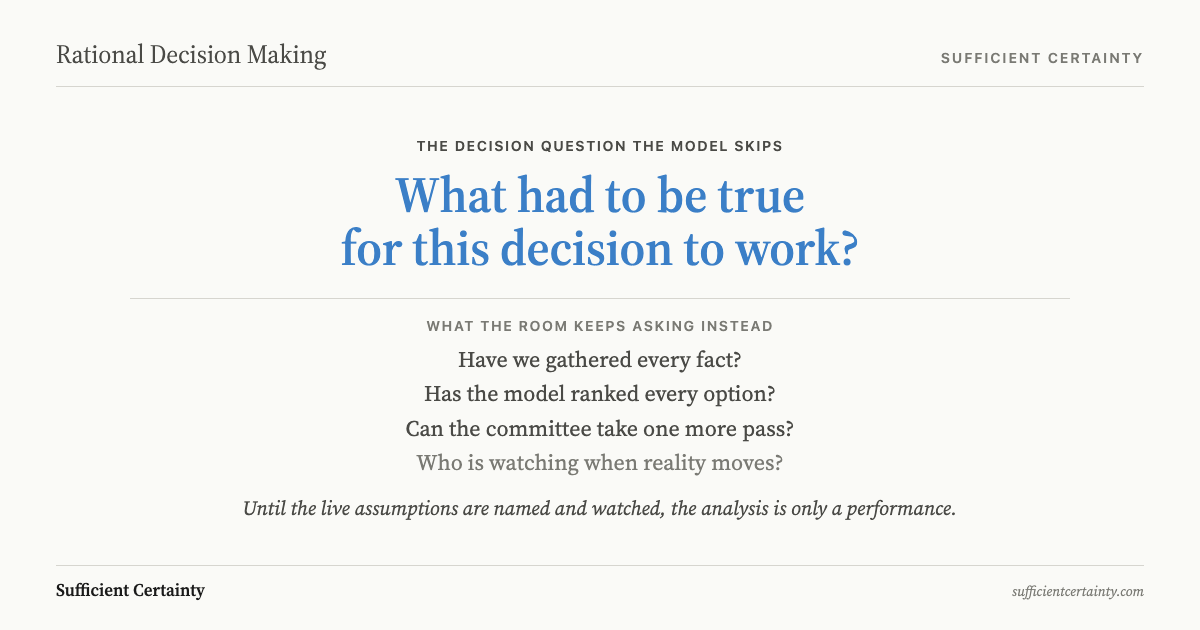
The rooms where I have seen this fail are the ones where nobody asks the question at all. A crisis hits, the pressure builds, and the organisation responds by doing whatever it did last time or whatever the most senior person in the room prefers. That is not a rapid decision. It is an inherited one, with no test applied and no monitoring attached. When it goes wrong, the post-mortem always finds the same gap: nobody asked what had to be true for this to work.
A rapid decision making framework that cannot operate in three minutes is not rapid. It is a normal framework with a shorter deadline bolted on. The discipline I am describing is structural. Name the assumption. Test it against what you know. Set a trigger. Those three moves do not require a workshop, a facilitator, or a consensus exercise. They require one person willing to say: here is what we are betting on, here is why I think it holds, and here is what will tell us if it does not.
That is rationality under pressure. Not the absence of rigour, but rigour aimed at the load-bearing joint instead of the entire edifice. The room wants a quick answer. Give it a tested one instead.
You could stack more facts and still face your next deal without a plain question.
Work through your decisionNo sign-up. Just pick your decision and start.
Grant Purdy is the co-author, with Roger Estall, of Deciding (2020), and the architect of the Universal Decision-Making Method.