
Decision making styles tell a manager their preference. They cannot tell the manager whether the recommendation rests on a claim that has been tested. Style labels sort personality. Three questions about what the decision depends on are worth more than any quadrant on a workshop pack.
A managing director once handed me a workshop pack on decision making styles while he was deciding whether to shut a plant that employed 240 people. The pack had a neat grid, 18 tick-box questions, and a warning not to overuse his natural type. It told him he was "conceptual". The label could not tell him whether the closure case rested on a forecast the company could trust, or what sign would force a review after the gates were locked.
The best decision-making style follows the needs of the live decision. The governing question was whether the case before him had enough basis to justify a closure, not whether he preferred to decide quickly or cautiously. A style can affect where someone starts. It cannot establish whether the decision is ready.
I do not object to description. I object to the sale. Style labelling lets a room discuss temperament while keeping the weak forecast off the page. That suits workshop vendors, HR test sellers, and executives who would rather diagnose one another than name the bad bet underneath the paper. The analytical person is expected to slow things down. The directive person is expected to push. Nobody asks whether the forecast underneath the recommendation is sound.
Decision making styles describe how a person prefers to choose, not whether the choice is any good.
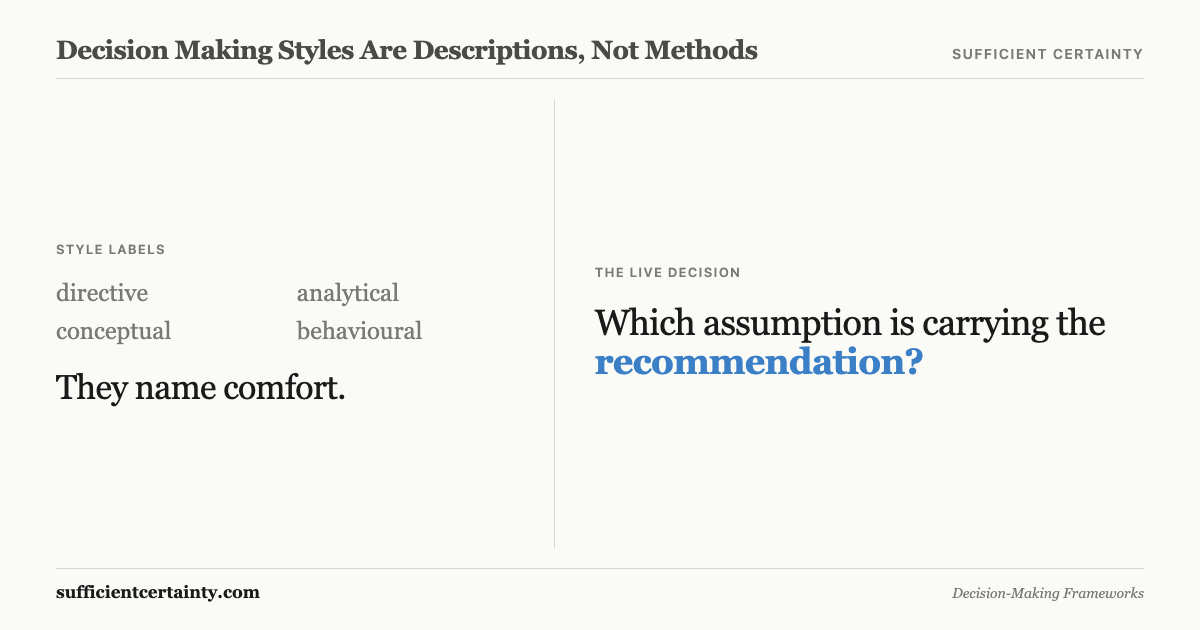
No decision-making style decides whether the call is sound
Most page-one advice pieces start with the same four-box diagram. Find your type, glance at the blind spots, and carry on as before. It is a pleasant ritual, and apparently many organisations find it soothing. The decision, however, still has to survive contact with reality.
The academic work is far less tidy than the workshop version. In a 1995 paper by Scott and Bruce, the authors developed a general decision-making style measure with five styles, not four, and reported reliability scores from .68 to .94. That matters because even the measurement literature does not line up with the neat quadrant sold on page one. More important, the paper built a measuring tool. It did not show that learning your label improves the decision itself.
A later 2012 study of 102 middle managers found something much smaller than the web promise. Rational style scores were associated with better rationality, and avoidant scores tracked indecisiveness. Useful, but modest. A board paper does not become sound because its sponsor has discovered he prefers more analysis.
The web sells style as if self-recognition were half the job. In my experience it is not even close. I have sat with boards who could name everybody's tendencies within ten minutes and still could not tell me what would have to be true for the recommendation to work. That is not a personality problem. It is a decision problem.
Set aside the style labels and test the live decision until the missing assumption shows up on the page. Start the Walk →
Style labels make a good alibi
The evidence also argues against treating style as identity. In a 2004 study of 206 Swedish military officers, Thunholm concluded that styles were not mutually exclusive and may be better understood as learned habits. That fits what I have seen. The same executive can demand six annexures on Monday and make a clean call on Wednesday if the issue is framed properly and the carrying assumption is visible.
The real appeal of style typing is bureaucratic. If the CFO is "analytical", nobody has to say the cash-flow forecast is wishful. If the chief executive is "directive", nobody has to say she shut debate before the awkward evidence arrived. The label sounds civilised, which is marvellous news if your business depends on civilised workshops. The weak assumption stays exactly where it was, unmentioned and unharmed.
That is who benefits from the machinery: vendors who can sell a quadrant, facilitators who can run a session, and managers who want to feel they have done something serious. What nobody has to do is write down the proposition that could actually fail.
Style language is especially attractive in large organisations because it feels blameless. Nobody is accused of wishful thinking or paper-hoarding. Everyone is merely expressing a preference. That sounds mature. It is also a tidy way to keep accountability slippery while the bad forecast continues to smile from the appendix.
The live decision can require behaviour against type
A real decision does not care what feels natural to the Decider. A plant closure may need a blunt authority call first, then slow work on the demand assumption. An acquisition may reverse the order. Decision making styles are secondary when the live question demands a different pace or a different standard of proof.
Recent work points the same way. A 2026 study of 500 Japanese adults modelled daily decision behaviour as two dimensions rather than fixed types. The detail that matters is simple: behaviour appears adjustable. That fits experience far better than the internet's habit of treating a questionnaire result as destiny.
I once watched a chief executive who scored as strongly intuitive spend three weeks on due diligence for a joint venture because the demand forecast depended on a single government contract that had not been signed. His style said decide fast. The assumption said wait. He waited. The contract fell through. His type would have cost the firm eight figures.
Time pressure makes this plainer, not murkier. If an executive says, "I am just intuitive", that tells me almost nothing. I still need to know what has been assumed, what has been ruled out, and what evidence would overturn the call. Once we do the work on assumptions in decision making, rooms often behave against type. I have seen forceful chief executives slow down, and cautious committees move, once the live uncertainty is stated plainly. If you only need a map of who recommends and who decides, the RAPID decision-rights framework is a decent role map, but it still does not tell you whether the case is ready.
Three questions matter more than a style label
I start with three rude questions. What are we actually deciding? What assumption is carrying the recommendation? What sign would force us to reopen the decision after we act? Until those questions are answered, the style conversation is decorative.
Those three questions do more work than any style inventory I have seen. The first stops the room from solving the wrong problem. The second forces the carrying assumption onto the table, where it can be tested instead of trusted. The third sets a review point, so the decision does not become orphaned the moment the meeting ends. None of them care whether the Decider prefers analysis or instinct.
People sometimes ask whether a directive person can use our method, or whether an analytical person will slow it down. Of course they can use it. Roger Estall and I wrote Deciding because organisations kept mistaking personality talk for judgement. The Universal Decision-Making Method asks the room to do the work style labelling avoids. It makes the assumption visible, asks how much certainty is sufficient before commitment, and requires decision monitoring, because a decision is not finished when the meeting ends.
For the wider map, read the overview of decision-making frameworks. My own view is simpler. Style labels can describe comfort. Once consequences are real, they are mostly decoration, and often cover for a bad forecast nobody wants to name.
You could close this tab and carry that decision into another week.
Work through your decisionNo sign-up. Just pick your decision and start.
Grant Purdy is the co-author, with Roger Estall, of Deciding (2020), and the architect of the Universal Decision-Making Method.