
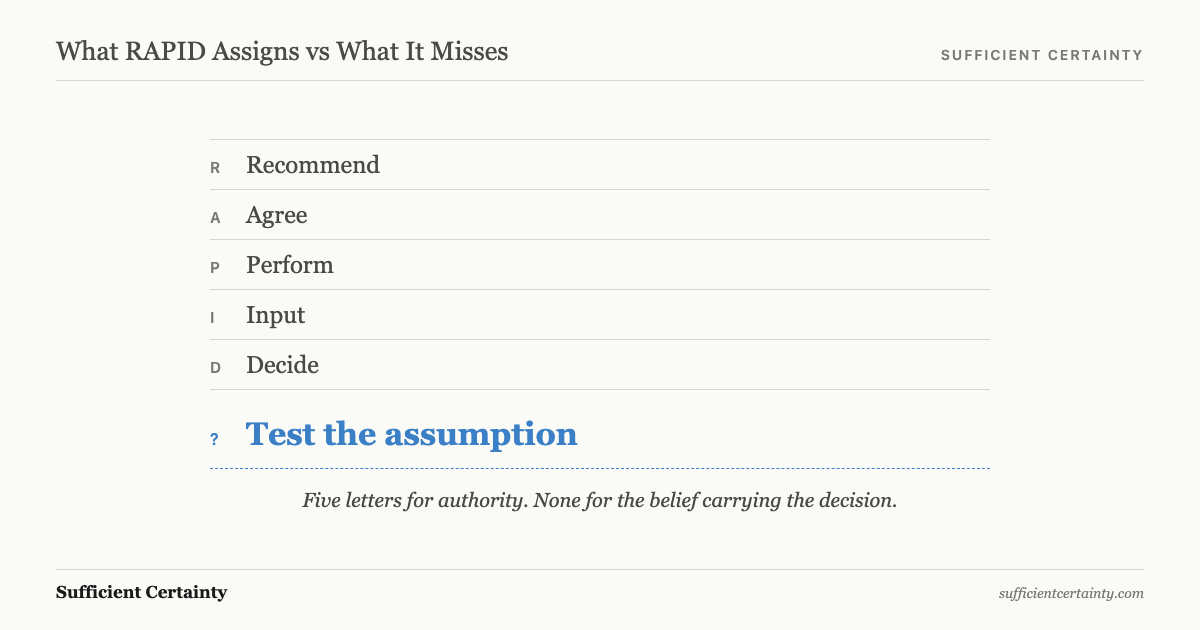
The RAPID decision making framework clarifies who decides. It does not test whether the decision is sound. Roles matter, but a room full of clearly assigned people can still approve a recommendation that rests on an assumption nobody has examined. Role clarity is not decision quality.
| Letter | Role | What it does |
|---|---|---|
| R | Recommend | Proposes a course of action. No requirement to name the assumptions behind it. |
| A | Agree | Must sign off before the decision can proceed. The sign-off tests authority, not evidence. |
| P | Perform | Executes the decision once made |
| I | Input | Consulted for information or expertise before the call |
| D | Decide | Single accountable person who makes the final call. RAPID gives no test for whether the call is ready. |
A rapid decision making framework looks impressive on a slide. On 20 April 2010, Deepwater Horizon burned in the Gulf of Mexico and eleven men died. Before the explosions, the crew argued over a negative pressure test while 1400 psi still sat on the drill pipe. The US Chemical Safety Board later found no Macondo-specific task risk assessments for the safety-critical work. That is where neat role charts run out of road.
A rapid decision making framework is a repeatable structure for assigning roles and compressing deliberation when time is scarce.
What the RAPID decision making framework actually fixes
Paul Rogers and Marcia Blenko were right about the narrow problem. Their survey of more than 350 global organisations suggested that only about 15% practised effective decision making. I do not need much convincing. I have spent too much time in rooms where the first half of the meeting was consumed by a petty fight over who had the right to end the discussion. If that is the disease, RAPID is a useful medicine.
At Wyeth, it helped clear the committee fog around the Enbrel manufacturing decision. If people stop wasting an hour on who gets the last word, that is an improvement. If RAPID identifies the Decider and gets the meeting out of procedural mud, good. The trouble is what happens next. Governance consultancies can sell the workshop, and internal champions can unveil a fresh chart for the board. The paperwork looks sober enough for the file. None of that requires anyone to expose the belief carrying the decision.
Where the rapid decision making framework stopped at Macondo
Macondo failed because BP and Transocean left the live assumptions inside the negative-test procedure without an owner. The CSB investigation found each company presumed the other was responsible for a proper procedure. The crew was left to assemble meaning on the fly in a situation that had no business depending on improvisation.
The live assumption was that the well had been sealed. The crew saw zero flow on the kill line for thirty minutes and treated that as proof, even though pressure kept reappearing on the drill pipe. The CSB said they incorrectly rationalised the indicators. That is exactly the kind of moment a role chart cannot rescue. A box marked D does not force anyone to write down the assumption and test it before the next step. Nine minutes after hydrocarbons reached the rig, the first explosion came. Eleven men never went home.
I have seen gentler versions of the same failure in boardrooms. The governance paper is tidy, the authority is tidy, and the load-bearing assumption is still invisible. In my experience, this is the stage that flatters the wrong people. The file looks disciplined and the meeting chair feels progress, so advisers can say the process was followed. Once that happens, the safest career move is to defend the procedure rather than question the evidence. Reality, which is rude about these things, does not care how elegant the signature block looked.
Why RAPID has no place for assumptions
RAPID has letters for authority. It has no step for asking what would have to be true for this call to work. That question is where the decision becomes real. A team can survive some muddle over who speaks first. It does not survive a false belief that nobody bothered to name.
The role-map side of this problem has its own shape, and I have written about it in decision rights framework. The harder work starts before the room begins defending a preferred answer, because that is when people stop testing assumptions and start protecting them.
Use RAPID for the roles, then run the decision itself until the key assumption and stopping rule are explicit. Start the Walk →
Why a rapid decision making framework still needs a stopping rule
RAPID can tell one person to decide. It cannot tell that person when enough work has been done. That is why executive teams buy a role framework and still stall. Someone has the D, yet nobody can say whether the evidence is sufficient for this decision, in this context, now. If you want my shorthand, it is this: RAPID can tell you who signs, not whether the thing being signed deserves to live.
Without a stopping rule, the apparent speed of RAPID becomes another corporate parlour trick. The room can assign the D in ten minutes, then spend six weeks commissioning more paper because nobody has said which uncertainty actually matters. PMO teams can keep the workflow moving. Governance software vendors can keep the dashboard glowing. The Decider is still left holding a decision that has not earned commitment. I have watched this happen often enough to know that delay dressed up as diligence is still delay.
Roger Estall and I built the Universal Decision-Making Method, and later set it out in Deciding, because decisions need an ending. Start with Frame the decision. Then name the assumptions that matter and work toward Sufficient certainty for this case. If certainty is thin, I do not ask for a grand report to decorate the board pack. I ask for the one piece of information that will either support the call or break it. If it does neither, I change the option. A rapid decision making framework never gets you to that judgment.
Where I put RAPID in a real method
I use role clarity early, not as the finish. Name the Decider and the recommender if that stops the turf fight. Then do the real work in order. Recognise assumptions and reach Sufficient certainty. Design monitoring before you commit, then keep watching the decision while the context is still fresh enough to question and cheap enough to adjust.
RAPID is one of the cleaner decision-making frameworks because at least it is honest about being a role device. The trouble starts when people pretend the role device has done the deciding for them. That fantasy is useful to consultants and software vendors, especially the internal champions who want visible machinery instead of an awkward argument about evidence. It is not useful to the person who will carry the consequence. A neat role chart can still sit on top of an unowned assumption, and RAPID is perfectly capable of putting an orderly signature on a bad decision.
How to make decisions faster without skipping what matters
Most frameworks promise speed by removing steps. Drop a gate, merge two reviews, skip the analysis. I have watched organisations buy that line and end up faster at making bad calls. The better move is to keep the structure but stop pretending every variable matters equally.
In practice, speed comes from triage. A leadership team I worked with had 48 hours to decide whether to exit a joint venture before the partner's reporting deadline closed their window. The CEO wanted a full commercial review. The CFO wanted updated projections. The general counsel wanted a legal opinion on the termination clause. If I had let the room run, they would have commissioned three workstreams and missed the deadline while feeling diligent about it.
I asked one question: what has to be true for staying in to work? The room produced about a dozen assumptions in ten minutes. Most were obvious. The partner would keep funding development. Regulatory approval in the second market would come through. The sales pipeline in Q3 would hold. Currency exposure was manageable. A few were just furniture, the kind of background noise committees list because it makes the whiteboard look thorough.
Two assumptions carried the decision. First, that the partner would continue funding past the current commitment period, which expired in five months. Second, that the regulatory path in the second market had not been blocked by a rule change already in draft. Everything else was either low-impact or already settled. The room did not need to study twelve uncertainties. It needed to test two.
The CFO made one call to the partner's finance director and got a clear answer: funding beyond the current tranche had not been approved internally and was unlikely. That took 40 minutes. The general counsel confirmed that the draft regulation would effectively bar entry for at least 18 months. That took a morning. By lunchtime the team had enough information to make a decision, and they exited cleanly before the deadline.
Nothing about the process was casual. Every step of the method was present. They framed the decision, developed two real options, surfaced assumptions, and tested the ones that mattered. What they did not do was waste the first day on a full commercial review that would have told them the same thing buried in 30 pages of context. The structure gave them speed because it told them where to look, not because it told them to skip looking.
This is where sufficient certainty works as a stopping rule. The team did not need certainty about everything. They needed certainty about the two beliefs holding up the preferred option. When both failed, the decision was made. No consultant's report. No extra board paper. No six-week delay dressed up as rigour.
I keep seeing the same pattern. Committees stall not because they lack a framework but because nobody has said which uncertainty actually matters for this decision, now. Once that question is answered, the irrelevant work falls away on its own. People do not need permission to move quickly. They need someone to name the assumption that would sink the call and then go after it, while leaving the rest alone.
Speed is a byproduct of knowing what to ignore. If you test twelve assumptions when two carry the weight, you are not being thorough. You are hiding. The stopping rule is not a shortcut. It is the discipline that tells the room when the evidence is sufficient and the delay is no longer earning its keep.
You could redraw RAPID roles and still freeze when your next safety call gets real.
Work through your decisionNo sign-up. Just pick your decision and start.
Grant Purdy is the co-author, with Roger Estall, of Deciding (2020), and the architect of the Universal Decision-Making Method.