
I sat in a leadership meeting where the CEO proposed a market entry in under fifteen minutes, backed by a net present value calculation, three scenario tables, and a brief from an external adviser. Two vice-presidents asked questions that sounded closer to compliments than challenges, and the executive committee approved unanimously.
A decision making tool for executives needs to do one thing before the room commits: force someone to name what the proposal is actually assuming.
The room had scoring tools; what it did not have was a mechanism that forced anyone to say what the proposal was actually assuming and what signal would tell them the assumption had failed. The higher the role, the fewer people will challenge what the decision rests on, and the more it matters that someone does.
I built the Walk so that an executive team can move from proposal to Decision Document in a single session, with every assumption surfaced and the monitoring signal agreed before the room commits.
A decision making tool for executives is a structured method that forces the leadership team to name the assumption underneath a proposal and test it before committing.
Why a decision making tool for executives is not a scoring model
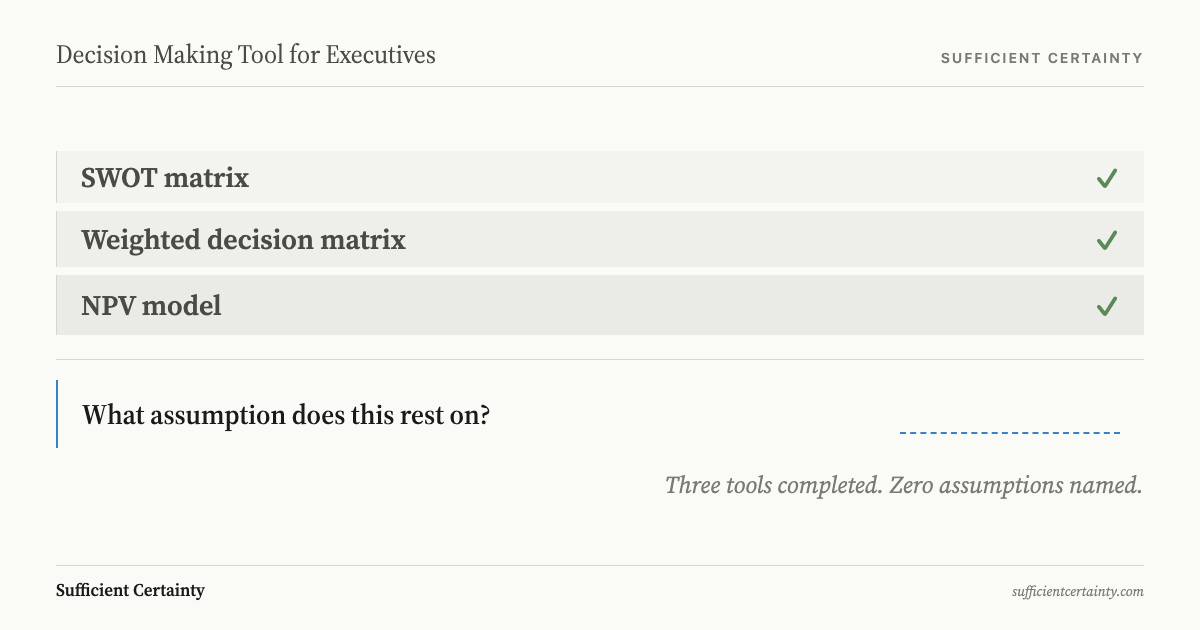
Search for a decision making tool for executives and every result offers a list: SWOT analysis, decision matrices, weighted scoring models. Those products end at selection.
McKinsey's survey of senior executives found that only 20 per cent said their organisations excelled at decision making. Among those who rated their organisations poorly, 72 per cent said quality suffered because leaders failed to test the assumptions behind major decisions.
The survey names lack of real debate and excessive deference to the most senior person in the room as two of the top four failure modes. In my experience, those two are the same problem: the room defers because the room has no structure that requires anything else.
Effah and Su's review of twenty years of CEO overconfidence research confirms the pattern at the structural level: overconfident executives pursue acquisitions that destroy shareholder value and resist the external counsel that might have caught the assumption early. The review identifies unchecked decision authority as the enabler: when governance structures do not require assumption disclosure, overconfidence stays hidden until outcomes reveal it.
A scoring model cannot detect overconfidence, because the overconfident executive sets the criteria the model scores against.
The assumption no one in the room challenged
WeWork's executive team approved a growth strategy through years of mounting losses. The scoring tools worked: financial models projected revenue growth and external advisers endorsed the vision, but none of those tools tested the assumption the strategy rested on.
Adam Neumann held super-voting shares that gave him majority control over every board decision, and directors who questioned the business model were sidelined.
When the S-1 filing became public in August 2019, external analysts read what the leadership team had never challenged: the unit economics assumed growth rates the company had never achieved and occupancy levels no co-working operator had sustained.
Valuation collapsed from $47 billion to below $8 billion in six weeks, and nobody in the room had written down what the growth forecast assumed about occupancy and retention.
Theranos presented the inverse of the same failure. The board included Henry Kissinger, George Shultz, and James Mattis: people with authority but no domain expertise in diagnostic technology. Elizabeth Holmes controlled the company through dual-class shares and board composition.
When the chief scientist warned that the Edison device did not work as claimed, he was marginalised. When Tyler Shultz raised concerns internally, he was threatened with litigation. The person who tried to surface the critical assumption was punished, not heard. Peak valuation reached $9 billion before the technology was independently tested.
Both companies had information: WeWork had market data and Theranos had test results, but what neither had was a requirement to separate fact from assumption before the executive team committed.
The Walk forces that separation before the room can move on. It does not let the executive team approve until the critical assumption has been named and tested, and the monitoring signal assigned.
Write down the assumption underneath the proposal your executive committee is about to approve and name who will know first if it fails. Start the Walk →
When an executive needs the full method
A scoring matrix or a pros-and-cons table is enough when the choice is bounded and the downside is containable. The routine operational decisions a manager handles daily and standard budget approvals where existing policy already covers the ground.
In those situations a scoring model does what it was designed to do: it ranks the options, the room picks the highest-scoring one, and the downside if it turns out wrong is containable.
The scoring model stops being enough when the decision carries a material commitment and the assumption underneath it reaches beyond the executive team.
A market entry staking capital on an unverified growth forecast. An acquisition where the integration plan assumes cultural alignment nobody has tested.
When a wrong assumption can reach people, capital, or the organisation's licence to operate, the room needs the full method: one that writes down what must be true for this commitment to succeed and who will notice first when it starts to fail.
The Walk takes an executive team through that sequence in a single session. At the end the team has a Decision Document it can defend when the board or an investor asks how the commitment was tested. The sequence takes one session and requires no external facilitator.
What a decision making tool for executives must produce
I want one page on the table before the room commits. At the top: the decision and the Purpose it serves. Below that: the dated Context, so the reader can judge how fresh the evidence still is. Then the harder half: the critical assumption and the person who will know first when it starts to fail.
The decision making tools that fill the first page of search results end at selection: the matrix produces a rank and the room disperses. Nobody writes down what must be true for the chosen option to work, and nobody names the signal that would bring the decision back to the table if the assumption fails.
The Universal Decision-Making Method puts assumption-testing before the commitment for this reason. Once the decision hardens, the people affected start living with whatever the room assumed, and the executive who made the call has moved on to the next one.
The Walk produces that Decision Document in one pass: it names the assumption, weighs the evidence, and writes the monitoring signal, with no facilitator between the decision and the record.
Roger Estall and I wrote Deciding because the gap between what executives approve and what executives can later defend is where governance actually fails.
The Decision Document stays short for a specific reason: once it grows into a strategy submission, executives sign the covering page and stop interrogating the assumptions underneath. A longer process protects the people who designed it, not the organisation that must live with the decision.
The Walk exists because executives face the highest assumption load and the fewest people willing to challenge it, and a one-page record naming the assumption and its monitoring signal is the smallest artefact that addresses both.
You could run every scoring model and still commit to the option whose assumption nobody challenged.
Work through your decisionNo sign-up. Just pick your decision and start.
Grant Purdy is the co-author, with Roger Estall, of Deciding (2020), and the architect of the Universal Decision-Making Method.