
A decision making tool for managers prevents bad calls by testing the one thing no popular framework examines: the assumption underneath the preferred option. Managers make more consequential decisions per week than most executives, and every popular framework from SWOT to weighted scoring handles the comparison without testing what the comparison rests on.
A department head I worked with last year had five decisions to clear in a single Monday planning meeting, each with a spreadsheet, a scoring model, and a recommendation, yet not one named what it was assuming about the preferred option.
By Wednesday two of those five decisions had been reopened: one vendor had revised their timeline, and a team lead raised a constraint nobody in Monday's meeting had mentioned. The decisions that seemed settled were no longer settled, because the assumptions behind them had never been tested.
That is a problem of velocity, not competence. Managers at the operational level decide faster and more often than the executives who set the strategic direction; the same assumptions go untested at higher frequency.
I built the Walk so that a manager can move from question to Decision Record in one meeting, with every assumption surfaced and the monitoring signal agreed before anyone commits.
A decision making tool for managers is a structured method that names the assumptions underneath the preferred option and judges whether evidence supports the decision before committing resources.
Why a decision making tool for managers fails at the point that matters
Paul Nutt studied 356 decisions in medium-to-large organisations across the US, Canada, and Europe over 20 years. Half failed outright: adopted but never implemented, or implemented and abandoned within two years.
The failure was not random; Nutt traced it to two dominant tactics: managers imposing a preferred solution without examining alternatives, and using positional authority to close discussion before the assumption underneath had been tested. Failure-prone tactics appeared in two out of every three decisions.
The managers whose decisions succeeded were a minority who set objectives, ran unrestricted searches, and involved key people before committing. In other words, they tested what they were assuming about the option before acting on it.
A McKinsey survey quantified the volume problem: 68 per cent of middle managers reported their decision-making time was spent inefficiently, and only 57 per cent of all decisions were rated as high quality.
Middle managers were, however, most familiar with delegated decisions and least familiar with big bets. Their highest-volume decisions received the least structured attention; the frameworks they reached for handled comparison without testing what the comparison assumed.
That is the velocity gap. A manager searching for a decision making tool will find no shortage of frameworks: the literature gives them eleven, yet not one tests the assumption at the speed the calendar demands.
The Walk does exactly that: it asks what the manager is assuming about the option already preferred, and whether evidence supports that assumption before resources are committed.
Write down the assumption underneath your next management decision and name the evidence that would change it. Start the Walk →
The assumption managers never tested
A vendor selection study compared two application development efforts where the vendor was chosen before a project manager was brought in. In the failed case, the assumption that determined the outcome sat in a single line of a vendor slide deck.
The stated assumption: the flexibility of the vendor's reporting tool will handle the organisation's custom reporting requirements. Nobody tested it. Nobody asked for evidence. The words appeared in a marketing document and were treated as fact.
The team had a scoring matrix and formal evaluation criteria. What neither tool produced was the question: we are assuming this vendor can deliver custom reports, and we have no evidence for that claim. The project failed; the comparison project, which tested its assumptions against explicit criteria, succeeded.
That is the difference between a decision making tool that scores options and one that tests what the score depends on. The Walk surfaces exactly this kind of assumption: 'reporting tool flexibility' would have appeared on the Decision Record as a tentative element requiring evidence, not in an unexamined line of a vendor presentation.
Managers spend three meetings circling a vendor decision that could have been settled in one, because the scoring matrix gives confidence in the comparison but nobody tests the assumption that makes the comparison meaningful. I have seen this across industries: the tool was present, the assumption was not examined, and the decision broke on the untested element.
When managers need the full method
A manager does not need the full method for a routine operational call. Choosing between two software vendors for an internal dashboard or scheduling a product demo does not need structured assumption testing; the cost of being wrong is a rebooking and a mild inconvenience. A risk-based assessment or a priority matrix handles it.
The full method matters when the assumption underneath the preferred option reaches beyond the manager's own team. A department head choosing a vendor whose delivery timeline determines a product launch date is not making a routine call, even if the decision sits on the agenda between two that are.
Neither is an operations manager consolidating two production lines when the integration assumption has not been tested independently. Those decisions rest on assumptions that a priority matrix cannot test.
In my experience, those are the decisions managers most often rush. The urgency that created the decision is the same urgency that suppresses the question nobody wants to raise.
Sufficient certainty does not mean perfect information, and a manager who waits for every assumption to be confirmed has stopped deciding; a manager who tests no assumptions has stopped thinking. The method provides the ground between those extremes.
The full Universal Decision-Making Method takes a manager through five steps in a single session: frame the decision, surface the assumptions, and judge whether the evidence is sufficient before naming the signal that would bring the decision back.
What a decision making tool for managers must actually produce
I want one document on the table before a manager commits resources. At the top: the decision and the Purpose that justifies it. Below that: the dated Context, so anyone reviewing the record later knows how current the evidence was when the decision was made.
Then the harder half: the critical assumptions the manager identified, the evidence threshold judged sufficient, and the monitoring signal that would reopen the decision if conditions change. That is what a decision record contains; that is what no scoring model or SWOT analysis produces.
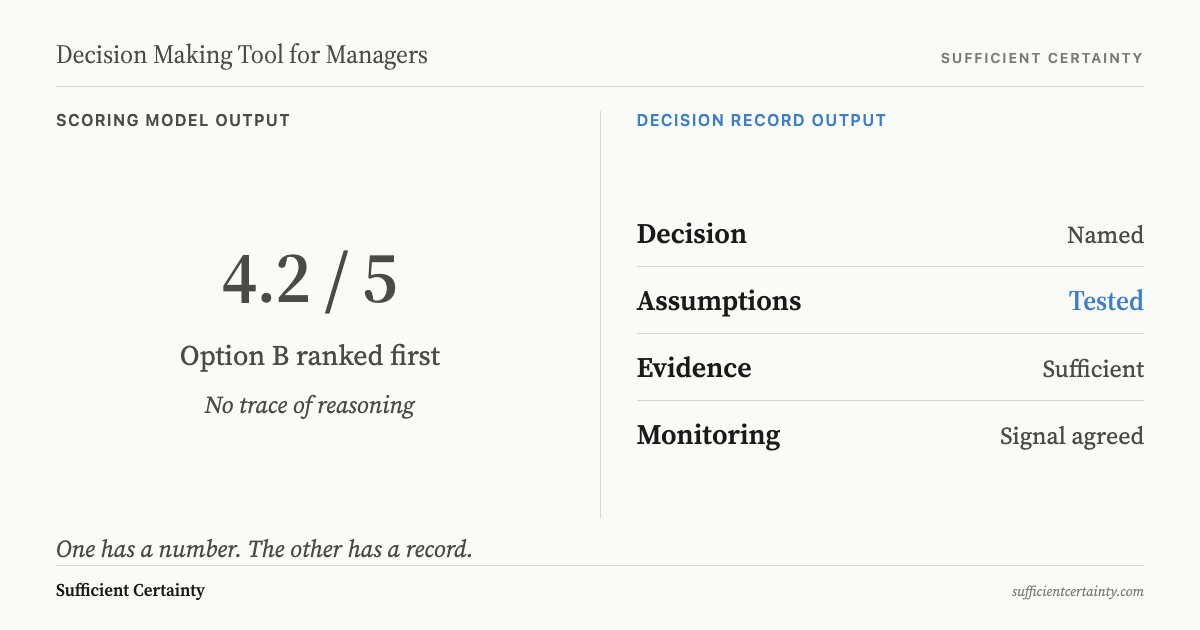
Most decision making tools for managers produce a ranking or a vote. Not one produces a record naming what the manager was assuming and what evidence was judged sufficient. When that decision is revisited six months later, the manager has a number in a spreadsheet but no trace of the reasoning.
The new team member who inherited the project reconstructs the argument from memory and email threads. The departing manager took the justification with them because the output of the original conversation was a verdict, not a record.
The Walk produces that record. A manager takes a decision through the five steps in a single meeting: the decision framed against the organisation's Purpose, the assumptions surfaced and ranked by significance, and the evidence judged against the threshold of sufficient certainty. A monitoring signal and owner are agreed before anyone commits.
Roger Estall and I wrote Deciding because the gap between what managers decide and what they can later defend is where organisational decision-making breaks.
The Walk exists because a manager who can produce a dated record of the assumption tested and the evidence judged sufficient has something no scoring model provides: a decision that does not need to be revisited.
You could clear five decisions in one meeting and still not know which assumption any of them rests on.
Work through your decisionNo sign-up. Just pick your decision and start.
Grant Purdy is the co-author, with Roger Estall, of Deciding (2020), and the architect of the Universal Decision-Making Method.