
A decision rights framework maps who recommends and who holds the final call. It does not test whether the person holding that authority has examined what the decision depends on. Organisations invest months in role clarity and still produce bad calls because authority is not judgement.
A decision rights framework does exactly what it promises. It maps who recommends and who holds the final call. I have watched organisations invest months rolling out RAPID and RACI across their entire decision-making structure. The arguments about authority genuinely reduced. People stopped arriving at meetings to fight about whether they had a vote. That clarity is real. The decisions kept failing at the same rate.
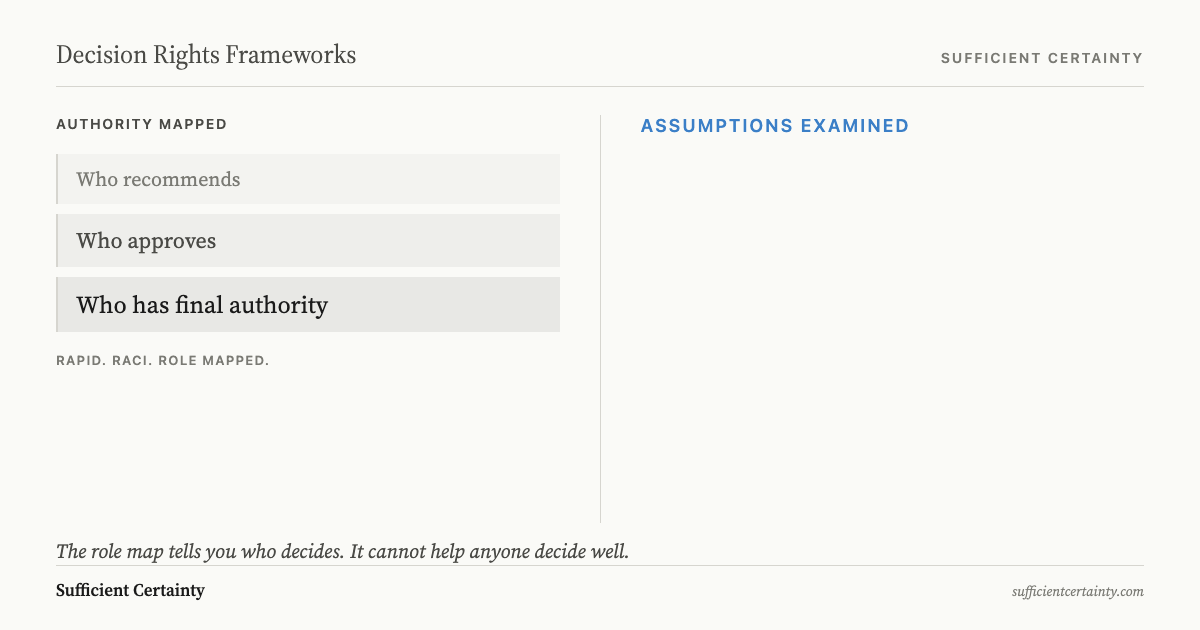
A decision rights framework answers one question well. What it cannot answer is what to examine before committing or whether the evidence meets what Deciding calls sufficient certainty. The role map tells you who decides but cannot help anyone decide well.
A decision rights framework is a map of who contributes, who approves, and who has final authority within a decision.
What a decision rights framework actually clarifies
Lindy Greer, Jennifer Jordan, and Maxim Sytch studied this directly. Their 2026 Harvard Business Review article identified four systemic failures in how organisations deploy these tools. The most telling: companies routinely set decision roles before clarifying what the decision actually is, and hierarchy overrides the assigned roles the moment pressure arrives. The framework assumes stable goals and honest interaction. Neither assumption is tested. The vendors selling these frameworks do not offer to test them either.
One case from the study makes the pattern visible. Twelve executives at a global technology company convened to decide whether to create a chief innovation officer role. Every participant had a defined decision right. The ninety-minute meeting devolved into a power struggle, with several arguing loudly and others quietly checking out. It ended without resolution. The framework gave everyone a position in the room without giving anyone a way to test what the decision rested on. Nobody had asked what they were trying to achieve or what assumptions they were making about the new role's effect.
The role map did not save Volkswagen
Volkswagen had one of the most architecturally complete decision rights structures in corporate governance: Germany's two-tier board, with a supervisory board overseeing a management board. Trade union representatives, state government shareholders, and senior leadership all had formally defined authority. Engineers rigged eleven million diesel vehicles under all of it. The company set aside €16.4 billion in provisions.
The governance was textbook. Nobody surfaced the assumption that regulatory testing would never detect the deception. The defeat device strategy rested entirely on that single untested belief. Any member of that supervisory board could have asked what the strategy assumed about detection. None did. An ethical decision making model was presumably somewhere in the filing system, no more useful than the governance it sat inside. The estimated savings from avoiding proper urea filtering ran to $4.8 billion, and every layer of that two-tier structure signed off without examining it. When regulators did detect the cheat, the savings evaporated overnight.
I saw the same pattern at Wivenhoe Dam in Brisbane, where an operations manual defined who controlled water releases but never tested the catchment assumptions those rules depended on. When the 2011 floods arrived, twenty-three people died. The roles were clear. The assumptions behind them were not.
What a decision rights framework cannot examine
McKinsey surveyed more than 1,200 managers across global companies in 2019. Sixty-one per cent said at least half the time spent on decisions was ineffective. In one company's network analysis, twenty-three per cent of participants in decision meetings added no value to the outcome despite each having a defined role. The finding that should concern anyone investing in role clarity: the factor most predictive of good decisions was the quality of debate and interaction, not who had been assigned which role. Nobody selling a decision-rights workshop leads with that finding.
That is what Roger Estall and I built into Deciding and the Universal Decision-Making Method. Step 3 forces the room to name the assumptions carrying the decision: what we believe to be true but have not verified. Step 4 asks whether certainty is sufficient to act. The framework skips both. It identifies who holds the pen but has no mechanism for examining what the pen is signing.
The firms that sell decision rights workshops have no commercial interest in pointing this out. RAPID consultancies generate fees. Assumption-surfacing does not require a facilitator certification or a proprietary matrix. It requires someone in the room willing to ask the question that decision coaching is built around: what are we assuming here? That question has no commercial constituency, but it works.
Work the decision with the messy role map through the five steps and separate authority from the judgement it avoids. Start the Walk →
Where decision rights sit inside a real method
Role clarity is useful at one specific point in the decision process: after the assumptions have been surfaced and tested, when someone needs to commit and be accountable for that commitment. Knowing who signs matters, but it does not matter first.
If your organisation has assigned decision rights and decisions are still failing, the framework did its job. It was sold to clarify authority, and it did. The gap is upstream. Nobody examined the assumptions carrying the decision. Nobody asked whether the evidence was sufficient to act. A decision rights framework is one component within the broader family of decision-making frameworks. Most of that family shares the same structural gap: none of them test what the decision rests on before someone commits to it.
How to assign decision rights that survive the first hard call
The framework looks complete on paper. A RACI matrix with every cell filled, roles defined, escalation paths mapped. Then an ambiguous call arrives and the entire structure folds. I have watched it happen often enough to identify the exact point of failure: the matrix assigns authority but never asks what that authority rests on.
Here is a common version. A VP of operations holds the "A" in the RACI for a supply chain sourcing decision. The matrix is clear. In practice, the decision goes to a cross-functional committee for input. The committee meets three times. Each meeting introduces a new concern. Procurement wants cost certainty. Legal wants contractual protections. The regional heads want optionality. By the third session, the VP's decision right has been diluted into a consensus exercise where nobody can name what was actually decided. The committee did not override the VP. It absorbed the decision until it had no edges left. I have written about this pattern in steering committees that do not make decisions. The dynamic is always the same: authority gets diffused, not challenged.
The matrix survived the entire process. Every participant could point to their role. The decision failed anyway, because nobody had stated the assumption underneath it. In this case, the sourcing decision rested on the belief that a single supplier could meet volume commitments through the next demand cycle. That was the load-bearing assumption. It was never named, never tested, and never assigned an owner. When the supplier missed delivery targets two quarters later, every member of the committee pointed to someone else. The VP pointed to the committee. The committee pointed to the VP. Accountability is a word people reach for after the fact. It means nothing if it was never attached to a specific assumption before the commitment was made.
The fix is structural, not procedural. Every decision right needs a paired obligation: state the assumptions this decision depends on. Not the risks. Not the stakeholder concerns. The assumptions. What do we believe to be true that we have not verified? The person who holds the decision right must be able to answer that question before they sign. If they cannot, the right is ceremonial.
Roger Estall and I built this into the method as Step 3: surface the assumptions carrying the decision, then judge whether certainty is sufficient to act. A decision rights framework that includes this step produces something the standard matrix cannot: a named set of beliefs that the decision depends on, each with an owner who is accountable for monitoring whether that belief still holds.
In practice, this means three additions to any decision right assignment. First, the person who holds the right states the assumptions they are relying on. Second, they judge whether the evidence behind each assumption is sufficient for the commitment they are about to make. Third, they set a signal: what would tell them the assumption has broken down, and when will they check? This is not bureaucracy. It takes less time than the three committee meetings that replaced the VP's authority. It takes less time because it asks a direct question instead of circulating opinions.
Decision rights work when they are paired with the obligation to say what you are betting on. Without that, the matrix is a seating chart for a meeting that never reaches a verdict.
You could map decision rights perfectly and still botch your next call.
Work through your decisionNo sign-up. Just pick your decision and start.
Grant Purdy is the co-author, with Roger Estall, of Deciding (2020), and the architect of the Universal Decision-Making Method.