
Decision coaching addresses one live choice, not a development programme. The coach does not teach frameworks or build capability over twelve sessions. The coach tests the assumptions behind a single pending commitment so the person who owns the call can see what the judgment actually rests on.
In the 2025 ICF Global Coaching Study, coaching had reached $5.34 billion in annual revenue and 122,974 practitioners worldwide. Most of that work is about leadership development and careers. Very little of it is about helping one person make one consequential choice under uncertainty. That is what decision coaching is for. Dawn Stacey and colleagues defined it in 2013 as "assessing decision-making needs; providing information on options; verifying understanding; clarifying values; building skills in deliberating".
Roger Estall and I spent decades doing exactly that with executives, boards, regulators, and public bodies. We did not go away, write a report, and return with the answer. We walked Deciders through their own reasoning. Sometimes the result was a clear decision. Sometimes it was the discovery that the reasoning was weak and had to be repaired. That is still progress. A report is not a decision.
Decision coaching is structured support that helps a person clarify a live choice, examine assumptions, and own the judgment behind the outcome.
Why decision coaching is not consulting
Consulting usually works like this: you hand over a problem, someone studies it, and you receive analysis. The analysis may be sound. It may even be expensive enough to feel authoritative. You still have to decide. I have seen this repeatedly in difficult business decisions. Boards buy diligence, not clarity. The sharper distinction is in Decision Coaching vs Consulting.
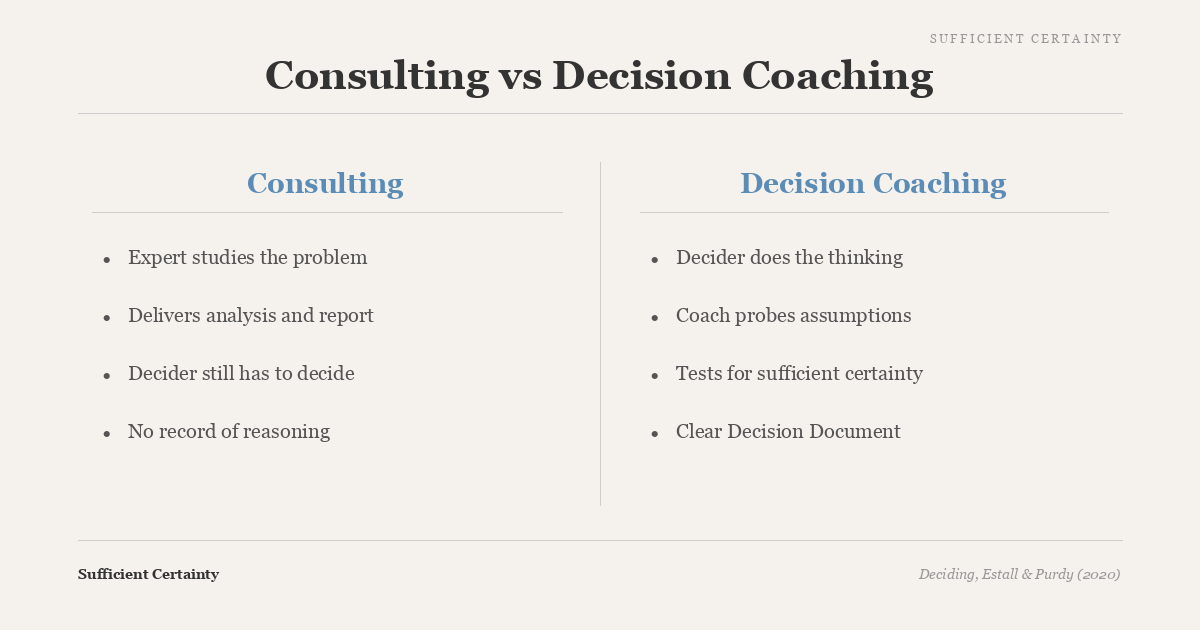
It keeps the decision with the person who must own it. The coach keeps asking what the decision rests on and whether the Decider knows enough to proceed. No evasion behind a report. No comfort in a stack of paper. If the reasoning is poor, it becomes visible.
Analysis can inform a decision. It cannot make it. A risk register, however elaborate, suffers the same defect. It may catalogue what could go wrong, but it does not tell a Decider what their reasoning rests on or whether it is good enough to proceed. This discipline asks what the decision rests on and whether that is enough.
Bring one consequential choice through the five steps and use the structure a decision coach is supposed to provide. Start the Walk →
What tools cannot do
Tools help. The strongest evidence comes from health care, because people have bothered to run trials instead of merely making claims. In a 2024 Cochrane review covering 209 randomised trials and 107,698 participants, structured decision aids improved knowledge by 11.90 points out of 100, reduced the feeling of being uninformed by 10.02 points, and made people 75% more likely to make choices that matched what mattered to them. When people work through a decision in a disciplined way, they understand more and choose in line with what matters to them.
But the same research tradition also exposes the weakness of relying on a tool alone. In Stacey and colleagues' 2013 review of coaching and guidance with decision aids, only 11 of 98 randomised trials included coaching at all. Hardly anyone studied the part where another person helps the Decider think through the decision. Yet Stacey's earlier review of those coaching trials found that adding coaching to a decision aid improved values-choice agreement and satisfaction compared with the aid alone.
Most bad decisions are not caused by a lack of information. They are caused by untested assumptions, confused Purpose, or a quiet refusal to decide until time forces the issue. A tool can present options neatly. It cannot tell you whether you are kidding yourself. A decision making coach can.
I do not mean that a coach tells you what to do. Good coaching of this kind makes it harder for the coach to smuggle in their own preferences. The coach's job is to make your reasoning explicit and hold you to it. That is the discipline Roger and I set out in the Universal Decision-Making Method, and it is the same discipline I argue for in decision-making under uncertainty. The question is never how to remove uncertainty. The question is whether you have enough certainty, about the assumptions that matter, to decide.
How decision coaching works in practice
I once worked with a senior executive who had spent months circling a plant-closure decision. She had reports, financial models, and a thick folder of commentary from advisers. None of it answered the only question that mattered: what did the decision actually rest on? Once we stripped away the clutter, the decision came down to a few assumptions about future demand, relocation cost, labour retention, and customer reaction. Those assumptions could be examined. The rest was noise.
We begin with Purpose, because if the Purpose is vague the rest of the conversation is theatre. The full decision coaching process runs through short sessions tied to one live choice. We make the tentative decision explicit. We record the assumptions that would need to hold for that decision to work. We test which of those assumptions are Critical and which barely matter. Then we decide whether the remaining uncertainty is acceptable, given the outcome sought. If it is, decide. If it is not, change the decision or go and get the missing information. This is plain English work. It is not mystical, and it does not require a priesthood.
The output should be a Decision Document, not a pile of disconnected notes. A proper Decision Document states what you decided, why you decided it, what you assumed, and what you will watch once the decision is in play. Conditions change after you decide. If you do not decide in advance what you will monitor, you will revisit the decision only when someone panics.
The Walk turns that discipline into a guided conversation for one live decision. It does not advise. It does not generate a recommendation. It helps you record your reasoning and leave with a Decision Document you can defend.
Why this matters now
The odd thing is that coaching is now a huge mainstream industry, yet the act of deciding is still poorly served. Leadership and executive coaching still dominate. Organisations do need help with behaviour, communication, and performance. They also need help deciding.
I think the reason is simple. Advice sells more easily than responsibility. It is comforting to receive a report that catalogues what might go wrong. It is less comfortable to write down the assumptions behind your own decision and ask if they can bear the weight. That discomfort is exactly why this discipline is useful. It makes the real work unavoidable.
Roger and I saw the consequences of skipping that work in public bodies, regulators, banks, mining companies, and health services. The apparatus changed. The defect did not. People were surrounded by analysis and short of decisions. If you want better decisions, help the Decider do the thinking. Everything else is support work.
You could keep circling alone and carry that consequential choice into another sleepless night.
Work through your decisionNo sign-up. Just pick your decision and start.
Grant Purdy is the co-author, with Roger Estall, of Deciding (2020), and the architect of the Universal Decision-Making Method.