
Decisiveness in leadership is not about speed. It is the willingness to state what you are betting on before you commit, so the people who carry the consequences can see the reasoning and challenge it while there is still time to change course.
On January 6, 2024, one day after a door plug blew out of Alaska Airlines Flight 1282 at 16,000 feet, the FAA grounded 171 Boeing 737-9 MAX aircraft. It did not ask Boeing to look confident or promise lessons learned. It stopped the planes and made inspection the price of flying again. That is decisiveness in leadership. It is a public stopping rule, not a personality display.
I have watched too many boards stare at a fat paper pack and a useless risk register, then complain that the room needs more decisive leadership. That advice is easy to sell because nobody has to name the broken machinery under it, which is excellent news if you bill by the workshop. Most of the leadership-advice trade flatters the leader and excuses the process. It tells people to trust instinct when what they really need is to expose the assumption carrying the decision. I set out what effective decision making in leadership actually requires elsewhere, and none of it involves instinct.
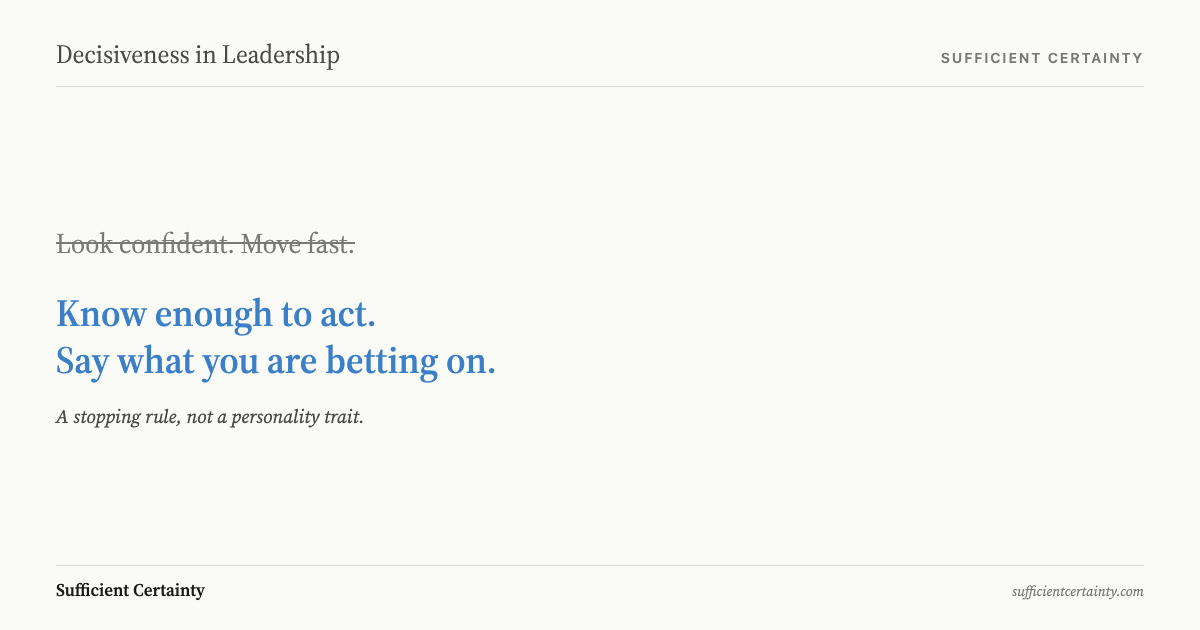
Decisiveness in leadership is timely commitment to a course of action with a clear basis for acting, stopping, or revising.
Why most advice on decisiveness in leadership is backwards
Even McKinsey's 2024 survey of 757 senior executives ends up at the obvious point: clean up roles and process, and decisions move faster. That should not require a survey, though a fair slice of the advisory industry depends on pretending it does. The useful finding is that delay sits in structure. The useless habit is to turn that back into a sermon about courage.
In my experience, slow organisations breed side-door vetoes and swollen papers until the whole thing turns into governance clutter. Consultants like it because it creates more surfaces to sell. Committees like it because responsibility goes foggy. The accountable leader inherits the mess at the end of the chain and gets told to be bolder. Much of what people call indecision is just exhaustion, which is the territory I wrote about in executive decision fatigue.
Why decisiveness in leadership starts with assumptions
The 2022 paper "The Relationship between Psychological Safety and Management Team Effectiveness" looked at 1,150 leaders across 160 Norwegian management teams. Ignore the subtitle. The point is simple: if nobody can say what they doubt, the meeting is theatre and the decision basis stays hidden. You do not get to sufficient certainty by intimidating the room into silence.
I have seen supposedly decisive leaders ruin a room by speaking first. Once the boss tips a preference, the conversation rearranges itself around it. People stop testing the live assumption and start decorating the emerging answer. Later everyone describes this as alignment, which is a charming term for obedience. The same dynamic wrecks problem solving in the workplace: the room stays in complaint mode because the boss has already read out the answer. I do not want alignment at that stage. I want the awkward question that shows the whole recommendation is resting on one untested belief.
Roger and I kept coming back to one question in Deciding: what are we assuming here? Ask it early enough and half the drama leaves the room. Ask it late and the room has already married the answer. When the stakes are high, this becomes the practical work of how to make a difficult business decision. The hard part is rarely finding more adjectives for boldness. It is naming the thing that has to be true for the decision to work.
Mt Erebus remains the bleakest warning I know. A small administrative change to the navigation coordinates for Air New Zealand Flight 901 was not properly communicated to the crew. They flew the programmed track into whiteout conditions and 257 people died. The disaster was built out of a hidden assumption and a broken chain of communication. If you want the accountability line around that, I wrote separately about Deciders. Small decisions kill people when nobody visible owns the assumptions beneath them.
Fast action is sometimes a pause
The same logic appeared in April 2021 when the CDC and FDA recommended a pause in the Johnson & Johnson vaccine after reports of rare clotting events. ACIP reviewed the evidence in public and resumed use with warnings and monitoring once the grounds were clear enough. That is decisive action under uncertainty. Pause when the assumption is in doubt, then move again when the threshold is met. People who equate decisiveness with uninterrupted motion usually have no serious monitoring design.
I have always distrusted leaders who think a pause makes them look weak. In real work, a pause can be the fastest honest move available. It tells people the decision has not vanished, only that the threshold for continuing has changed. It also tells implementers what signal matters next. That is miles better than ploughing on and calling the wreckage resilience.
State the bet behind your next fast-moving call and check whether the pause belongs before the action. Start the Walk →
Consistency is not what decisiveness looks like
Maersk did this in the Red Sea. It paused vessel transits, signalled a return, then reversed again when the security picture still did not support that call. Executives who call that inconsistency usually mean they would rather protect face than revise a bad assumption. Face-saving is very popular in senior circles. It is also expensive.
I call the alternative stubbornness with good lighting. A leader announces a course, then clings to it so nobody can accuse them of wobbling. If the assumption changed, the decision should change with it. This is where decisiveness in leadership parts company with performance. Refuse to do that and you teach the whole organisation that fresh evidence is unwelcome, which is one road into analysis paralysis in business. People stop speaking because they know the answer has already been staged.
What decisive leaders can say out loud
What I want from a decisive leader is plain speech. Tell me what we are doing and what would make us stop or reverse. If you cannot say the assumption carrying the call in one sentence, you are not ready. Those lines are more useful than any sermon about courage, and in my experience they are rarer. The leadership market prefers traits because traits are flattering. If you want the broader frame around that job, I set it out in the broader piece on decision making for leaders.
Decisiveness theatre protects egos and keeps the governance machinery well fed. The people who pay for it are usually nowhere near the polished table where the performance took place.
How to be more decisive without being reckless
I am sometimes asked how a leader becomes more decisive without lurching into recklessness. The question is reasonable, but it hides an assumption that needs pulling apart. It treats decisiveness and recklessness as two points on the same line, with speed as the dial. They are not. Recklessness is acting without knowing what you are betting on. Decisiveness is acting because you do know, and you have judged that the basis is strong enough.
Most leaders who stall are not slow by temperament. They are stuck. They cannot tell when enough is enough, so they keep commissioning work. One more report, one more legal opinion, one more stakeholder round. Each request feels responsible. None of them comes with a condition: if this report shows X, I will commit. Without that condition, the new information just joins the pile and the next meeting opens with the same question.
I once sat with a leadership team deciding whether to close a regional office and consolidate into headquarters. The data was adequate. The financials were clear. Staff consultation had run its course. The CEO kept asking for one more thing. First it was an updated lease analysis. Then a revised headcount projection. Then a sensitivity test on the retention assumptions. Each request took a week. Each week, the team below waited, rumours spread, and the best people started looking elsewhere. By the time the CEO moved, two of the people the consolidation was designed to retain had already accepted offers. The delay cost more than any analysis could have prevented.
What the CEO lacked was not courage. It was a stopping rule. Nobody had named the three assumptions carrying the decision and asked whether the evidence behind each one was strong enough to act. I walked the team through that exercise after the fact, and it took twenty minutes. The assumptions were straightforward: the lease exit penalty was manageable, the consolidated site could absorb the headcount, and key staff would stay through the transition. The first two had been settled weeks earlier. The third was the live one, and no amount of sensitivity modelling was going to resolve it, because retention depends on leadership behaviour during the change, not on a spreadsheet forecast. The CEO had been asking for certainty where none was available, and using more analysis as a substitute for owning the call.
The practical fix is not complicated. Before the next meeting where a decision is waiting, name the three assumptions the choice depends on. Not twelve. Not a register full of colour-coded entries. Three. For each one, ask a plain question: is there enough information to act on this belief, or is there a specific gap that would change the answer? If the gap is real, go after it. If it is not, you are stalling.
Then set a monitoring trigger. This is the part that gives leaders permission to commit without feeling reckless. A monitoring trigger says: I am acting on these beliefs, and if this specific signal appears, I will reopen the decision. It is not a hedge. It is a discipline. It means the decision stays alive after the meeting, and the people implementing it know what would change the direction. Roger Estall and I built this into the method because we kept watching leaders freeze at the point of commitment, unable to close because closing felt permanent. It is not permanent if you have designed the condition for reopening.
Decisiveness is not about moving fast. It is about closing when the reasoning is strong enough and knowing what would make you reopen. The leaders I respect most are not the ones who announce a direction with theatrical certainty. They are the ones who can tell you, in one sentence, what the decision is resting on and what signal would change their mind. That is what decisive looks like when nobody is performing.
You could push for speed and still enter your next meeting without a stopping rule.
Work through your decisionNo sign-up. Just pick your decision and start.
Grant Purdy is the co-author, with Roger Estall, of Deciding (2020), and the architect of the Universal Decision-Making Method.