
Delivering bad news at work fails when the messenger rehearses the script but cannot answer what happens next. Staff do not need comfort. They need to know what was decided, who has authority to handle exceptions, and what Monday morning looks like. Most delivery failures are information failures wearing emotional language.
Delivering bad news at work fails when the messenger rehearses the script but cannot answer what happens next. Staff do not need comfort. They need to know what was decided, who has authority to handle exceptions, and what their Monday morning looks like. Most delivery failures are information failures wearing emotional language.
A few years ago I was in the room when a divisional manager told her service team that they would stop taking new cases from Monday. She had rehearsed the script. She had not been told what would happen to a client halfway through a promised engagement, or who had authority to approve an exception. The executive who made the decision was not in the building. By the next morning, staff were making different promises to different clients.
The announcement is not a meeting about tone. It is the handover between a business decision and tomorrow's work. Before the manager speaks, someone needs to settle the changed work, the authority for exceptions, and the condition that will return the decision for review.
Delivering bad news at work is explaining an organisational decision so the people affected can judge why it was made and what their next workday requires.
The questions staff will ask after the meeting
Airbnb's announcement gave people a decision they could examine, because travel had collapsed and the company said it would run a narrower business. The 1,900 lost roles followed from that position, and the letter set out how departing staff would be treated before individual discussions began. Losing a job remained a loss, while the message told people what the company said had changed and what would happen to them next.
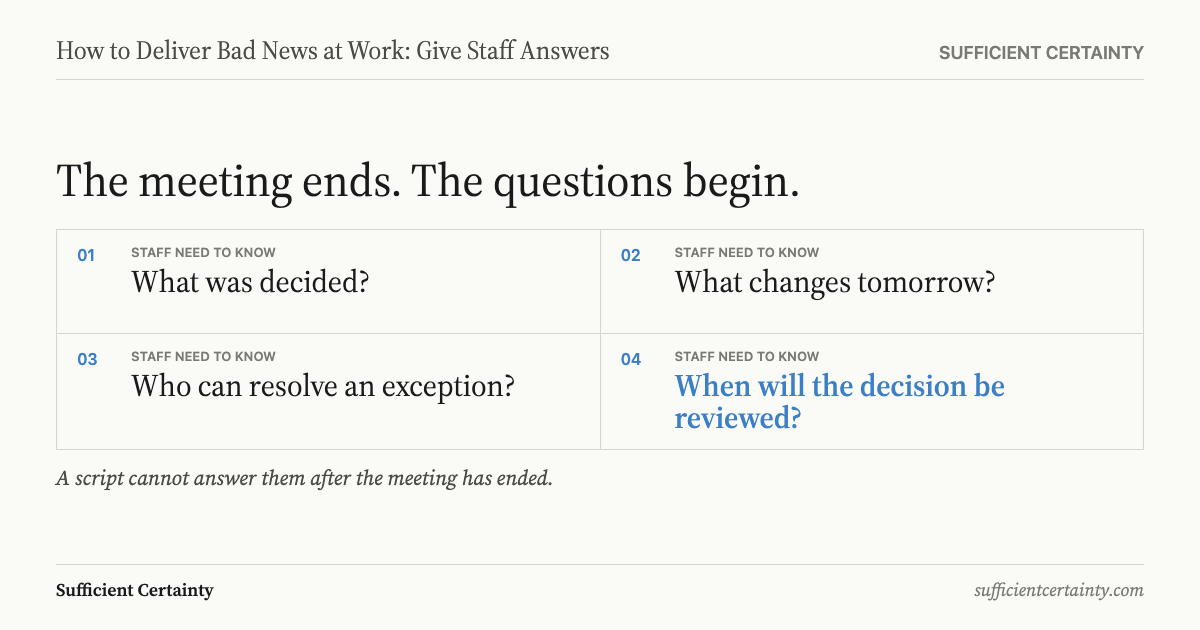
I have sat through announcements where the manager could recite the script but could not name the decision authority, because the authority had settled the matter in papers and private conversations that were never supplied to the person leading the meeting. Staff asked who had made the call. They needed to know whether anyone present could change the decision or answer for its effects. The organisation had sent one person to absorb anger for a decision it had kept unowned. The manager was left to account for a call they did not make.
Calling this a communications problem gives the organisation a convenient alibi, because discussion turns to the manager's tone while the person who made the call avoids answering for the work and employment consequences they authorised. I have yet to see a script produce the missing authority that staff need when their jobs or duties are being altered.
People receiving a major workplace change are trying to establish where the decision sits after the meeting has ended. They also need to know what it requires of them when ordinary work resumes. Polite delivery alone cannot answer either question. The decision account must connect the business change to the action and identify the person responsible for the work that follows.
How to deliver bad news when the manager must answer
Before a manager is delivering bad news, the accountable person has work to finish: they must state the decision in one sentence and explain the business change that made it necessary for this particular workforce. A vague assurance that every option was considered tells staff that the reasoning has been withheld. They must now live with the decision's effects.
The manager needs the same record that the decision maker used, with the reason stated in ordinary language, because a summary prepared after the decision will not answer the question everyone will ask: what did you know when this call was made? I have seen meetings derail when the person presenting the news was given conclusions without the basis on which those conclusions rested.
Some uncertainty will remain after the decision is made. I want the decision maker to name the assumption that still carries the call and the evidence that would put it back in question. In the Universal Decision-Making Method, Recognise assumptions makes that uncertainty visible, while Design monitoring requires the decision to be tested against events after the announcement; staff should know the limit of the current judgement before the manager speaks.
Robert Bies treats the meeting as part of an organisational process that begins before the conversation. His analysis of bad-news delivery follows the process after people return to their work. Kitz and colleagues reviewed 685 articles and reached the same practical conclusion: bad-news delivery unfolds through the preparation and the work that follows a meeting. The review matters because the meeting cannot carry a decision whose rationale and changed work are still unsettled.
Before you announce the change, name the person who decides exceptions when tomorrow's work no longer fits the old plan. Start the Walk →
Delivering bad news has a legal boundary
On 17 March 2022, P&O Ferries dismissed about 800 seafarers with immediate effect and intended to replace crews with agency labour. The House of Commons Transport Committee recorded that the company had bypassed the required consultation and breached employment law. Many workers learned of the dismissal by video call or text message. The Committee's report records a process failure, not a problem of meeting technique.
The P&O case is a boundary because law and consultation define work that must be completed before anybody writes a message. That includes the process through which people can be told their jobs may end. I would pause any announcement work where the decision has no legitimate authority or the organisation has missed its obligations to people affected. Continuing merely shifts the consequences onto the manager and staff. The pause puts the decision into a lawful process before people are told its outcome. The decision needs a named handover between responsible people; otherwise a manager is being asked to explain a process that ought to be repaired first.
I have found that organisations become very concerned about the manager's manner when the manager is the only person available to be blamed. The decision owner has remained elsewhere while someone else explains its consequences. Staff then have no one in the room who can change the call or answer for the obligations that should have been met beforehand. Empathy remains necessary, but it cannot discharge a legal obligation or give an absent owner authority.
The next workday exposes the decision
Bad news becomes real when work is due the next morning, because a team losing a colleague still needs someone to take the work that has not disappeared with that person's role. In a service withdrawal, customers may still ask for the service after the announcement. Staff need an authorised answer on what they can say and which exceptions they can make. I have seen a restructure declared complete before its central handover had an owner, and the team delayed decisions while staff invented their own arrangements.
When delivering bad news about a workplace change, I want the monitoring trigger stated before the meeting. It needs an actual threshold and a route back to the Decider. For a service withdrawal, the responsible manager might return the decision to the Decider if the weekly customer backlog exceeds the published limit for two consecutive weeks. A monitoring trigger is an instruction for the manager: watch the stated result, then send the decision back when the condition occurs, rather than allow an unowned problem to accumulate in the enquiry queue.
At 8 am on the first workday after a service withdrawal, the team receiving the old enquiry queue needs to know which open cases it may finish and who can authorise an exception for a customer already mid-process. The decision handover determines which manager may approve an exception at that point. An unanswered request leaves staff choosing between withdrawing a promised service and making commitments that the organisation has already withdrawn.
Employees judge the account before the speaker
I judge delivering bad news by what employees can assess after the meeting, and a 2023 Airbnb study of 117 former and remaining employees found associations between perceived information and fair treatment, and trust and cynicism. The study measures associations, so it cannot establish that a particular CEO letter caused those outcomes. It does show that employees distinguish information that lets them assess a process from courtesy delivered in the room.
Leaders who ask for stakeholder buy-in after withholding the basis of a decision are asking people to stand behind a call they cannot examine; the Decider is retaining the reasoning needed to assess it. I expect that account from the Decider as much as the manager. I have seen the request turn into silence in the meeting and contradictory work afterwards. A meeting that leaves the owner and the changed work unnamed sends every team away with a different decision, producing operational damage before anyone has a route to correct it.
You could leave staff inventing answers when the service they promised has ended.
Work through your decisionNo sign-up. Just pick your decision and start.
Grant Purdy is the co-author, with Roger Estall, of Deciding (2020), and the architect of the Universal Decision-Making Method.