
Organizational alignment can scale a bad strategy just as efficiently as a good one. Sixty-three KPIs cascading in perfect formation do not prove the top-level decision was sound. They prove the machinery works. Whether the machinery points at the right objective is a question the alignment process quietly skipped.
Organizational alignment can scale a bad strategy just as efficiently as a good one. Sixty-three KPIs cascading in perfect formation do not prove the top-level decision was sound. They prove the machinery works. Whether the machinery is pointed at the right objective is a question the alignment process quietly skipped.
A chief executive once showed me sixty-three KPIs and a cascade map that painted every division green. I asked which assumption was carrying the weight. Sales gave one answer, operations gave another. That is what passes for organizational alignment in many companies.
Everyone knew the target revenue and the launch dates. Nobody had written down the demand assumption that made the target sensible, or the signal that would force a rethink if the market did not behave. People were being asked to execute a slogan, not a decision.
Organizational alignment is when the people executing a plan know which assumption holds it up and which fact would send it back for review.
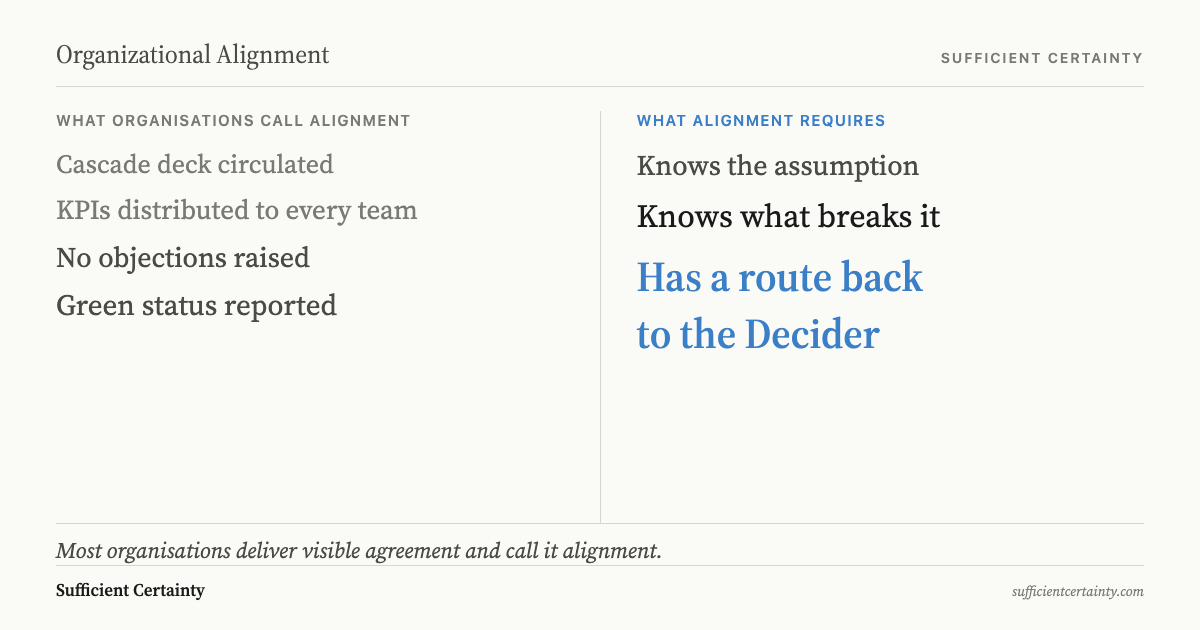
Organizational alignment often protects a weak strategy
In its 2025 Global Workforce Survey, PwC heard from 49,843 workers across 48 countries and territories. Only 64% said they understood the goals of their leaders. Workers who felt aligned with company values were 78% more likely to feel motivated. The promise is familiar: goal clarity drives motivation, motivation drives performance. I have no quarrel with clarity. My quarrel is with the superstition that clarity of communication makes a weak decision strong.
Motivation is not the same thing as judgment. A workforce can understand the strategy perfectly and still be carrying an error upstream in the board paper. I have seen whole capital programs driven by a forecast that only one person truly believed. Once approval is given, the doubtful forecast hardens into milestones and performance targets. Dissent starts to look like poor attitude. Consultants love this territory because the cascade can then be sold as the hard part. It is not. The hard part is naming the assumption underneath, in plain words, before the money goes out.
The person who questions the assumption is no longer treated as careful. They are treated as misaligned. That is why the organizational alignment problem begins upstream. The organisation needs the assumption to stay visible after approval, even when visibility is uncomfortable. Without it, stakeholder buy-in registers as support from people who cannot tell you what they are supporting.
Trace your strategy decision through the five steps and find where alignment survives only because nobody tests the core assumption. Start the Walk →
When the reasoning does not travel, the alignment is decorative
The UK Government’s 2025 review of best-value interventions examined 24 councils that needed outside intervention. Eighteen had governance failures and 17 had financial ones. The report named what Whitehall calls a broken “golden thread” between strategy and delivery. That is the civil service way of saying the decision reached the front line as mush. The reasoning did not travel because nobody was obliged to carry it. Committees existed, structures existed, reporting existed. The reasoning sat in none of them.
I see this constantly. Boards get a stack of documents whose main accomplishment is proving the stack exists. Managers repeat the approved line. People downstream are left to guess which assumptions were fixed and which were provisional. Another committee does not repair that. It only distributes the misunderstanding. When no one owns the call, you do not have decision rights, you have a guessing contest. The same structural failure turns change management, including a tidy ADKAR sequence, into busywork: the initiative cascades downward, but the reasoning never arrives. By the time people start arguing about accountability and responsibility, the decision has already dissolved into interpretation.
Organizational alignment can scale losses very quickly
Ford’s 2024 Form 10-K shows what happens when clean reporting lines do not rescue a weak thesis. Model e revenue fell 35% to $3.9 billion. EBIT loss hit $5.076 billion. The EBIT margin was negative 131.8%. Nobody at Ford was confused about the EV push. Capital and headcount together pulled in one direction, the kind of fit a McKinsey 7S review checks for. The demand and pricing assumptions underneath could not carry the scale the company built around them.
Zillow Offers failed faster. In its third-quarter 2021 results, Zillow recorded a $304.4 million inventory write-down, expected another $240 million to $265 million in losses on homes already under contract, and said the wind-down would cut about 25% of the workforce. Execution was tidy while the premise rotted. Alignment manuals skip this territory because tidy execution lets the sponsor look competent right up until the write-down. If the forecast is too brittle for the scale, organizational alignment merely helps the company compound the mistake faster.
Ford bled slowly and Zillow snapped. The mechanism is the same. Once hiring plans and bonus stories are hung off the forecast, the people who sold it stop testing and start defending the myth. Changing course requires admitting the original bet was weaker than it looked, and by then the admission costs more than another quarter of denial. It prices the correction out of reach.
What I ask for before I call a team aligned
I want the assumption written plainly before execution begins, so the team is aligned enough to start execution. Not buried in a risk register, not folded into a slide deck. Written where the people doing the work can read it in ten seconds. I also want the signal that will reopen the decision if that assumption starts to fail. If nobody can show me those two things, I do not care how neat the cascade deck is.
Roger Estall and I wrote Deciding because too many organisations send strategy downstream as a chant and call the result discipline. The Universal Decision-Making Method forces the Decider to Frame the decision first. Then it makes them Recognise assumptions and Design monitoring while the reasoning is still fresh. The people doing the work need a route back to the Decider when reality moves. Without that route, the organisation is running on faith.
I test it simply. I ask two people from different parts of the organisation to tell me, without notes, what the decision assumed. If I get two different answers, the reasoning never travelled. If neither can name what evidence would bring the matter back to the Decider, the monitoring was decorative from the start. I have run this test in dozens of organisations. Most fail it.
I cover the wider argument in the stakeholder alignment guide. My narrower test is this: when the evidence turns, does it reach someone who can reopen the call? If not, the organisation is just following orders with no route back to the decision.
You could cascade the strategy one more level and still never test what it assumes.
Work through your decisionNo sign-up. Just pick your decision and start.
Grant Purdy is the co-author, with Roger Estall, of Deciding (2020), and the architect of the Universal Decision-Making Method.