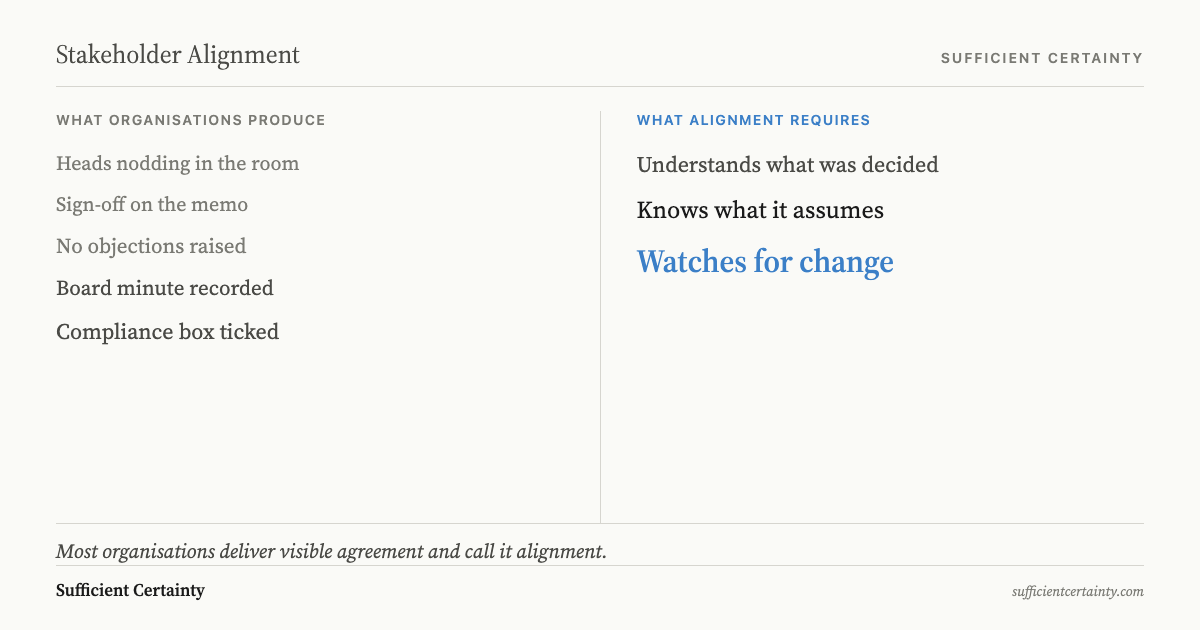
Stakeholder alignment is not agreement. It is the state in which every person who must act on a decision can say what was decided, what it assumes, and what would force the decision back open. Most organisations treat sign-off as alignment. Sign-off is attendance. Alignment requires comprehension.
Stakeholder alignment is not agreement. It is the state in which every person who must act on a decision can say what was decided, what it assumes, and what would force the decision back open. Most organisations treat sign-off as alignment. Sign-off is attendance. Alignment requires comprehension, and comprehension requires something worth testing.
In 1914, a message reading "send reinforcements, going to advance at midnight" was passed verbally down a chain of soldiers. By the time it reached the end of the line, it had become "send refreshments, going to a dance at midnight." Beer arrived instead of troops. The story is famous because it is absurd. It should be famous because the failure mode it describes is routine. In most organisations, the decision that leaves the boardroom is not the decision that reaches the people who must act on it. What changes is not the words. What changes is the understanding.
Stakeholder alignment is the state in which everyone who must act on a decision understands what was decided, what it assumes, and what to watch. It is not agreement. It is comprehension with monitoring.
What stakeholder alignment actually requires
Stakeholder alignment requires three things. First, the people who must implement the decision understand what was decided and why. Second, the assumptions the decision rests on are visible to them, not buried in a slide deck they never opened. Third, monitoring is in place so that variance can be detected before the decision fails silently.
That is the structural answer. It is not what most organisations mean by alignment. Most organisations mean agreement: visible nodding in a meeting, a show-of-hands consensus, a carefully worded email saying "we are aligned." None of that is alignment. It is the appearance of alignment, and the appearance is the most dangerous part, because it gives the Decider confidence that the decision will be carried out as intended when it may not be.
Roger and I spent decades watching organisations confuse the two. The committee agrees. The minutes say "approved." Then nothing happens as intended, and nobody can explain why, because nobody checked whether the people tasked with implementation understood the reasoning behind the call. They understood the instruction. They did not understand the bet.
I call this governance theatre. Organisations superimpose committees, reporting structures, risk policies, and approval gates whose purpose is "seldom transparent, explicit or understood." The apparatus produces a paper trail of agreement. It does not produce comprehension. And comprehension is the only thing that matters when someone three levels down must make a judgment call that the boardroom never anticipated.
The plainest case of it is a steering committee that keeps deferring a call it already has the authority to make. The body meets, the paper is noted rather than approved, and the delivery date absorbs the difference. Usually someone suggests another meeting. That request is rarely about meetings. It is about exposure. The real question is whether the group needs more stakeholder meetings or a clearer decision.
Why stakeholder buy-in efforts fail
Most stakeholder buy-in efforts fail because they treat alignment as persuasion. The language gives it away. "Getting buy-in" frames the stakeholder as someone to be sold to, as if the quality of the decision were a function of the pitch rather than the reasoning. When the pitch works, the organisation records agreement and moves on. When it does not, the organisation records resistance and escalates. Neither response checks whether the people involved understood the assumptions the decision rests on.
That is the buried assumption in every buy-in strategy: that understanding follows agreement. It does not. Agreement is what people offer when they trust the presenter, when they want the meeting to end, or when they lack the context to object. Understanding is what they need to carry the decision through implementation without corrupting it. The two are not the same, and confusing them is how organisations produce decisions that look unanimous on paper and unravel on the ground.
I wrote about three national-scale cases where stakeholder buy-in looked solid on paper and collapsed the moment assumptions hit operations.
The mechanism for getting buy-in from leadership is not a better pitch. It is a written statement of what the recommendation assumes, handed to the leader before the meeting begins.
The assumption nobody surfaced
The WWI message is a communication failure, but it is also a design failure. Nobody tested the assumption that verbal relay would preserve meaning under battlefield conditions. The decision at the top was correct. The communication chain was not designed for the signal it was asked to carry. That distinction matters. Most alignment failures are not failures of intent. They are failures of transmission.
A multinational company designs a product for flat-pack assembly. The engineering is sound. The instructions are translated by someone who understands the language but not the assembly sequence. Customers receive a box of parts and a document that does not quite say what the designers intended. The product is fine. The implementation fails because meaning was not transmitted. In every functional sense, the assembly team was "aligned" with the company's objectives. They agreed with the goal. They could not act on it because the instructions were garbled. Before customer feedback becomes a requirement, the follow-up to a Voice of Customer analysis traces the original evidence to a proposed response and an observable acceptance check.
A subtler version plays out with auditors. An organisation hires external reviewers to assess its monitoring arrangements. The reviewers report no outstanding variances. The board receives the report and concludes that nothing is wrong. But "no outstanding variances found" is not the same as "nothing is wrong." The audit rests on its own assumptions: that the instruments are calibrated, that the sample is representative, that the criteria match the actual risk. If nobody surfaces those assumptions, the audit creates a false sense of confidence. The board thinks it has alignment on the state of the business. What it has is a chain of sign-offs, each resting on assumptions nobody tested.
These cases share a structure. The decision was sound. The analysis was competent. The failure was not in the thinking. It was in the space between deciding and acting, where meaning was lost, degraded, or replaced by a comforting proxy. That gap is where stakeholder alignment either holds or breaks, and most organisations never look there because they are too busy measuring agreement.
Write down what you decided and why, then check whether the version reaching your team says the same thing. Start the Walk →
One person decides, everyone understands
The first step of the Universal Decision-Making Method is to name the Decider: the single person with the authority to make this decision. One person decides. Others contribute knowledge, challenge assumptions, and bring implementation experience. But the decision has a single owner, named before the conversation begins.
This matters for stakeholder alignment because committees do not align people. Committees produce compromise, which looks like agreement but is actually the absence of a clear position. I once worked with a standards-making body whose expert committee spent months negotiating a document that satisfied nobody and was adopted by fewer still. Agreement was reached through "consensus amongst experts." The result lacked real consensus, had poor uptake, and illustrated the old truth that a camel is a horse designed by committee.
Participant selection is functional, not political. The Decider selects people for relevant knowledge, capacity to challenge group wisdom, involvement in implementation, and learning value. Not for seniority, not for representation, not because their feelings will be hurt if they are excluded. This is not collaborative decision making as therapy. It is about getting the right knowledge into the room so the Decider can make a better call and so the people who must act on it leave with genuine understanding.
Before choosing who needs to be involved, a power-interest matrix can show who has enough influence to block the call and what they need from the Decider.
Once the matrix is mapped, the guide to what to do after a stakeholder analysis shows how to convert the map into a decision about who belongs in the room and what each person needs to hear.
Once the Decider is named and the purpose is framed, stakeholder alignment becomes structural rather than political. The question shifts from "does everyone agree?" to "does everyone who must act understand what was decided, what it assumes, and what they are responsible for?" That is a question you can verify. Agreement is a feeling. Understanding is observable.
The same discipline applies when alignment must cross organisational boundaries. A negotiation strategy that treats the other side's position as fixed misses the same step: testing assumptions before the room commits.
I wrote about this distinction in detail: why the argument over alignment vs consensus misses the point until the decision itself is tested.
Five steps to stakeholder alignment that holds
The method has five steps: frame the decision, develop options, recognise assumptions, reach sufficient certainty, and design monitoring. Alignment is woven through all five, but it becomes structural in the last two.
In the first three steps, the Decider builds the reasoning. The decision is framed with a clear purpose. Options are developed and tested. Assumptions are surfaced, categorised, and ranked by significance. This is where the material of alignment is created: the reasoning, the evidence, the gaps, the judgment calls. Without this material, there is nothing to align stakeholders on except a conclusion. And a conclusion without visible reasoning is just an instruction.
At sufficient certainty, the Decider judges whether the basis for the decision is adequate. What is sufficient for one Decider might not be sufficient for another. That is not an invitation to whim. It is a statement about judgment, and judgment is what makes the Decider accountable. The Decider must be able to explain what assumptions carry the decision and why the basis was judged adequate. This explanation is the core of stakeholder alignment. If the Decider cannot articulate it, the stakeholders cannot understand it. The practical test is whether the people who must act are aligned enough to start execution.
In the fifth step, the decision becomes real. The Decider tasks people with the skills and authority to implement, communicates fully and unambiguously what is required, specifies time frames, coordination requirements, and accountabilities. Implementers receive the big picture even if their part is small. This is where most organisations cut corners. They announce the decision. They do not communicate the reasoning. They hand out tasks without explaining the assumptions those tasks rest on.
Communication is not rollout. It is a design element that makes implementation more likely to happen as intended. The method treats communication, training, monitoring, and contingency arrangements as part of the decision itself, not as things that happen afterwards. If communication is an afterthought, alignment is an afterthought. That is the structural difference, and it is why so many decisions that looked clear in the meeting room die on the shop floor.
Most organisations assume the cascade is the hard part. It is not. The hard part is making the assumption travel with the instruction. I cover the mechanics in organizational alignment: what to test before calling a team aligned, and what happens when alignment scales a weak strategy instead of a sound one.
Alignment is not complete at the moment of decision
The Pocket Card, which compresses the method into a five-step sequence, does not end at "decide." It ends at "implement, including monitoring." That is not a footnote. Monitoring is the mechanism that makes alignment real over time, because understanding decays, assumptions prove wrong, and context shifts in ways nobody anticipated.
Decisions fail for four broad reasons, all of which monitoring can catch: the decision-making process itself was defective; primary implementation does not proceed as intended; secondary elements malfunction over time; or the context changes in ways that were not contemplated. Alignment that does not include monitoring is a snapshot of understanding at a single moment. It will degrade.
When to specify monitoring is not a secondary question. It must be done as part of making the decision, when the Decider has the greatest awareness of the assumptions. Leaving it for later means the people who design the monitoring were not in the room when the reasoning was visible. They will monitor what looks important from the outside, which is rarely what the Decider judged critical from the inside.
Monitoring is worthless unless results reach a competent, empowered person who understands them and can act. That is not a bureaucratic requirement. It is the difference between an organisation that detects variance and one that collects data nobody reads. The annual employee satisfaction survey is the familiar case: the action plan is signed, and nobody reads the scores again until the next round. Stakeholder alignment is not a state you achieve. It is a practice, maintained by monitoring and corrected when variance appears.
When stakeholders genuinely disagree
Disagreement is data. It signals that an assumption is contested, which means it needs testing, not suppressing. The method is clear on this: do not confuse consensus with compromise. Consensus, properly done, tests options rigorously until the best idea is self-evident. Compromise smooths differences so the meeting can end. Most organisations do neither. They record a majority position and call it alignment.
When stakeholders genuinely disagree, the productive response is to identify which assumption is in dispute, rather than who is louder, who has more authority, or whose feelings are strongest. Once the assumption is named, it can be investigated, tested, or accepted as a known uncertainty. The decision then rests on the Decider's judgment about that assumption, and the disagreement is resolved not by social pressure but by a visible act of ownership. That same structure is why conflict resolution starts with naming the stalled decision, not calming the room. For a public proposal, the follow-up to a public consultation traces a material objection to the requirement it would change before approval.
When the disagreement has hardened enough that a third party is brought in, the same test applies. Formal workplace mediation can restore civility between two people and still leave the disputed assumption untouched, which is why so many mediated agreements hold for a few months and then break in the same place.
This is why the Decider role matters so much for alignment. Without a named Decider, disagreement has no resolution mechanism except hierarchy or exhaustion. With a named Decider, disagreement is a contribution. The Decider listens, tests, judges, and records the basis of the call. Stakeholders who disagree and lose the argument can still be aligned, because they understand what was decided, what it assumed, and why the Decider judged it sufficient. That is more than most organisations offer. Most organisations offer silence after the meeting, followed by quiet non-compliance.
I wrote about this pattern in detail: how managing disagreement in teams starts with naming the disputed assumption, not calming the room.
You could get visible agreement from every stakeholder and still watch the decision fail in implementation.
Work through your decisionNo sign-up. Just pick your decision and start.
Grant Purdy is the co-author, with Roger Estall, of Deciding (2020), and the architect of the Universal Decision-Making Method.