
Economic factors that could kill market entry sit inside every entry deck, labelled and unranked. Nobody names the one factor whose shift would force the board to reopen the decision before launch. A catalogued risk is not a tested assumption, and the distinction costs real money when the economy moves.
A strategy director once showed me a 43-slide entry deck with a five-year revenue ramp and a pricing bridge split across six customer segments. One page was headed "economic factors". When I asked which economic factors that could kill market entry would make the board reopen the decision before launch, someone pointed at the macro page and said it was all in there. Nobody in that room could name the assumption that would break the entry.
That failure is common. Teams describe the economy, then leave the board to guess which assumption actually carries the entry or what number would break it. They also fail to say how quickly anyone would know. A board needs the number that would make it reopen the decision, not a tour of macro variables.
Economic factors that could kill market entry are the few economic conditions that can turn a viable expansion into an uneconomic one by breaking its commercial assumptions.
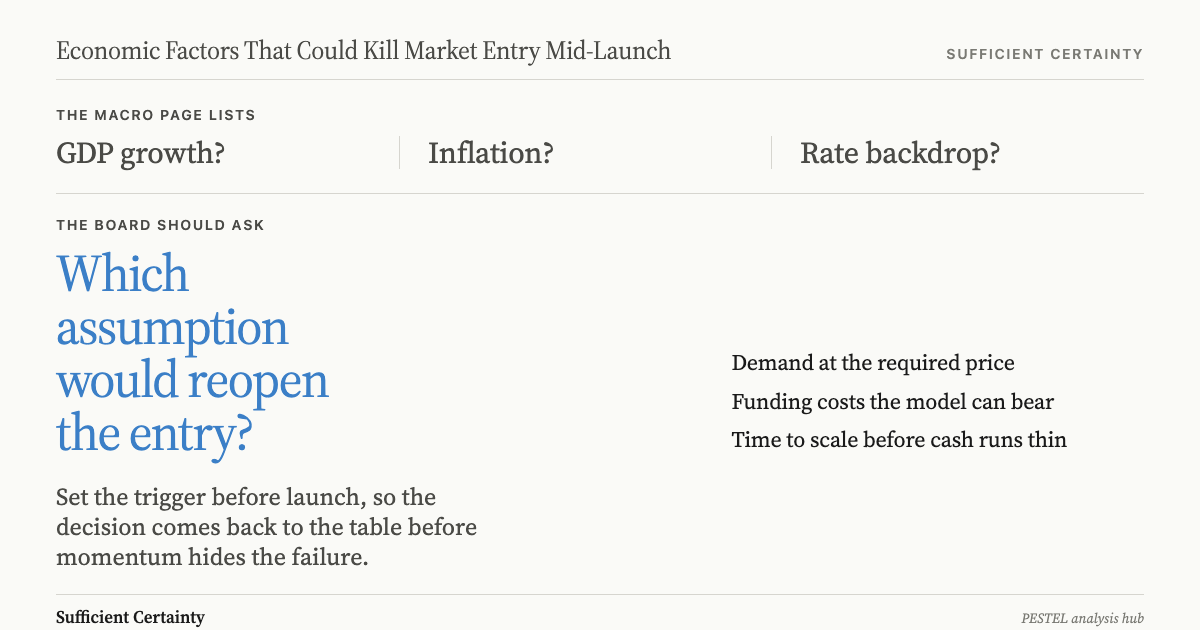
Which Economic Factors That Could Kill Market Entry Matter First?
Demand at the local price point comes first. I do not mean headline GDP growth, or the line in the deck that says "large and expanding market". I mean the narrower question that destroys entries in real life: will enough customers in this segment buy at the price that makes the model work, soon enough to justify the capital committed?
Ford's 2021 statement on India is worth reading for that reason. After treating India as a major growth market for years, Ford said demand for new vehicles had been much weaker than forecast, disclosed accumulated operating losses of more than $2 billion over a decade, and confirmed the wind-down of local vehicle manufacturing. That is what happens when the market story is larger than the demand assumption underneath it.
I have seen boards approve an entry because everyone in the room agreed the country was attractive. Attractive is not an economic assumption. The real assumption is sharper: this offer, at this price, with this cost base, reaches viable volume before the patience or cash runs out. The wider external scan belongs in a proper PESTEL analysis.
The same weakness sits inside the older PEST analysis framework. Teams write labels such as "economic growth" or "inflation", then stop. That is decoration, not analysis. The advisory firm that compiled the deck bills either way; the board that approved the entry does not. I want the board pack to say which condition the entry depends on, and what level turns the economics against you.
Write the economic assumption your entry depends on and set the level that would make you reopen the decision before launch. Start the Walk →
Economic Factors That Could Kill Market Entry When Money Tightens
The cost and availability of money is among the economic factors that could kill market entry faster than most feasibility decks admit. Cheap capital hides weak economics because it lets the team buy customers and absorb losses while postponing the moment when the unit economics must cover the cost of capital without further raises.
Cazoo's September 2022 strategic review said the company would exit mainland Europe entirely, reversing an expansion push backed by $630 million of convertible notes (the sort of figure that only makes sense while equity markets are forgiving). By the third quarter, management described a continued weak macroeconomic environment and was concentrating on unit economics and cash preservation; the projected savings from pulling out of the continent exceeded GBP100 million. The expansion only worked in a funding window that did not stay open.
The IMF's October 2023 Global Financial Stability Report put the backdrop plainly. Inflation remained elevated, and the Fund warned that rates could stay higher for longer as the credit cycle turned. If your entry needs cheap debt or repeated refinancing, especially with a long period of negative cash flow, that backdrop is a kill factor, not background context.
This is where I push teams to stop writing "interest rates" as though the phrase itself is useful. Write the assumption instead. Can this entry still work if funding costs stay above your base case for 18 months, or if the next raise does not arrive on schedule? If the honest answer is no, the decision is more fragile than the deck admits.
Time to scale is an economic assumption
An entry can fail even when customers exist, because the business runs out of room before scale arrives. Time is part of the economics, and I rarely see it treated that way in board papers.
Flyr said in October 2022 that it was taking forceful action to reduce cash burn, cutting winter capacity, furloughing staff, and targeting a temporary cost reduction of up to 50% with roughly NOK400 million less winter cash burn. On February 1, 2023, it filed for bankruptcy after failing to secure financing; the board said there was no realistic short-term liquidity solution. That sequence matters because entries do not wait for a neat annual review; they run out of room before the board looks up.
I would treat time to scale as brutally as I treat price and funding. How long before the unit economics become self-supporting? What happens if that date slips by two quarters? Which cost moves first, and does the margin survive it? The same failure shows up across industries; these PESTEL analysis examples carry the wider pattern of economic factors that could kill market entry through timing rather than pricing.
Boards often hear "currency risk" and assume treasury will mop it up later. I do not. If local revenue comes in one currency and the crucial costs sit in another (a mismatch most finance teams assume treasury has hedged, and most treasuries assume finance has budgeted for), the exchange rate belongs in the entry decision itself.
Turn the kill factors into reopen triggers
Roger Estall and I built the Universal Decision-Making Method around that discipline; it runs through every chapter of Deciding. The method does not ask for a grand catalog of everything that might happen. It asks what the decision relies on (not the twenty items a risk register would list, but the three or four that would overturn the case); then it makes the team say how exposed that assumption is to change and what they will watch after committing.
I would put very little on the slide. First, demand at the required price. Then funding and time to scale, because Cazoo and Flyr show what happens when cheap money disappears or the runway runs out before scale arrives.
A final line covers the factor that is specific to the model (in one business that will be commodity cost; in another it will be the exchange rate). I also want a written trigger beside each assumption: if segment demand misses plan for two quarters, or if financing costs stay above the level the model can bear, the decision comes back to the table. That discipline sounds severe until you compare it with writing off years of effort because nobody wanted to reopen the call in time.
Boards are often taught to talk about barriers. I would rather ask which economic factor could kill the entry, and whether the team would know in time. That question produces a better feasibility deck because it forces the economics to carry the decision, not decorate it.
You could approve the entry deck and never name the economic assumption that would kill it.
Work through your decisionNo sign-up. Just pick your decision and start.
Grant Purdy is the co-author, with Roger Estall, of Deciding (2020), and the architect of the Universal Decision-Making Method.