
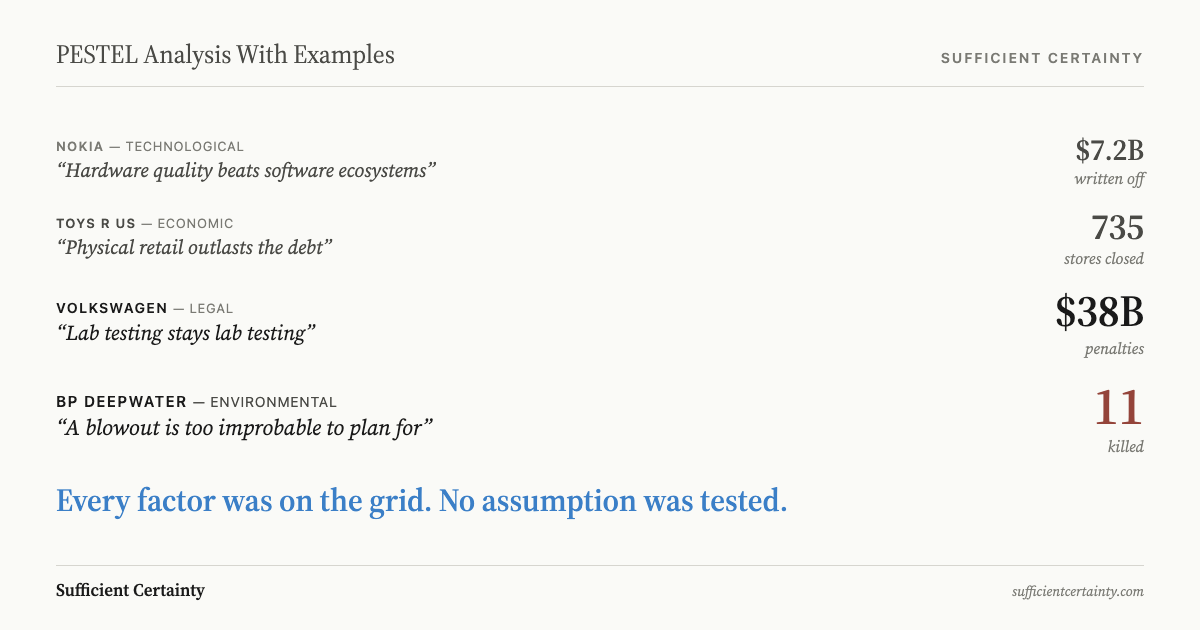
PESTEL analysis with examples usually demonstrates the tool working as intended and says nothing about the premise it missed. Nokia, Volkswagen, Toys R Us, and BP each had catalogued external factors competently. Each failed on one assumption the grid did not force anyone to name.
Nokia held 51% of the global smartphone market in 2007. Its strategy team had the external environment thoroughly catalogued: strong hardware margins and a dominant operating system running on more than half the world’s smartphones. A PESTEL analysis of Nokia in that year would have returned a clean grid with every factor correctly identified.
Within six years the market share sat below 3%. Microsoft paid $7.2 billion for what remained of the mobile division and subsequently wrote off nearly the entire amount. The scan was never wrong. The premise the strategy rested on was never examined: that customers would continue to reward hardware quality over software ecosystems.
Most worked examples available online stop at the completed grid; they demonstrate what to write in each box but do not show what happened next. The difference matters, because a grid populated with accurate factors gives the team a false sense of completion: the analytical work looks finished when the most important question has not been asked. I have found that the harder question is never "what are the external factors?" but "which of these factors are we assuming will stay the same, and what happens to the decision if they do not?" The four cases below show what happened when four organisations failed to ask it.
A PESTEL analysis with examples applies the six macro-environmental categories (political, economic, social, technological, environmental, legal) to a real organisation or decision, showing which factors were identified, what assumptions they implied, and what strategic outcome followed.
Four PESTEL analysis examples that ended in strategic failure
Nokia: a technological factor nobody questioned
This is what a filled-in PESTEL grid for Nokia in 2007 would have looked like:
| Factor | Condition identified (2007) |
|---|---|
| Political | EU harmonisation favouring pan-European handset standards |
| Economic | 22% operating margin on mobile devices; dominant global market share |
| Social | Brand loyalty across 150+ markets; 900 million handsets sold |
| Technological | Touchscreen smartphones emerging; iPhone launched June 2007; Symbian running 57 incompatible versions |
| Environmental | EU WEEE and RoHS directives on handset manufacturing and disposal |
| Legal | Patent portfolio exceeding 10,000 mobile technology patents |
Every factor was correctly catalogued. Internally, Nokia’s leadership dismissed the touchscreen shift as a niche product for the American market. Research by Vuori and Huy at INSEAD later found that the company’s culture actively suppressed dissent: middle managers feared reporting bad news upward, and senior leaders feared losing status if they acknowledged the threat publicly.
The technological factor was visible on the grid. Nokia was running 57 incompatible versions of its Symbian operating system while Apple offered a single integrated ecosystem; the platform shift was already measurable in developer adoption and app-store growth. I have watched boards receive a grid like that one and move to the next slide without anyone in the room asking how confident they were in the premise sitting underneath it. Revenue collapsed from $51 billion, and the mobile division was eventually sold for parts.
Volkswagen: a legal factor assumed to be permanent
| Factor | Condition identified (2006) |
|---|---|
| Political | EU diesel-friendly tax incentives; government subsidies for “clean diesel” |
| Economic | Diesel margins higher than petrol equivalents; growing European market share |
| Social | Consumer preference for fuel efficiency; “green diesel” marketing narrative accepted |
| Technological | Defeat-device software passing laboratory tests; no real-world testing protocols in use |
| Environmental | Tightening NOx limits across EU and US; growing urban air-quality concerns |
| Legal | Emissions enforcement relying entirely on laboratory testing |
From 2006 to 2015, Volkswagen programmed defeat devices into 11 million diesel vehicles worldwide. The cars emitted up to 40 times the legal NOx limit during normal driving while passing laboratory emissions tests without difficulty. ProPublica’s investigation documented a total US penalty exceeding $25 billion; global costs have since approached $38 billion.
A PESTEL analysis of VW’s diesel strategy in 2006 would have placed emissions regulation under the L column and noted that enforcement at the time relied entirely on laboratory testing. The legal factor was correctly identified.
The bet the board never wrote down: that regulatory testing methods would remain laboratory-only for the life of the strategy. I have sat across from teams that treated a regulatory regime the same way, as though the current enforcement method were a geological feature rather than a policy choice that a single parliamentary committee could revise. Volkswagen built a nine-year corporate strategy on that premise. That is a $38 billion wager on a single legal assumption that nobody rated for volatility or assigned to anyone for monitoring.
Toys R Us: an economic factor with a hidden timer
Annual interest payments exceeding $400 million consumed nearly every dollar Toys R Us could have spent building an online channel. The payments followed a 2005 leveraged buyout by KKR, Bain Capital, and Vornado Realty Trust, which according to Tactyqal’s post-mortem analysis loaded approximately $5 billion in debt onto the balance sheet against a $6.6 billion acquisition price.
| Factor | Condition identified (2005) |
|---|---|
| Political | No significant regulatory barriers to retail consolidation or leveraged buyouts |
| Economic | $5 billion LBO debt against $6.6 billion acquisition; $400 million annual interest payments |
| Social | Brand loyalty among parents; dominant physical presence in toy retail |
| Technological | E-commerce accelerating; Amazon expanding into toy category |
| Environmental | Growing consumer preference for sustainable, non-plastic toy alternatives |
| Legal | Standard retail regulatory compliance; no material litigation exposure |
The company’s e-commerce investment amounted to roughly $100 million over the period, a fraction of the annual debt service alone; every dollar flowing to creditors was a dollar unavailable for the digital transition that the economic and technological factors on the grid were already forecasting. The same board problem shows up before market entry as well: the useful work is naming the economic factors that could kill market entry before the label hardens into comfort.
The premise the sponsors took for granted was the intersection: whether physical retail dominance in the toy category would persist long enough to service a decade of buyout debt repayments. E-commerce was accelerating with high probability and high speed; the debt repayment horizon stretched beyond ten years. In my experience the premise always reads the same way: the current market structure will hold.
Nobody converted the mismatch between those two timelines into a rated assumption with a confidence score attached. Toys R Us filed for bankruptcy in 2017 and closed 735 American stores the following year. The consulting firms and private equity advisers who structured the deal had no commercial reason to run that test; their fees closed with the transaction, not with the outcome.
BP Deepwater Horizon: an environmental factor treated as background noise
| Factor | Condition identified (pre-2010) |
|---|---|
| Political | US Minerals Management Service under-resourced; regulatory capture documented |
| Economic | Deepwater wells yielding higher margins than onshore; cost-cutting across safety budgets |
| Social | Gulf Coast communities economically dependent on offshore drilling employment |
| Technological | Drilling at 5,000+ feet with single blowout-preventer redundancy; no proven capping technology for ultra-deep failures |
| Environmental | Extreme subsea pressure; high-consequence spill risk in enclosed marine ecosystem |
| Legal | Liability caps under Oil Pollution Act of 1990 ($75 million for non-gross-negligence); post-Exxon Valdez punitive damage precedent |
On 20 April 2010, the Deepwater Horizon drilling rig exploded in the Gulf of Mexico, killing 11 workers and releasing approximately five million barrels of crude oil over 87 days. Total remediation and legal costs exceeded $65 billion, according to Bryghtpath’s case study, and BP’s market capitalisation fell by 55%.
The environmental factors in a deepwater drilling analysis are conspicuous: extreme operating depths and high-pressure hydrocarbon reservoirs present obvious exposure. BP’s unexamined premise was that the probability of a catastrophic blowout remained low enough to manage through routine operational procedures alone. The company had reduced safety budgets and operated without adequate blowout-preventer redundancy.
I have reviewed board papers where the environmental section of the scan was populated correctly and treated as a compliance exercise, filed and forgotten; the factors were catalogued, but they were treated as background information rather than as assumptions requiring a significance rating and a monitoring protocol. When the blowout occurred, the gap between the identified factor and the premise the strategy depended on proved fatal for 11 people and ruinous for the company.
Convert the factor your strategy depends on into an assumption and rate it before the next annual scan files it away again. Start the Walk →
Why a PESTEL analysis stops short of testing
All four organisations performed the scanning part of the work correctly. In each case, the factor that later proved decisive was already visible in strategy documents and board presentations before the crisis arrived. The external environment was mapped; the grid was populated; the analytical step that every textbook recommends was completed on schedule. The gap was not in what the grid captured but in what the team did with it afterward.
I have watched this pattern repeat across more than two hundred organisations in nearly fifty years. The team presents a completed environmental scan; the board approves the strategy; twelve or eighteen months later, a condition that was visible on the original grid shifts, and the strategy breaks.
When I ask what assumption that factor rested on, the room falls silent, because nobody wrote it down and nobody rated how confident they were. That is the gap between scanning and deciding.
The pattern holds across all six categories. Political assumptions are among the most dangerous because they tend to carry an implicit premise of regulatory permanence; I have sat in strategy meetings where the team’s entire market-entry plan rested on a tariff regime that had been stable for a decade, and nobody asked what would happen if the regulation was revised.
Social factors suffer from a different version of the same problem: consumer attitudes shift gradually until they do not, and the factor on the grid reads as stable right up to the quarter it moves decisively.
The annual cycle makes this worse. Many organisations conduct a PESTEL scan once a year as part of the strategic planning process; the grid is updated and the old one is filed. A fact recorded on a specific date becomes an assumption the moment the world moves on from that date; a regulatory environment that was stable in January can be under political review by April. Annual scanning treats the external environment as though it updates on the organisation’s timetable, and it never does.
There is a reason the six-box workshop sells so well as a repeatable annual exercise: the consulting firms that deliver it get paid per session, and a framework that ends at the grid guarantees a rebooking.
Roger Estall and I spent years watching organisations treat the completed scan as the end of the analytical work, and the structural gap in the standard PESTEL framework was always the same one.
How a PESTEL analysis becomes a testable assumption
The Universal Decision-Making Method addresses this gap directly. After scanning the external environment, which is the work a PESTEL analysis does competently, the five-step method asks the team to name the assumptions their decision rests on and rate each one for significance and volatility.
In Deciding, the book Roger Estall and I wrote together, we described an eight-column tool that converts a factor list into a set of rated assumptions a Decider can act on. Each factor is restated as the specific assumption the decision depends on, then rated for significance (how much it matters to the outcome) and volatility (how likely it is to change during the life of the decision). The output is not a categorised list of observations; it is a ranked set of assumptions with monitoring triggers, which gives the Decider something to act on rather than something to file.
Take VW’s legal factor as a demonstration. The factor itself (emissions testing regime) was correctly identified. Converted to an assumption, it reads: "regulatory testing methods will remain laboratory-only during the life of this strategy." Significance: critical, because the entire diesel programme depended on it. Volatility: high, because regulatory methodology had already shifted in adjacent sectors and public concern about air quality was mounting across Europe.
That combination demands monitoring and contingency planning, not a nine-year unhedged commitment. The assumption-rating step would have surfaced the premise, rated it, and forced a conversation about what the team would do if it proved wrong.
Monitoring is the step that distinguishes a decision from a bet. Each high-significance, high-volatility assumption gets a trigger: a specific condition in the external environment that, if it changes, reopens the decision for review. VW’s trigger would have been straightforward: any regulatory body announcing real-world emissions testing protocols. Nokia’s would have been simpler still: any competitor launching an integrated software platform with growing app-ecosystem traction.
In both cases the trigger fired years before the crisis arrived, but nobody was watching for it, because nobody had written down what they were assuming.
Every factor on a PESTEL grid carries this structure underneath. "Government regulation exists" is an observation; "the current regulatory framework will persist long enough for this strategy to deliver its intended outcome" is an assumption. The difference is that an observation describes the present, and an assumption predicts the future. Stating the assumption explicitly is what converts a scan into the beginning of a decision.
Most PESTEL analysis examples stop before that step, and so did the organisations in these four cases. That is the pattern: the grid is complete and the decision still fails because nobody converted the factor into a testable assumption. Adding more categories does not fix this; a PEST analysis with four boxes, a STEEPLED analysis with eight, or a combined PESTEL SWOT analysis has the same structural gap. The missing step is always assumption testing, not more scanning.
You could fill in every box on the grid and still leave the premise underneath it untested.
Work through your decisionNo sign-up. Just pick your decision and start.
Grant Purdy is the co-author, with Roger Estall, of Deciding (2020), and the architect of the Universal Decision-Making Method.