PESTEL analysis catalogues external factors into six tidy boxes and gives the presenter a slide that looks thorough. It does not force anyone to name the one assumption beneath the decision that those factors could break. The scan is useful. Stopping at the scan is the problem.
In the mid-2010s, a taxi operator could run a pestel analysis, fill every box, and still miss the only question that mattered. Ride-sharing apps were visible. Customer frustration with taxis was visible. Pressure on regulators was visible. Lower-cost dispatch models were visible. The blind spot was the assumption beneath the incumbents' whole position: that licensing rules would keep protecting the market they already had.
That is the recurring weakness in pestel analysis. The scan gets done, the slide looks serious, and the decision is still weak. A list of external factors is useful, but it does not create value by itself. As Roger Estall and I wrote in Deciding, value appears only when a team decides what it is going to do and why that choice is sound enough to back.
I am not against PESTEL. I am against stopping there. Used properly, it helps a team see the forces around a decision. Used lazily, it becomes one more annual ritual that catalogs change while leaving the real assumptions untouched.
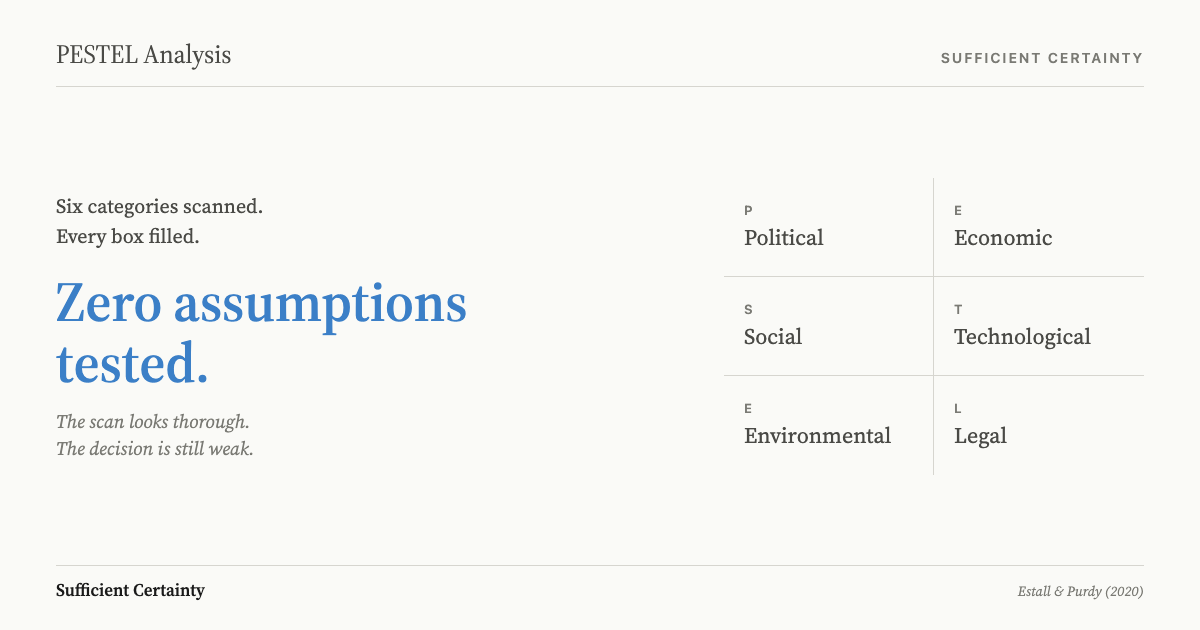
A PESTEL analysis organizes external factors into six categories (political, economic, social, technological, environmental, and legal) to scan what is changing around an organization. It captures context but does not test the assumptions behind it.
What PESTEL analysis is
PESTEL stands for political, economic, social, technological, environmental, and legal. That is the basic pestel meaning, and it is the part every business textbook gets right. The PESTEL framework gives people a way to sort external influences into familiar headings so they can scan what is happening outside the organization.
Where I part company with most definitions is the phrase "strategic planning tool." That description gives PESTEL more credit than it deserves. A pestel analysis is not a strategy. It does not even contain a decision. It is a macro-environmental scan, which means it helps you describe context. It does not tell you which part of that context matters most, what the team is relying on, or whether the decision can survive if one of those factors shifts.
That is why I treat PESTEL as one input into situation analysis, not as a stand-alone method. Situation analysis is broader. It asks what context matters to this decision, in this organization, over this time horizon. PESTEL helps with the external and wider bands of that picture. It does not cover the internal conditions, and it does not convert observations into judgment.
So if someone asks what does PESTEL stand for, the short answer is easy. If they ask what a pestel analysis is for, the honest answer is sharper: it helps you scan the outside world in an orderly way. That is worthwhile. It is still only the beginning.
The six factors and what they actually tell you
Political factors tell you that policy, government action, and power relationships may change. The implied assumption is that public decisions, subsidies, trade rules, or licensing settings will remain favorable enough for your option to work.
Economic factors tell you that prices, rates, demand, and capital conditions can move while your decision is still unfolding. The implied assumption is that inflation, interest rates, exchange rates, margins, or purchasing power will stay within bounds that your plan can tolerate.
When those move, the question is which economic factors could actually kill the entry.
Social factors tell you that people do not stay still. Tastes shift, habits change, generations age, and public tolerance moves. The implied assumption is that customers, staff, voters, or communities will keep behaving in a way your decision depends on.
Social shifts that could break a launch assumption are the ones worth auditing before the decision is final.Technological factors tell you that new tools, new platforms, and new operating models can quickly alter cost, speed, and customer expectations. The implied assumption is that your current systems, channels, or capabilities will not be made second-rate before the decision has paid off.
Environmental factors tell you that physical conditions, resource constraints, and climate-related pressures can change the feasibility of the plan. The implied assumption is that supply, location, weather, energy, or environmental tolerance will stay workable long enough for the decision to deliver.
Legal factors tell you what the rules are today, but the real issue is whether those rules will still protect you tomorrow. A single legislative shift can reopen an expansion decision the board considered settled. The implied assumption is that regulation, enforcement, liability, and compliance obligations will remain stable enough for the decision to hold.
The pattern is the same in every box. The factor is the external force. The decision rests on an assumption about that force staying favorable, changing slowly, or remaining detectable. That is the step most PESTEL templates never make explicit.
How to conduct a PESTEL analysis
If you want to know how to conduct a pestel analysis, the mechanics are straightforward. First, scope the decision. Be clear about what choice the scan is supposed to support and over what period the consequences will be felt. A market-entry decision with a two-year horizon needs a different scan from a factory investment expected to shape the business for a decade.
Next, scan each category. Look at political settings, economic conditions, social behavior, technology shifts, environmental pressures, and legal requirements. Collect the factors that appear relevant to the decision, not every interesting article your team has read this quarter. Then record those factors in a simple working document so the team can see what it thinks is changing.
That is the point where most guides stop. I do not think they should. Once the scan is complete, the next question is not "what else can we add?" It is "so what?" In our glossary we were explicit that context is decision-specific, "not a generic 'environmental scan' or 'PESTLE' once-a-year exercise." A yearly PESTEL ritual with no decision at the center is paperwork pretending to be strategy.
The practical move is to separate the scan from the judgment that follows it. Gather the factors first. Then come back to them in a short working session and ask what each factor means for the choice in front of you. That is the bridge to a tested decision-making method.
The same gap appears when teams apply PESTEL to a campaign or product launch. A marketing PESTEL that scans every category and never names what the budget depends on is the most common version of this failure.
The external scan is not the failure. Treating the scan as the result is the failure.
Take the PESTEL factor your strategy depends on most and rewrite it as a testable assumption. Start the Walk →
What PESTEL gives you and what it does not
What PESTEL gives you is coverage. It helps a team look beyond its own office and notice the wider forces that could affect the decision. That is useful, especially when managers are too close to their own operations and assume the outside world will stay roughly as it is.
What it does not give you is a way to test which of those factors really matter, how confident you should be in each one, or what action follows if a factor starts moving against you. A factor on a PESTEL chart and a factor that can overturn a decision do not carry the same weight. The method has no built-in way to tell you the difference.
The conventional taxi industry is the cleanest example I know. A mid-2010s pestel analysis of that industry would have looked almost prescient. Under Technology, it would have listed ride-sharing apps and GPS-based dispatch. Under Social, it would have listed customers preferring app-based booking and visible pricing. Under Political, it would have listed city-level debates over whether ride-sharing should be licensed. Under Economic, it would have listed lower per-ride costs through dynamic pricing. Every factor was visible. Nothing was hiding.
What incumbents failed to do was state and test the assumption underneath their existing decisions: that the regulatory structure would continue protecting their market position. Once that assumption is visible, the conversation changes. How confident are we in it? How quickly could it fail? Would we detect the failure early enough to change course? Because those questions were never asked, four PESTEL categories converged at once and hit operators who believed the old barriers would hold.
This is also why I do not treat PESTEL as a substitute for SWOT analysis, for risk assessment, or for thinking clearly about risk. Teams that run PESTEL, SWOT, or both before a market entry still need the step that names the assumption carrying the move. Each tool may help surface something relevant. None solves the ranking problem by itself. As we observed in our critique of registers, the prevailing context is rarely recorded properly and the list can only ever be a sample. The artifact stays still while the world keeps moving.
I saw the same problem during COVID disruption. Organizations made decisions about staffing, suppliers, cash, and operations in real time. They did not reach for yesterday's slide deck and treat it as an answer. The companies that coped best did not have the prettiest lists. They were the ones that recognized when the assumptions behind those lists had stopped holding. Nokia, Volkswagen, Toys R Us, and BP each had a completed grid; the PESTEL analysis examples show what one unexamined premise cost each of them.
From factors to decisions: what to do after PESTEL
After a PESTEL scan, every factor should be rewritten as an assumption about the future. Political pressure becomes an assumption about regulation. Inflation becomes an assumption about margins. Customer attitudes become an assumption about demand. Technology change becomes an assumption about whether your current model will stay good enough. The question that matters is the one we built Stage 3 around: "What are the assumptions we are making here?"
Appendix D gives the practical bridge. It uses an eight-column tool that records characteristics, probability of change, speed of change, timing of change, detectability of change, assumption, significance, and volatility. That matters because PESTEL factors live on the left side of that structure, while the decision you are trying to defend lives on the right. In the worked example, the horizon is ten years and several external assumptions are rated Important or Critical with Medium or High volatility. That is the kind of discipline a plain PESTEL scan never provides.
The follow-on from any PESTEL is the same five-step sequence in the Universal Decision-Making Method:
- Frame the decision. Name the exact decision, the purpose it serves, and the intended duration. Without that frame, a pestel analysis is only a survey.
- Develop options. The same external factor has different implications for entering, waiting, partnering, exiting, or doing nothing.
- Recognise assumptions. Rewrite each factor as something the option depends on. If you want the deeper treatment, read assumptions in decision making.
- Sufficient certainty. Judge whether the highest-significance assumptions are strong enough, or whether you need better information, a modified decision, or a different one.
- Design monitoring. Record the assumptions and watch the volatile ones. "Recording the assumptions as well as the decision itself also allows monitoring for any subsequent change" in the circumstances on which the decision depends.
That final step matters more than most teams realize. Once assumptions are visible, you can decide what signals to watch and what changes should trigger review. This is also where a scenario planning framework becomes useful. Scenario work takes the external assumptions you have already surfaced and tests combinations of change instead of isolated factors. Used well, scenario planning is not a prettier scan. It is a way to stress the decision against alternative futures.
Roger Estall and I wrote Deciding to close precisely this gap. PESTEL helps teams notice change. The five steps help them decide what to do about it.
PESTEL variants: PEST, STEEP, STEEPLE, STEEPLED
PEST, PESTLE, STEEP, STEEPLE, STEEPLED. The letters multiply. The core weakness stays the same.
| Variant | What it includes | What it adds | What it still misses |
|---|---|---|---|
| PEST | Political, Economic, Social, Technological | The original four-box scan | No mechanism to test assumptions or rank significance |
| PESTEL or PESTLE | PEST plus Environmental and Legal | Broader treatment of regulation and physical context | Same gap as PEST, with two extra boxes |
| STEEP | Social, Technological, Economic, Environmental, Political | Environmental pressure brought forward as a headline category | Same scan, no bridge to decision |
| STEEPLE | STEEP plus Legal or Ethics, depending on the source | More explicit treatment of compliance or values | More categories, same ranking problem |
| STEEPLED | STEEPLE plus Demographics | A separate place for population and workforce shifts | Eight boxes, still no test of what the decision depends on |
The swapped-letter question is easy: PESTLE and PESTEL mean the same six categories, and what to do after a PESTLE analysis is identical to what to do after PESTEL. The longer question is the only one that matters. Does adding another category fix the fact that the team still has not said what it is assuming, how important that assumption is, or what it will do if the assumption fails? It does not. Seven boxes have the same gap as six. Eight have the same gap as seven.
My view is unchanged across all of them: adding letters can improve coverage, but it cannot make the decision for you. The four-letter original is examined in PEST analysis, where the same gap appears in its purest form, and the eight-letter end of the family is weighed in STEEPLED vs PESTEL, where the test is whether the two extra columns would alter anything you do.
You can list the factors, or test whether the assumptions behind them hold.
Work through your decisionNo sign-up. Just pick your decision and start.
Grant Purdy is the co-author, with Roger Estall, of Deciding (2020), and the architect of the Universal Decision-Making Method.