
A pest analysis framework earns its place only when it ranks the external shifts that could change the call. Most templates sort factors into four boxes and stop there, giving the presenter a tidy slide and the decision maker nothing to act on. The filter matters more than the framework.
A product director I worked with had a market-entry paper due Friday and a steering committee on Monday. Her deck already had a slide labelled "PEST", the sort of thing templates demand because no template has ever had to defend a recommendation. She needed the pest analysis framework to show which external shifts could change the call, and which ones were just slide insulation.
That is where most guides become evasive. They explain the four boxes, offer a grid, then leave the difficult work to the person who has to recommend something. A completed scan can be sensible and still useless if it never touches the decision it is meant to support.
A PEST analysis framework is a way of organising external political, economic, social, and technological factors so they can inform a business decision.
Why the PEST analysis framework disappoints good teams
Most people do not want PEST. They want a slide that will survive the senior person who asks what any of it changes. The private worry is not the acronym. It is putting respectable material in the boxes and discovering, in public, that none of it explains the recommendation.
The SI Labs critique of PESTLE says the awkward part plainly: teams fall into a checklist trap. They gather forty or more factors, recycle last year's wording with new dates, then mistake the heavier document for better judgement. That suits the template owner nicely. The annual planning ritual can show activity without anyone having to say which premise could break the recommendation.
I have watched that scene often enough to distrust the tidy grid. A room fills the page, an adviser nods at the coverage, and then someone asks, "what changes?" The four-box page has nothing to say because nobody has separated the factor that could alter the decision from the factor that merely makes the slide look adult. The framework fails when the categories become the result rather than a prompt for judgement.
One scan I still remember came from a business deciding whether to keep a production line open. The page looked complete, with government support in one box and energy costs in another. The team had assumed the grant would arrive before the board meeting and that power prices would stay inside the finance model. Neither assumption was written down. When we asked what would make them close the line rather than invest in it, the grid went quiet.
The answer was not hidden in another category. It was sitting in the economics of one assumption: the plant only made sense if the grant landed before the maintenance bill came due. That changed the conversation from scanning the environment to testing a date and a number. The original page had looked responsible because every box had something in it. It had not helped the Deciders until the bet was stated plainly. For a market entry, the same discipline starts by naming the economic factors that could kill the entry instead of adding another macro list.
How the PEST analysis framework multiplied without improving
The weakness was present at birth. In 1967, Francis Aguilar published Scanning the Business Environment and sorted the outside world into Economic, Technical, Political and Social. He built a scanning taxonomy, not a decision method. Everything since has rearranged his letters. Arnold Brown turned them into STEP, and by 1986 Liam Fahey and V. K. Narayanan had added the environmental and legal categories that gave us PESTEL. A new acronym looks like progress. It is much cheaper than adding a test for significance.
PESTEL and PESTLE are the same device with its pockets rearranged. If you want the six-factor version, the six-factor PESTEL analysis covers it, and the worked PESTEL examples show what happened when four organisations stopped at the grid. The longer label still does not tell you which external fact should change your recommendation; what to do after a PESTLE analysis covers the step that does.
I have little patience for acronym shopping. When a team debates PEST versus PESTEL, it is usually avoiding the more uncomfortable question: which external factor changes the decision? The same habit produces STEEPLED analysis, another longer label for the same missing act of judgement. After the boxes are full, classification is over. If nobody can say which premise would change the call, the team has only alphabetised its uncertainty.
Filter your PEST scan down to the external shift most likely to change the recommendation you are preparing. Start the Walk →
What every PEST analysis framework still leaves out
Academics have spent years bolting ranking machinery onto this family of tools. That is the confession. In 2012, Ihsan Yuksel wrote in the International Journal of Business and Management that PESTEL gives only a general picture of the macro environment and needs extra machinery for prioritisation. In May 2025, Per Dannemand Andersen at the Technical University of Denmark published a systematic review of the PESTEL family and found more than twenty variants carrying the same limits: weak prioritisation and no bridge to action. If the base tool needs extra devices before it can say what matters, it was never a decision method.
PEST has the defect in its purest form: four tidy headings, no rule for significance, and no obligation to state what the recommendation depends on. That is why a broad scan can be accurate and dead on arrival. It can name a tariff risk, an interest-rate shift or a technology change, then leave the Deciders with the same problem they had before the consultant arrived. The scan describes the weather. It does not say whether to build the factory, delay the launch or change the price.
The defect is not repaired by adding another grid. I see teams bolt the scan onto how to do a SWOT analysis and hope the second table will finish the thinking. Usually it doubles the paperwork before it improves the judgement. The external factor has to be tied to a specific decision, or it becomes one more labelled thing that can be listed, checked and safely ignored.
How I turn a scan into a decision input
Roger Estall and I wrote Deciding after years of seeing organisations mistake due diligence for decision-making. The Universal Decision-Making Method came from the same frustration. Environmental scanning earns its keep only when it changes the decision being made.
For PEST, I use a small repair. First, put the decision on the table. The Deciders must state the actual choice and the Purpose it serves before anyone starts collecting factors. The time period must be plain as well, because a tariff change that matters for a ten-year factory investment may be background noise in a two-quarter pricing decision. The external fact has not changed. The decision has.
Then I rewrite each factor as a claim the decision is relying on. The label "interest rates" becomes "we are relying on rates staying low enough for the project economics to hold." The label "regulation" becomes "we are relying on the rule not tightening before launch." If the word assumption makes the room nervous, good. Assumptions in decision-making are where the real bet is hiding.
| PEST factor | Claim the decision relies on | What would change the call |
|---|---|---|
| Political: regulation | The rule stays unchanged before launch | A draft rule makes the planned model unlawful or uneconomic |
| Economic: interest rates | Rates stay low enough for the economics to hold | The project fails its hurdle rate under a plausible rise |
| Social: customer habit | Enough buyers shift to the new format inside the payback period | Early adoption runs below the rate the payback assumes |
| Technological: platform dependence | The supplier's platform stays available on current terms through the build | A vendor roadmap change forces a rebuild before payback |
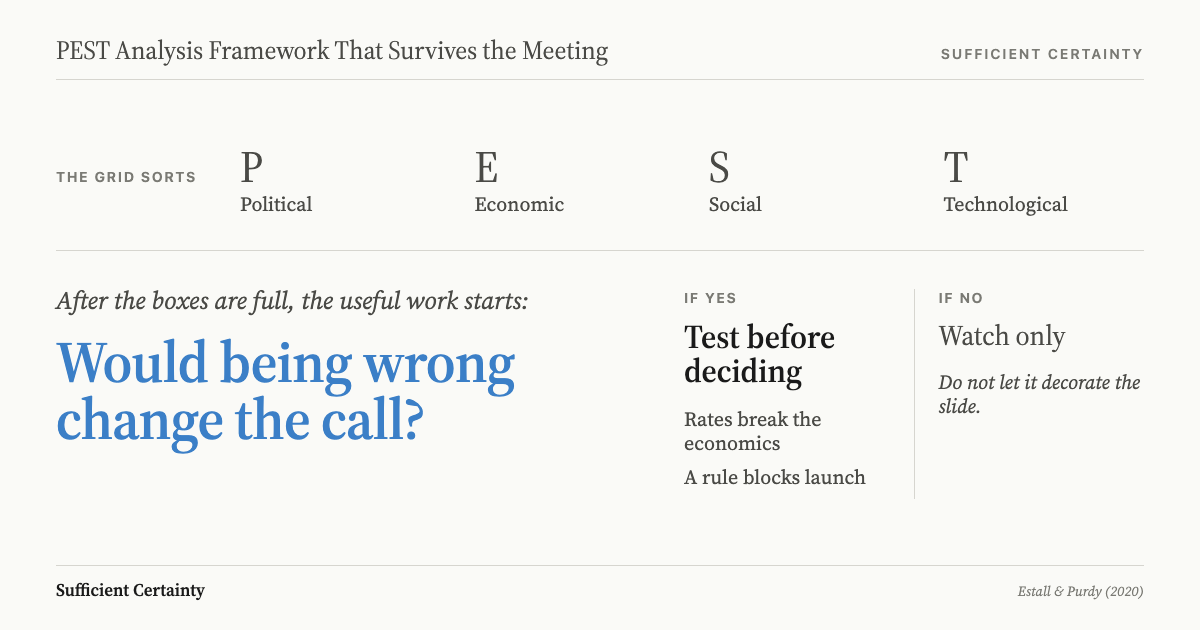
This is where template owners get nervous, because half the page they asked for may have to be thrown away. I separate the assumptions that could change the decision from those that only need watching, and I cut the rest. The original pest analysis framework never supplied that filter. It asked what belongs in the boxes. I ask which claim, if wrong, embarrasses the recommendation.
The useful output is smaller than the ritual suggests. It should show the Deciders where the recommendation is vulnerable and what would give them sufficient certainty to act. After that, the practical question is simple: what will we watch, and which movement would force the decision to change?
You could fill every box in the PEST grid and leave the meeting without a decision.
Work through your decisionNo sign-up. Just pick your decision and start.
Grant Purdy is the co-author, with Roger Estall, of Deciding (2020), and the architect of the Universal Decision-Making Method.