
An ethical decision making model can flag a bad option. It cannot make the call. The model earns its keep when it changes who can challenge the decision before pressure makes the wrong act look sensible, not when it names a principle nobody in the room intends to override.
I have never seen an ethical decision making model stop a bad call on its own. I have seen directors with a 42-page board paper in front of them while a sales target made the wrong act look sensible, even though the signed policy was already in the file. Once that happens, the code of conduct is mostly stage dressing.
Search results on this topic mostly promise a sequence you can follow. In my experience, the real trouble starts earlier, when the commercial frame hardens before anyone says, plainly, that one option is out of bounds.
An ethical decision making model is a structured way to test a proposed action against moral duties and acceptable harm before it is approved.
Why an ethical decision making model rarely decides the live issue
Most page-one results give you steps or a named framework. A 2023 cross-disciplinary review indexed in PubMed found 55 ethical models across 60 articles and seven professions; 52 were step sequences, and fewer than half included explicit problem-solving. That is the category problem in one sentence: plenty of ways to discuss ethics, not enough ways to kill a live option before the room talks itself into it.
An ethical model can test a choice. It does not tell you who owns the call, and it does not drag the hidden bet into daylight. It rarely tells the room when enough is enough. That is the gap between this kind of test and a full decision-making framework.
I have no quarrel with models as inputs. I do have a quarrel with pretending the model is the decision, which is usually the moment somebody wants the thinking to stop. That arrangement is very convenient for people who sell templates, and even more convenient for people who would rather outsource responsibility. I made the same point in my piece on decision models: once the diagram starts standing in for judgement, compliance takes over and responsibility slips out the side door.
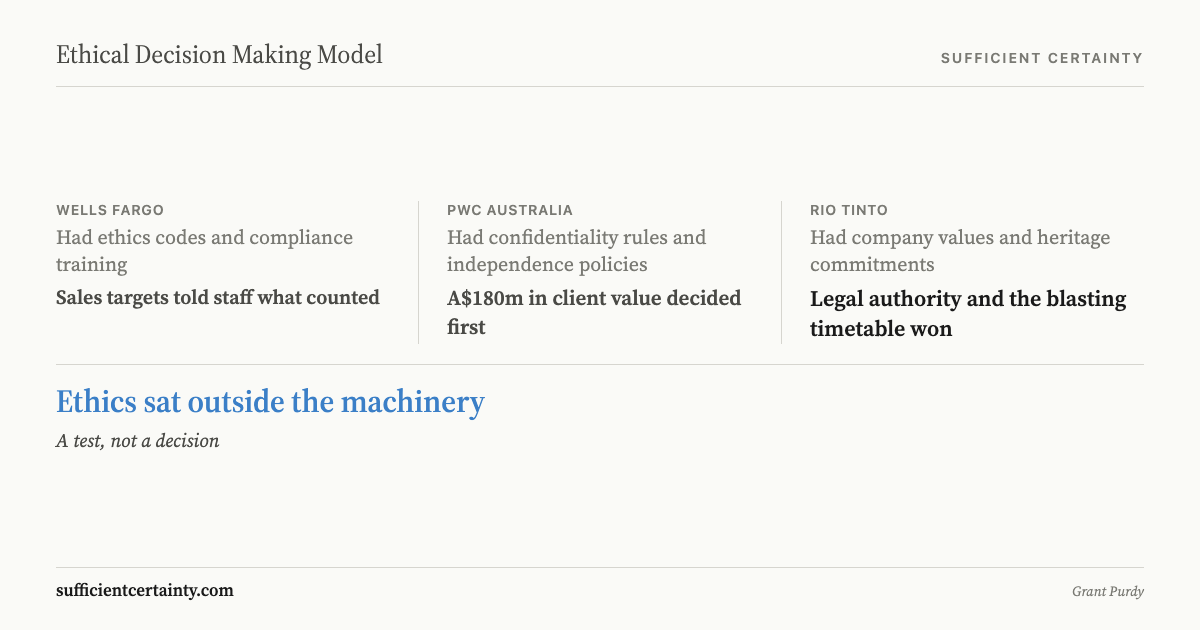
An ethical decision making model cannot fix a bad frame
Most ethical failures are bent before the ethical model appears. By the time a board asks if something is acceptable, the Purpose has often been quietly swapped for revenue or schedule. Someone has already decided whose interests count. Ethics arrives late, asked to bless a story that is already half written.
Wells Fargo's 2017 board investigation described a sales model that drove false accounts and an oversight system too weak to stop them. That is the part that matters. The bank did not lack ethics language. Its incentive design had already told staff what counted, and the code of conduct was expected to applaud politely from the shelf (where noble documents go once incentives have won).
The same thing happened at PwC Australia. The parliamentary inquiry described confidential Treasury information being turned into client value from 2013 to 2016, with up to A$180 million in annual tax at stake. Firms like that do not lack codes or training. They lack a moment in the decision where someone with authority says: we are not selling this. That is why who the Deciders are matters so much. If nobody owns the moral boundary, the revenue line owns it by default.
Take the tradeoff in front of you through five steps and see where the ethical test flags the wrong frame. Start the Walk →
Why legal authority does not rescue an unethical decision
Rio Tinto's board review after Juukan Gorge said the company had legal authority to blast the 46,000-year-old rock shelters, yet still fell short of its own values. Legal authority comforts the people who need cover, especially when the timetable has already become sacred. It settles the narrow compliance question and leaves the ethical one on the floor. The review described data that did not travel, then escalation and oversight that failed when the facts changed. That is what these cases share: the moral language sat outside the real machinery of the decision.
That is why I do not think the search for the best ethics model gets you very far. Two models can both ask who gets hurt and who gets paid. Neither tells you what to do when the bonus scheme and the timetable both reward silence. Ethics fails when it sits outside the actual mechanics of deciding.
I have seen the same mistake in quieter rooms. A management team says it values safety or candour, then frames the live choice so narrowly that the value survives only as a note in the compliance memo. Once that happens, the ethical question is commentary, not constraint. If you want to stop that drift, you need monitoring that keeps the decision tied to reality, not another training module.
What a real ethical decision making model still needs
An ethical model matters only if it sits inside the decision before money hardens the answer. When Roger Estall and I wrote Deciding, we were trying to make that live decision visible, not add one more compliance memo to the pile.
That is why the Universal Decision-Making Method still matters here. We Frame the decision around the real Purpose, not the slogan in the annual report. We Develop options early enough to kill the one that depends on quiet harm. We Recognise assumptions, especially the pious fiction that margin and restraint will somehow coexist unaided (a favourite corporate fairy tale). Then we judge Sufficient certainty and Design monitoring so the decision can be reopened before the damage becomes irreversible.
That is broader than the usual ethical decision making model because a live business decision is not a seminar problem. It carries authority and incentives, with uncertainty still moving under both. Treat ethics as a late-stage check and you get late-stage courage, which is usually another name for doing nothing until the cost is harder to hide.
Before approval, I would ask ruder questions than most ethics templates do.
- What purpose is really driving this, and which option should already be dead on ethical grounds?
- What assumption is the room too embarrassed to write down?
- What sign would force the decision back onto the table once it is underway?
If nobody wants those questions in the board paper, the model is not guiding the decision. It is conscience theatre.
That is also why I would not separate this topic from the harder question of how to make a difficult business decision. Ethical difficulty is usually woven into commercial difficulty. Turn it into a separate worksheet and you get the familiar farce: a signed policy on one side, expediency running the meeting on the other.
You could close this tab and carry that decision into another week.
Work through your decisionNo sign-up. Just pick your decision and start.
Grant Purdy is the co-author, with Roger Estall, of Deciding (2020), and the architect of the Universal Decision-Making Method.