
Examples of sound judgment share one visible trace: someone named the assumption the decision depended on and tested it before the room committed. The cases people remember are not about instinct or seniority. They are about a team that refused to let the preferred answer travel on an untested claim.
If you want examples of sound judgment, ignore the interview-answer rubbish. At 55:54:53 into Apollo 13, an oxygen tank blew, the spacecraft was about 200,000 miles from Earth, the Service Propulsion System sat in the same damaged section, and Gene Kranz had to choose between a faster direct abort and a longer free-return path. At Stafford Hospital, mortality ratios were running between 127 and 145, and the board preferred to call the problem a coding error. One team exposed the assumption that could kill people. The other protected it.
I have spent forty years watching people talk about judgment as though it were some glow around senior people. It is plainer than that. Judgment appears when somebody names what has to be true, then decides only after that claim has earned the right to carry the consequence. Most organizations do the opposite. They protect the preferred answer and bury the claim underneath it.
I make the wider case in the longer piece on sound judgment. Here I want to stay with cases, because they are useless if they cannot show you the live bet inside the decision.
Sound judgment is the act of identifying the assumption a decision rests on, testing it against the evidence you have, and acting only when that assumption can carry the consequence.
Examples of sound judgment start with the live assumption
The real thing starts when the room asks a rough question in plain English: what has to be true for this answer to work? Once that sentence is visible, the rest of the job changes. You can frame the decision properly, test the weak point, reach Sufficient Certainty, and say what signal would reopen the call. That is the discipline Roger Estall and I wrote down as the Universal Decision-Making Method.
People prefer softer substitutes. Experience sounds respectable and paperwork looks serious. Neither tells you whether the preferred answer is sitting on a fantasy. The useful question is always narrower and less flattering: which assumption is carrying this decision, and what happens if it is wrong?
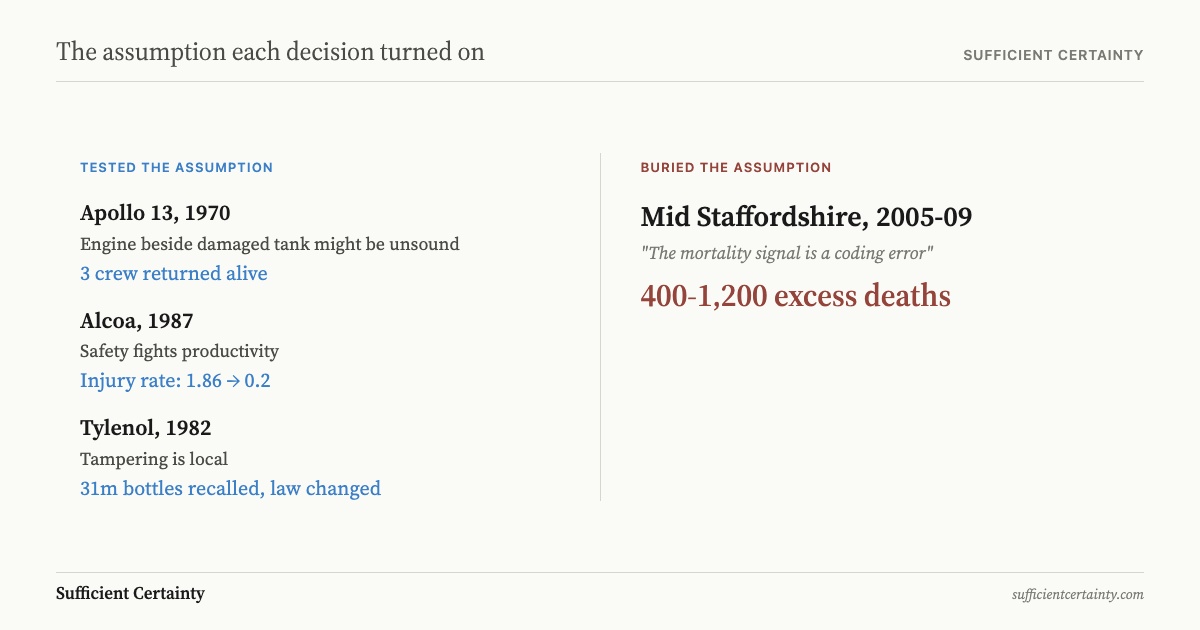
Apollo 13 and Mid Staffordshire split on one question
Apollo 13 is one of the cleanest cases because the decision was ugly and time was short. In the NASA mission report, the explosion hits at 55:54:53. Kranz and Mission Control then face a tempting option: use the Service Propulsion System for a direct abort. It was quicker. It also depended on an assumption they could not test, that the engine sitting beside the damaged tank was still sound. So they chose the free-return path and worked the problem from there. Three men came home on April 17, 1970 because the room refused to treat an untested hope as evidence.
Mid Staffordshire did the opposite. The Francis Report later described mortality ratios of 127 to 145, patients left filthy and dehydrated, and a board determined to win Foundation Trust status between 2005 and 2009. The convenient story was that the mortality signal was a coding issue. That story spared the board from asking whether care itself had broken down. The Healthcare Commission's central estimate was 491 excess deaths, and the wider range ran from 400 to 1,200.
The difference between the two cases was not intelligence. It was willingness to test the dangerous assumption before the room committed. That is the hard center of making decisions with uncertainty. One room treated the assumption as the problem. The other treated it as an inconvenience.
Use one live high-stakes call to see whether your judgment rests on the assumption that actually deserves the test. Start the Walk →
Alcoa and Tylenol refused the convenient story
Paul O'Neill did not take over Alcoa in 1987 and announce a warm feeling about safety. He treated safety as a diagnostic signal. The company's lost workday injury rate was 1.86 per 100 workers, and O'Neill required that every serious injury be reported to him within 24 hours, a discipline described in later accounts of his record on safety. By 2000 the injury rate had fallen to 0.2. He had tested the lazy corporate assumption that safety fights productivity, and he found that safer work exposed weak processes and weak reporting lines.
James Burke faced a different version of the same problem in 1982. Seven people died in the Chicago area after taking cyanide-laced Tylenol capsules. The cheap answer was to assume the tampering was local and protect the national brand. Burke would not do it. Guided by Johnson & Johnson's Credo, he ordered a nationwide recall of 31 million bottles at a cost above $100 million because he could not prove the danger stopped at the city line. Tamper-resistant packaging turned that judgment into law a year later.
O'Neill and Burke were not performing instinct. They were refusing a story that made management look comfortable. That is why I get impatient when people ask if judgment can be learned. Of course it can. Both men used a discipline that can be named, taught, and checked. They found the assumption that management most wanted to keep implicit, then forced it into the open.
What these examples of sound judgment have in common
What these examples of sound judgment have in common is not heroism. It is a sequence in which the decision is framed correctly, the weak assumption is named in ordinary language, the team either tests that assumption or changes course so the call no longer depends on it, and somebody watches the signal that would reopen the decision. People often confuse that with critical thinking. Critical thinking may spot a flaw. Judgment carries the consequence.
Good judgment also leaves a trace after the decision. Kranz watched telemetry and corrected course. O'Neill wanted injuries reported inside 24 hours. Mid Staffordshire had mortality data and explained it away. Burke's recall and the later FDA anti-tampering rules turned monitoring into packaging and law. When nobody says what signal would reopen the call, the decision has not been finished, whatever the board minutes claim.
That is why the usual Google rubbish about traits and interview answers misses the point. The real thing is visible in the reasoning, not in the halo around the person. Roger and I wrote the Universal Decision-Making Method down because competent people already do parts of this instinctively and then skip the part that hurts.
You could praise judgment in the next crisis and still miss the fatal assumption.
Work through your decisionNo sign-up. Just pick your decision and start.
Grant Purdy is the co-author, with Roger Estall, of Deciding (2020), and the architect of the Universal Decision-Making Method.