
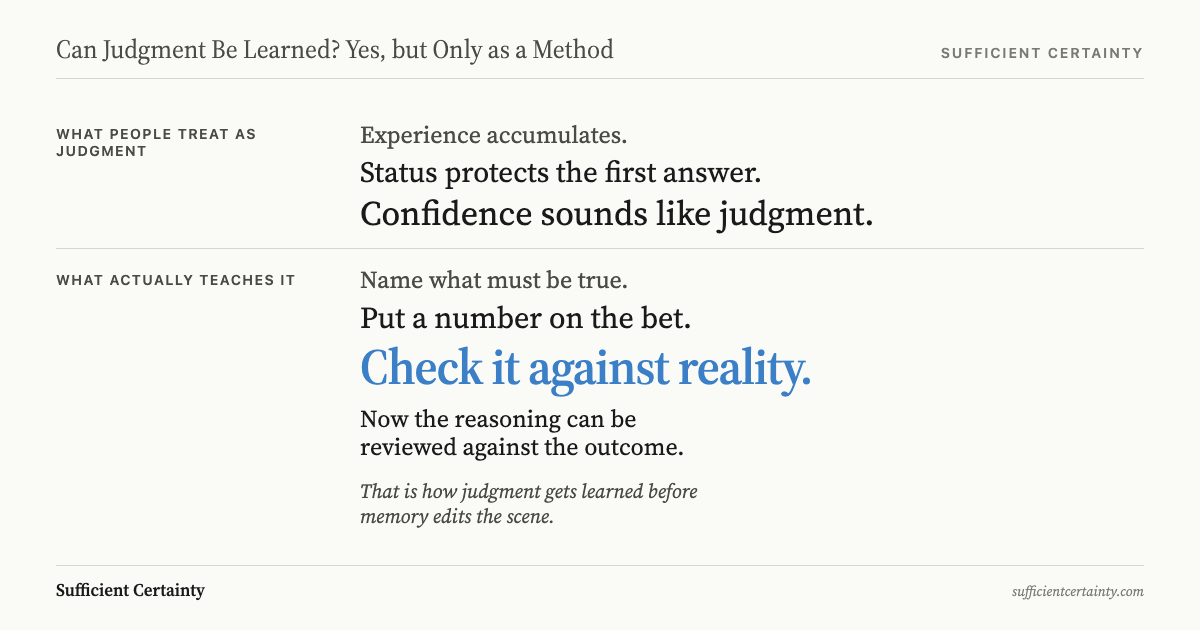
Can judgment be learned? Yes, but only as a method. If judgment is a trait, it cannot be taught, and organisations are left hiring for something they cannot define. A repeatable method makes the bet visible before the room commits, then checks it against reality. That is learnable.
A chief operating officer once asked me a blunt question while her team argued over whether to shut a production line for six weeks and rebuild it properly: can judgment be learned, or do we just keep promoting the people who sound calmest in the meeting? The paper was polished. The choice was not. She wanted to know who would still think straight after the spreadsheet stopped flattering them.
In a 2019 Psychological Science study, Alessandra Sellier, Irene Scopelliti and Carey Morewedge gave 290 graduate students a one-shot debiasing intervention. Later, in a field-style case where nobody warned them a bias test was coming, the trained group were 29 per cent less likely to choose the inferior hypothesis-confirming answer. That is method changing performance, not temperament revealing itself.
It embarrasses every executive who talks about judgment as if it were handed out with bone structure.
Judgment can be learned because every step that separates good calls from bad ones can be written down, practised, and improved with feedback.
Why can judgment be learned at all?
Can judgment be learned? Yes, because judgment sits in the work, not in the aura. People call it a trait because that excuses them from teaching it, which is a tidy arrangement for everyone paid to assess it after the fact (and invoice for the privilege). In my experience this is also where people muddle judgement and decision making. A decision is the wider job. Judgment is the quality of the testing inside it. Improve the testing and you improve the judgment.
That transfer result matters to me. Roger Estall and I wrote Deciding because too many organisations still treat judgment as a mysterious gift when the real defect is much plainer: nobody has written down what the preferred answer is assuming.
Can judgment be learned by experts who already trust experience?
A 2025 Scientific Reports study tested 71 national risk analysts and 118 risk-related master's students. The analysts outperformed the students, which is only fair given they were supposed to be the adults in the room, but both groups still showed confirmation bias and both improved after a structured debiasing intervention. Expertise had not removed the defect, a method reduced it.
That finding flatters nobody who treats seniority as if it were a vaccine.
What experience often buys senior people is not cleaner judgment but protection for the first answer. The room hesitates to embarrass it. Questions arrive late or in a watered-down form. I have watched weak proposals survive simply because they were spoken in the voice of somebody who had been around a long time. That is one reason smart people still make poor decisions under uncertainty. Status can keep a bad assumption alive long enough for everyone else to call it momentum.
Medicine shows the same defect. In a 2010 JAMA study, internal-medicine residents first made quick diagnoses and then reworked the cases using reflective reasoning. Second-year residents actually did worse on bias-triggering similar cases than on others, then improved when the process forced reflection. Experience gave them speed. Reflection cleaned up the judgment.
Years in the chair did not cure it. A process that forced reflection did.
Take a live call through the five steps and practise judgment as a method rather than a performance by the calmest voice. Start the Walk →
How can judgment be learned inside an organisation?
In the McDaniel meta-analysis, structured interviews predicted performance better than unstructured ones, .44 against .33, across 245 coefficients from 86,311 people. Once the criteria were made explicit, the judgment got better. This is awkward for the people who insist they can just "size someone up" over coffee.
I once watched a board split over an acquisition paper that looked perfectly respectable. The paper had the same numbers and the same timetable whichever executive spoke to it. One had written down what the cash-flow forecast depended on. The other had not. The first argument could be tested. The second could only be admired, which is often enough to get a bad deal moving. That gap is the whole of sound judgment in leadership.
Daniel Kahneman made the same point from the other direction in an interview about Noise. An insurance company gave identical underwriting cases to 48 underwriters. Executives expected about 10 per cent variation. They got about 55 per cent. That is not deep wisdom. That is roulette in a tie.
When people ask can judgment be learned inside a company, I give an answer nobody in the training market enjoys, least of all the people selling critical thinking courses. Keep a decision log and attach a number to the forecast. Then bring the same people back to face the outcome and explain what they missed. Roger Estall and I built the Universal Decision-Making Method to support that sort of discipline, not to decorate governance paperwork. The essence is simple: review the call against reality before memory edits the scene.
What I look for when judgment is being learned
A procurement director I worked with learned this the hard way. Early on he arrived with recommendations and defended them like verdicts. Six months later he opened differently. He would tell the room what had to be true for his answer to hold, then name the point at which he would revisit it. His recommendations got better because the conversation stopped circling his confidence and started testing the bet.
That is what I look for now. I do not ask whether a person sounds decisive. I ask whether they can state the assumption clearly enough to be wrong in public. People who are learning judgment can do that. They can tell me what would change their mind, and they do it before events force the humiliation for them.
When Roger Estall and I wrote Deciding, we were trying to pull judgment out of mystique and into review. In my experience the learning starts at a very unglamorous moment, the room writes down the bet and later has to face what happened. That is my wider argument about sound judgment: it gets learned the moment a room stops admiring confidence and puts the bet in writing.
You could keep promoting the calmest voice and miss the method your next call needs.
Work through your decisionNo sign-up. Just pick your decision and start.
Grant Purdy is the co-author, with Roger Estall, of Deciding (2020), and the architect of the Universal Decision-Making Method.