
Explaining a decision to your team fails when nobody recorded what the call rested on while it was still live. A manager who rebuilds the reasoning from memory in front of the room is not explaining. They are improvising, and the team hears it as defensiveness or concealment.
Most advice on how to explain a decision to your team is about tone. The harder problem comes earlier. If nobody wrote down what the call rested on, you are not explaining a decision in that room, you are rebuilding one from memory while people watch. That is what a team hears as defensiveness.
It gets worse when the decision came from above, because then you are carrying reasoning you were never given in the first place.
This is not only a small-team failing. When the US Government Accountability Office reviewed the IRS estimates of identity theft refund fraud, it could not find the reasoning behind them. Different assumptions moved the figure by billions, and officials said documenting which ones they had used would have cost time they did not have. If that can happen to a federal agency under audit, it can happen to a call handed to you on a Monday morning.
Explaining a decision to your team is setting out the reasoning the call rested on, including the alternative it beat and the conditions that would reopen it.
Why Most Advice on How to Explain a Decision to Your Team Fails
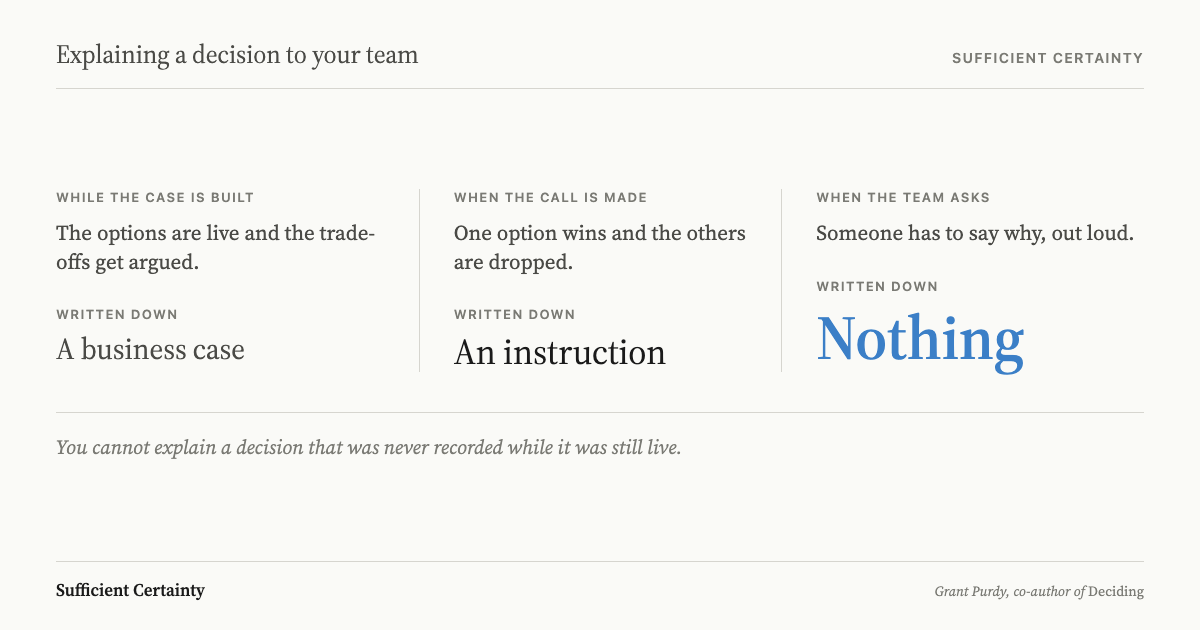
If you are still working out how to explain a decision to your team after the meeting invite has gone out, the meeting is already doing secondary damage. Anyone who has sat through that performance knows the look of it. The speaker keeps circling back, adds explanation where none was asked for, and sounds like counsel reading from missing pages.
The better model is dull in the best possible way. Microsoft's guidance on architecture decision records says to start the record when the work begins, keep it through the life of the decision, and treat it as append-only. Record the context and live options, then state the outcome and the trade-off it accepted. That is ordinary record-keeping, which organisations drunk on templates have somehow managed to make sound exotic.
I have watched organisations spend real money on change packs, cascade decks, and briefing notes, then leave the actual reasoning in a senior person's head. That arrangement protects the executive who made the call and the consultant who sold the pack, along with the approvals theatre wrapped around both of them. It does not protect the manager sent into the room at 8:59 to explain the mess. Bad machinery usually has beneficiaries. In this case they are rarely the people doing the explaining.
Roger Estall and I wrote Deciding because too many organisations mistake collected signatures for thought. A file that proves the right people initialled the paper is useless when the first serious question is, "What was this call actually resting on?" The answer has to be somewhere more substantial than the memory of the most senior person present.
What Your Team Is Actually Testing
Your team is testing whether the call had a basis and whether you are willing to show it. They may dislike the outcome, but the first trust question is cruder than that: was this decision made on purpose, or did somebody simply get their preference over the line? In a meta-analysis covering 183 studies, Colquitt and his colleagues found strong links between perceived fairness of process, quality of explanation, and trust in authority. People do not need a perfect outcome before they trust a call. They do need some reason to think it was not arbitrary.
That is why the room tightens when you cannot say what serious alternative stayed alive, or what would have had to be true for that other path to win. Missing that answer makes the whole exercise look like preference with stationery wrapped around it. I have sat in too many boardrooms where that was exactly the arrangement, dressed up with more formatting and better coffee.
Writing the explanation before the meeting also improves the decision itself. Isler, Yilmaz, and Dogruyol ran a 1,748-person experiment and found that asking people to justify a decision improved their reflective thinking. I did not need a journal to tell me that weak reasoning dislikes daylight.
Take the decision you have to explain this week and work out what it actually rested on, before the room asks you first. Start the Walk →
The Page I Would Build Tonight
If I had to walk into that meeting tomorrow, I would build one page before I rehearsed a sentence. One page is enough because the point is not to create another management relic that nobody reads. The first line says what decision had to be made. The second says what serious alternative stayed live until the end. If those two lines come out muddy, you are not ready for the room, and no amount of vocal warmth is going to rescue you.
Then I would write the basis of the call in ordinary language. Write the bet, then write the fact that would kill it. That keeps the record close to the heart of assumptions in decision making without turning the meeting into a lecture. It also sits squarely inside the Universal Decision-Making Method. If the reasoning cannot survive one sheet of paper, it will not survive a tense meeting with people whose week has just been rearranged by it.
The IRS did not stay where that review found it. It moved to a signed decision memorandum for the significant estimates and a shorter template for the day-to-day calls, which is what sensible people do once the first embarrassment has landed. Scrutiny does not make undocumented reasoning more respectable, only more visible.
If the decision came from above, I would still make the page. I would state the objective I was handed and the option that was chosen, then mark plainly where my knowledge of the reasoning runs out. Then I would write the unanswered question beside it. Pretending you know more than you do is the cheap trick. Marking the gap and taking the question back for a real answer is how to explain a decision to your team when the decision was somebody else's. Teams can forgive a limit. They do not forgive bluffing for long.
I would also add one line on what will be watched after implementation. People want to know whether reality still gets a vote, or whether the organisation plans to treat this as settled because the slide deck has already been approved. A decision that cannot be revisited as evidence changes becomes brittle, which is why monitoring belongs on the page before anything is rolled out.
How to Explain a Decision to Your Team When the Room Turns
In the room, start with what won and why. Then say what nearly won, and what would have had to be true for that other path to beat it. You can do this in plain speech: "We chose this because it gave us the best chance of achieving X. We nearly chose Y, and we would have done if Z had been true." That small act changes the atmosphere because it shows there really was a decision here, not merely an announcement delivered after the interesting part had been hidden elsewhere.
Next, say what is still uncertain in language a tired operations manager can follow before their coffee has done its job. I do not mean a long recital of caveats. I mean the part of the call carrying the most weight right now. In my experience, the temperature drops as soon as people hear that you know exactly where the weak spot is. They may still hate the decision. At least they stop wondering whether anyone has actually thought about it.
If you did not make the decision, say that early and without a small speech about how complicated things are. Carry the rationale you were given as faithfully as you can, and stop where your knowledge stops. Your job is not to counterfeit certainty on behalf of somebody more senior, because that is how to explain a decision to your team badly and lose trust twice, once with them and once with yourself. Honesty is the only version that survives the second question, which is usually the one that matters.
Most of the pain starts long before anybody walks into the room. The meeting merely exposes whether the reasoning exists, which is why this is really a decision quality problem. A sound decision can survive being said aloud; a bad one needs theatre.
You could stand in front of your team tomorrow and invent reasons you cannot defend.
Work through your decisionNo sign-up. Just pick your decision and start.
Grant Purdy is the co-author, with Roger Estall, of Deciding (2020), and the architect of the Universal Decision-Making Method.