
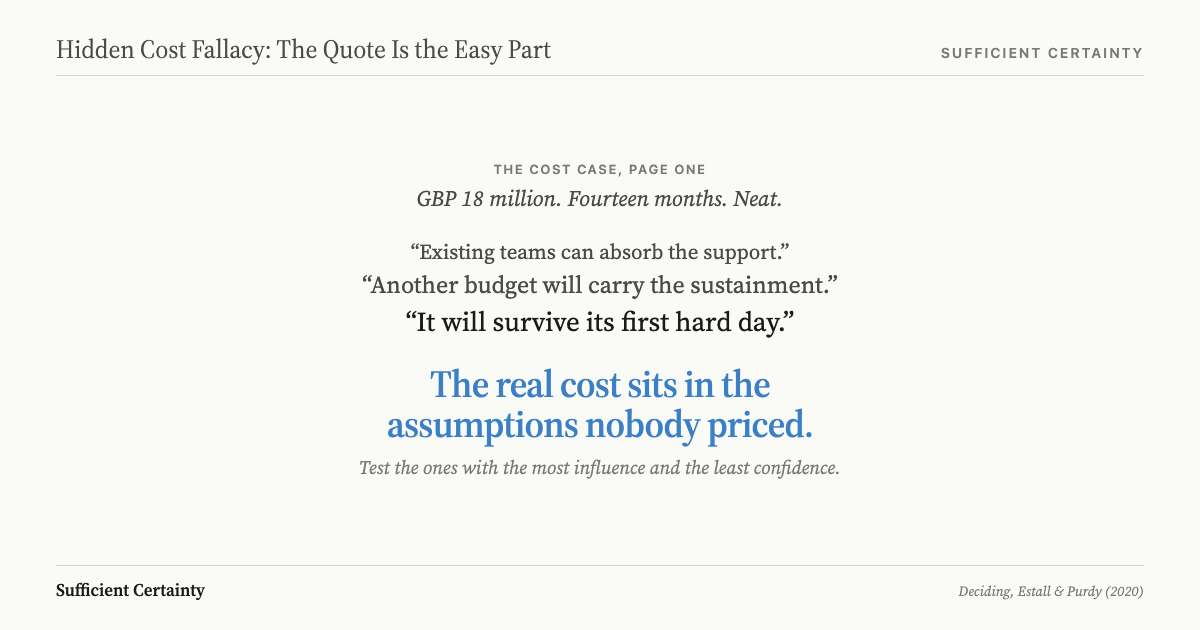
Hidden cost fallacy begins when the quoted price is treated as fact. The real cost sits in the assumptions nobody priced: staff retraining, interface rework, the twelve months of parallel running that no vendor mentions. A forward-looking test of those assumptions is worth more than a sharper quote.
I once watched a board approve an enterprise system on the strength of a GBP18 million quote and a 14-month timetable. The paper said post-go-live support would be absorbed by existing teams, which is a lovely phrase when the aim is to hide the bill until after the signatures are dry. Six months later the software was still the cheap part. The expensive part was the business change nobody had priced. That is the hidden cost fallacy.
The headline number is rarely what breaks the decision. The damage sits in the operating claims nobody had to defend, which is exactly where the Universal Decision-Making Method goes looking.
I do not mean the sort of petty surcharge people complain about in consumer life. I mean the bigger concealment inside organisations. The number on page one is treated as fact, while the staffing burden or the recovery burden is left floating as though it will sort itself out. It usually sorts itself out onto someone else's desk.
This suits the people who need approval to happen. The vendor gets a cleaner number. The internal sponsor gets the program away before the awkward questions arrive. The repair work can always be sold later (funny how often that miracle occurs), usually to operations first and finance after that, because broken machinery rarely lacks volunteers when the invoice is delayed.
The hidden cost fallacy is the habit of treating a quoted price as the whole cost while the assumptions carrying that price stay buried and untested.
Why the hidden cost fallacy survives the first spreadsheet
The GAO cost estimating guide says a credible estimate covers the full life cycle and exposes missing cost elements. That should be embarrassingly obvious. It still has to be written down because committees keep blessing partial prices and calling them analysis. If the estimate leaves out the part that will cost money later, it is a sales document. Someone has simply pushed the awkward number off page one and hoped governance would not go looking for it.
Once the number is blessed, the omissions get redistributed. Support lands on operations. Rework lands on the project team. The same trick sits inside the broader sunk cost fallacy: the decision is mispriced before the spend is even sunk.
I treat this as a governance honesty problem. If the room will not ask which buried condition is carrying the quoted cost, the spreadsheet becomes formatted permission to approve something half-priced.
Price your actual purchase through the five steps and expose the fragility, rework, and operating cost missing from the quote. Start the Walk →
The hidden cost fallacy in aircraft and software
GAO's 2024 review of the F-35 program said projected life-cycle sustainment cost had risen from about USD1.1 trillion in 2018 to USD1.58 trillion in 2023, while planned use and availability both fell. Acquisition stories stay clean because sustainment pain can be parked in another budget line and another meeting. The jet is bought up front, the burden arrives later in overalls.
People call that an overrun, which is a polite way of pretending the cost materialised from nowhere. It did not. The hidden cost fallacy let maintenance and readiness stay dressed as detail until procurement pride made the assumption awkward to reopen. By the time the burden starts shouting, the organisation is usually slipping into sunk cost and decision making, but the original concealment happened at approval.
Birmingham City Council's June 2025 Oracle reimplementation report tells the same story in office clothes. The program started with a GBP86.5 million budget, had already spent GBP63.4 million before reimplementation, later reached an approved envelope of GBP131 million, and then picked up GBP15 million a year in ongoing support from 2026/27. I have yet to see an ERP quote that prices its own embarrassment bill, or the internal clean-up crew that arrives after the launch deck has gone home.
Fragility is a hidden cost even when operations look cheap
The U.S. Department of Transportation's Southwest order said the airline cancelled or significantly delayed more than 16,900 flights between 21 December 2022 and 2 January 2023, disrupting more than 2 million passengers. Later DOT said Southwest paid more than USD600 million in refunds and reimbursements, and imposed a USD140 million penalty. Cheap operations look clever until winter asks them to work.
Southwest was paying the bill for an operating model that assumed crew recovery and customer support would somehow keep up. That assumption was convenient for the people selling efficiency and less convenient for the passengers sleeping on terminal floors.
In my experience, the question is whether the operating model is strong enough that the downside is tolerable on its first hard day. If the answer is shaky, the low operating cost is bait for an approval that fails as soon as real conditions arrive.
How I make hidden costs show themselves
I do not ask for a prettier spreadsheet. I ask which buried condition is carrying the quote. "Support can be absorbed" is not reassurance, it is a claim about capacity that somebody should have had the decency to test. "Go-live in 14 months" is a claim about data readiness. Once the sentence is written properly, the romance goes out of it.
Roger Estall and I wrote Deciding because boards kept mistaking tidy prices for knowledge. The Universal Decision-Making Method drags that buried burden into the open by forcing us to Recognise assumptions and judge Sufficient certainty before we approve anything expensive. When someone mutters that I am slowing the meeting down, it usually means I have asked who carries the support bill after the applause dies.
We Design monitoring before implementation so the trigger to reopen the decision is agreed while everyone is still pretending the quote was accurate. After launch, sponsors want approval left alone, and vendors are happy to sell phase two while operations carries the burden. Nobody is keen to tell the board that page one was fiction, which is useful to everyone except the people who inherit the work. That is how hidden cost turns into sunk cost bias and then into ritualised denial.
A low quote is easy to approve because the real cost has been posted forward to future operations with no forwarding address. Calling that thrift is polite nonsense.
You could sign the quote and meet the real bill after go-live.
Work through your decisionNo sign-up. Just pick your decision and start.
Grant Purdy is the co-author, with Roger Estall, of Deciding (2020), and the architect of the Universal Decision-Making Method.