
How to get buy-in from leadership is the wrong question to start with. A pitch invites opinion. State the decision you need, name the assumption it depends on, and show whether that assumption holds. Leaders approve faster when you bring a tested claim than when you bring a persuasion deck.
How to get buy-in from leadership is the wrong question to start with. A pitch invites opinion. State the decision you need, name the assumption it depends on, and show whether that assumption holds. Leaders approve faster when you bring a tested claim than when you bring a persuasion deck they cannot verify.
I sat in on a presentation last year where a senior manager pitched her executive team on consolidating two regional offices. She had scenario modelling at three confidence levels, endorsement from an external advisor, and results from a six-month pilot showing a 20% cost reduction across two sites. The committee thanked her, asked for time to reflect, and never scheduled the follow-up. She told me the politics had killed it. I told her it was not politics. She had never shown anyone how to get buy-in from leadership on that recommendation because she had never stated what it assumed.
When I asked her to write down what the plan needed to be true, she went quiet. She had argued why the consolidation was good without naming the beliefs it depended on. The problem was not her delivery. The problem was structural.
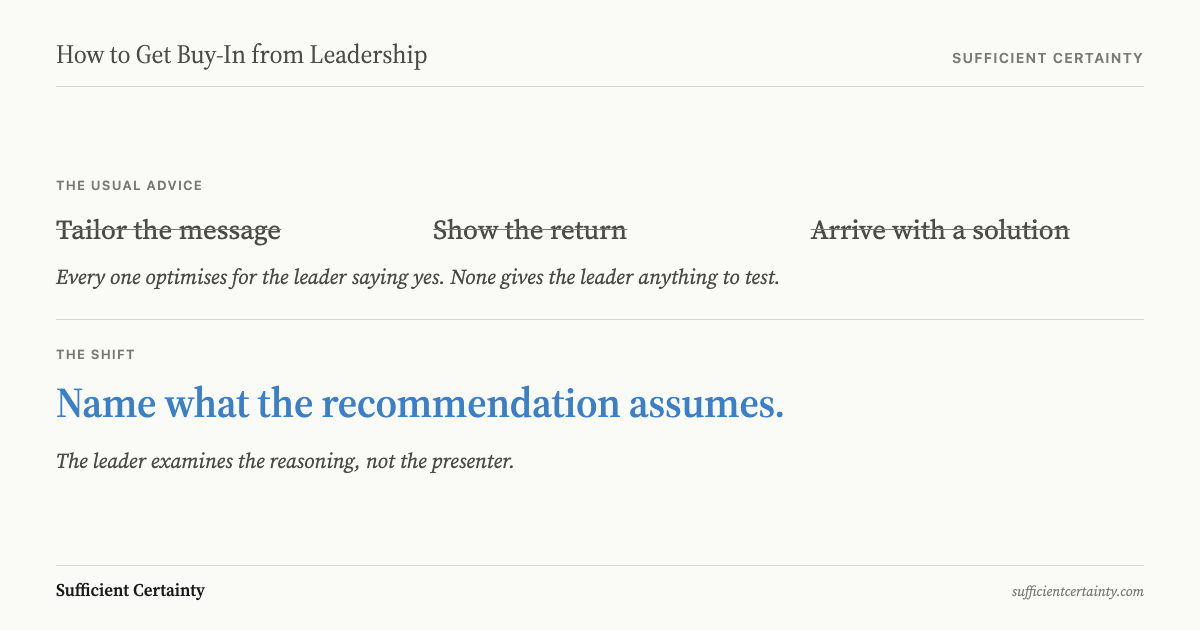
Most advice on how to get buy-in from leadership treats the leader as a gate you push through with better delivery. Tailor the message. Show the return. All of that optimises for the leader saying yes. None of it gives the leader anything to test. When a leader cannot see the assumption underneath the recommendation, the only rational response is caution. The polite nod means the leader has nothing to decide on.
Leadership buy-in is a senior decision-maker's commitment to act on a recommendation after examining what it assumes, not approval extracted through a better argument.
The assumption Blockbuster's board never tested
In 2000, Reed Hastings and Marc Randolph walked into Blockbuster's headquarters and offered to sell Netflix for $50 million. They proposed a partnership: Netflix would run the online business, Blockbuster would keep the stores. John Antioco's team reportedly suppressed laughter. He called Netflix a "niche business," dismissed the offer, and moved on. Blockbuster filed for bankruptcy in 2010. Netflix is now valued above $150 billion.
The standard lesson is that Antioco was arrogant or short-sighted. I do not think he was either. I have watched smart leaders dismiss sound proposals for the same reason: nobody showed them the assumption they were actually betting on. Hastings and Randolph pitched the deal. They argued why the partnership worked for both companies. What nobody placed on the table was the assumption Antioco's entire strategy rested on: that Blockbuster's late-fee, foot-traffic retail model would remain durable against digital distribution for the foreseeable future.
That assumption was load-bearing. If it held, dismissing Netflix was sensible. If it did not, Blockbuster was already on borrowed time regardless of any partnership. But nobody wrote it down. Nobody asked Antioco to examine it. The room debated whether Netflix was worth $50 million. The question that actually determined Blockbuster's survival, whether physical rental had a decade left, was never stated and never tested. The answer arrived as a bankruptcy filing.
I saw the same pattern with the senior manager and her pilot results. She had built the case for the plan without stating what it needed to be true. The standard pitch format does not make room for the beliefs a recommendation depends on. That is precisely what a Decider needs in order to approve with confidence: a visible statement of what the plan is betting on.
Why getting buy-in from leadership looks like a sales problem
The most cited article on this exact question is Ashford and Detert's "Get the Boss to Buy In" in the Harvard Business Review (2015). It distils seven tactics for middle managers, from tailoring the pitch to the decision-maker's goals through to arriving with a solution rather than a problem. Every one of the seven optimises for the leader saying yes, and none asks whether the leader understands what the plan assumes.
The academic roots run deeper. Dutton and Ashford's "Selling Issues to Top Management" (Academy of Management Review, 1993) framed the entire task as a competition for scarce leadership attention, analysed through three theoretical lenses all centred on influence and impression management. The field has spent three decades theorising how to sell upward and calling it management science.
An entire industry of presentation coaches and executive communication consultants has grown around this frame. They get paid whether the leader approves or not, so the pitch never has to survive scrutiny. They begin from the same premise: the recommendation is sound, and the problem is that the leader has not been sufficiently persuaded. Nobody pauses to ask whether the leader was given anything to examine besides the presenter's confidence. That is a structural confusion between agreement and understanding, and it explains why competent people keep leaving meetings empty-handed.
Write down what your recommendation needs to be true and hand it to the leader before the meeting begins. Start the Walk →
What happens when you write the assumption down
Amazon does not use slide decks for internal decisions. Proposals are written as six-page narrative memos. Meetings open with a silent reading period where every executive reads the full document before anyone speaks. Jeff Bezos described the format in his 2017 letter to shareholders.
The memo forces a writer to state assumptions in full sentences that can be read, re-read, and challenged. A slide deck lets the presenter control the pace and skip past the weak part. The memo removes that control. Every claim sits on the page with equal weight, and the leader reads the reasoning at their own pace before the room starts talking.
The strongest communicator in the room dominates a slide presentation; the strongest reasoning dominates a written memo. I have seen boards approve terrible plans from charismatic executives and reject sound ones from people who were simply nervous at the lectern. The memo format does not fix personality. It removes personality from the judgement chain.
I have spent nearly fifty years working on how organisations make decisions. When a recommendation arrives as a performance, the leader evaluates the performer. When it arrives as a written statement of reasoning with its assumptions named, the leader evaluates the reasoning. Amazon understood that distinction and built a format around it. Most organisations have not.
The Universal Decision-Making Method formalises this. The third step asks the Decider to recognise the assumptions a tentative decision rests on, which is a different task from listing risks or scoring them on a coloured matrix. It means naming what the plan believes to be true, so that the Decider can test whether that belief is sound enough to act on.
What leadership buy-in actually requires
The practical mechanism is not complicated. Before the meeting, write down what your recommendation needs to be true in order to work, as distinct from what it proposes or what it costs.
If you are recommending a new market entry, the assumptions might include that the regulatory environment will remain stable for eighteen months and that the supplier contract can be extended on current terms. Those are load-bearing beliefs underneath the plan. If either turns out to be wrong, the recommendation fails regardless of how well it was argued in the room.
A useful test: if you removed the assumption and the plan still worked, it was not really an assumption. If removing it would break the plan, write it down. Put it in front of the leader in plain sentences. Let the leader read it, test it against what they know, and tell you which assumptions they accept and which ones they do not.
That is the conversation that produces buy-in from leadership. The moment a leader sees the assumption and can examine it, the decision stops being about whether the presenter was persuasive and starts being about whether the premise holds. The distinction matters because assumptions can be tested against evidence, while belief in a plan is unanswerable.
Stakeholder alignment works when the people who must act on the decision understand what it assumes, not merely agree that it sounded convincing in the room.
Consensus is the most expensive version of this mistake: everyone agrees without understanding, and the plan drifts from the moment it leaves the room.
If your leadership team rejected your last recommendation, do not go back with a better pitch. Go back with a written list of what the recommendation assumed. The leader was not against the plan. The leader had nothing to examine.
You could refine the pitch deck and still leave the leader with nothing to examine.
Work through your decisionNo sign-up. Just pick your decision and start.
Grant Purdy is the co-author, with Roger Estall, of Deciding (2020), and the architect of the Universal Decision-Making Method.