
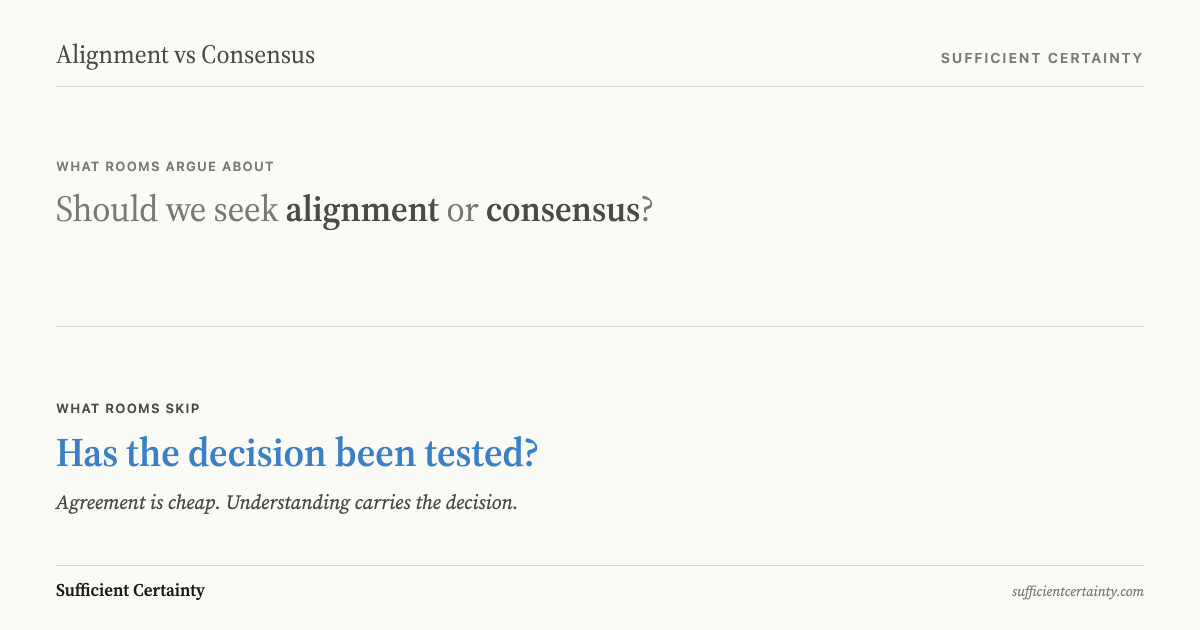
Alignment vs consensus is not a style preference. Both labels often cover the same failure: the room asked for commitment before it tested the one assumption that could still break the decision. Consensus waits for agreement. Alignment checks that each person can state the call and say what would reopen it.
Alignment vs consensus is not a style preference. Both labels often cover the same failure: the room asked for commitment before it tested the one assumption that could still break the decision. Consensus waits for agreement. Alignment checks that each person can state the call and say what would reopen it. Only one of those can be verified.
A department head I worked with came out of a 94-minute meeting with a compromise nobody believed. He asked me whether this was an alignment vs consensus problem. It was the wrong question. The room had asked for commitment before it had exposed the one assumption that could still break the decision.
I see this constantly. Teams talk as if consensus is the slow option and alignment is the fast one. Both labels often cover the same failure. Nobody has done the work that lets a dissenting fact either kill the decision or strengthen it, so the meeting reaches for a social answer to an unfinished factual problem.
Alignment means the people who must act on a decision understand what was decided and what it assumes. Consensus means the group deliberates until it reaches a position everyone can accept. The question is which standard a decision actually needs.
Alignment vs consensus starts with the hidden fact
Consensus often hides the fact nobody wanted to test the one detail that could still sink the call. Most rooms drift toward the information everybody already shares and step around the awkward point held by one person at the edge of the table.
Research shows the same bias. In a meta-analysis of 65 hidden-profile studies, Lu, Yuan, and McLeod found that groups discussed shared information about twice as often as unique information, and hidden-profile groups were about eight times less likely than manifest-profile groups to identify the best option. That matters because a room can sound diligent while it is only repeating itself. Shared information creates the feeling of coverage, which is why bad consensus can masquerade as careful work.
Schulz-Hardt and colleagues found the same weakness from the other direction. In their 135-group experiment on dissent, decision quality improved when disagreement stayed alive long enough to force a harder discussion. The improvement came from less bias and more pressure on the favourite option, rather than because the meeting was better chaired.
The practical consequence is brutal. Once a meeting starts treating the stray fact as a social irritation, the conversation turns away from the decision and toward the person raising the trouble. The group feels informed because it has heard the same evidence from five mouths. The one fact that should slow the room down starts to look rude.
That is why I get impatient when people ask me for the alignment vs consensus answer after a bad meeting. I ask a ruder question. Which fact in that room was still being protected from scrutiny when the chair tried to close the matter? Until that fact is surfaced, the process argument is camouflage.
Process language usually appears after the room has already ducked the hard point. Once that happens, alignment becomes the polite word for carrying an unresolved decision, and consensus becomes the polite word for asking everyone to share the risk of a call nobody really tested. The room does not need more stakeholder meetings. It needs a harder conversation in the one it already has.
Run your team's disputed call through the five steps and surface the hidden fact consensus keeps covering over. Start the Walk →
Consensus is useful when the stakes justify the delay
Consensus can be worth its cost, but stop arguing about alignment vs consensus until the decision has been tested hard enough for the stakes.
The Iraq Inquiry records that there was no March 2003 Security Council consensus for military action and says that, had the matter been left there, military action might have been postponed and possibly avoided. For a grave decision that could not be recalled, missing consensus showed the case had not yet carried its own weight. Delay was part of the evidence.
I have little patience with the instruction to disagree and commit when the decision is still soft. Commit to what? If the owner is clear and the decision is easy to revisit, full agreement may be unnecessary. If the consequences are close to permanent, the lack of consensus may be the most useful warning the room has produced.
Reversibility changes the threshold. When authority is genuinely shared, or when the downside is hard to unwind, delay is part of deciding well. I do not ask every operational call to wait for universal assent. I do expect serious decisions to survive hard testing before anyone starts policing the mood in the room.
Rooms often use consensus as cover for the fact nobody wants to own the call alone. If everyone nods, nobody has to say plainly who carries the consequences when the key assumption fails.
That is also why the Universal Decision-Making Method separates testing the decision from carrying it out. Consensus has a job when it exposes weak reasoning before commitment hardens around it. Without that job, consensus is mostly a comfort device.
I care less about how harmonious the meeting felt than about whether the decision changed under pressure. A difficult exchange that moves the answer is useful. A smooth exchange that leaves the favourite option untouched should make you suspicious.
Alignment vs consensus failed at HealthCare.gov for a simpler reason
HealthCare.gov is a better lesson in alignment because the launch failed in public. Nobody looking at that program would say the problem was too little consultation. The system had ample participation and more than enough warning. What it lacked was clean ownership of the call.
The HHS Inspector General review interviewed 86 officials and contractors and called the absence of clear leadership the most critical problem. It also notes that the site recovered for high consumer use within two months once the work was reorganised around clear priorities, and that 5.4 million plan selections were made by the end of the first open-enrolment period. Once one owner could rank the work, warnings had somewhere to land and trade-offs could finally be made.
Before the recovery, warnings could circulate as updates with no owner forced to reconcile them. After the reorganisation, one person could decide which problem mattered first and which promise had to give way.
I have seen this move in smaller rooms too. One fact stays unresolved, then the room starts talking about alignment because that sounds more respectable than admitting the decision is still unfinished. The chair gets closure and the sponsor gets clean minutes, while the people doing the work inherit the muddle. Later they are the ones asked why the plan never hung together.
Much of what passes for organizational alignment is a neat pile of approvals and sign-offs that comforts the sponsor while leaving the work itself unclear. The paper trail says the meeting was settled. The schedule and the frontline work discover later that the hard question was never resolved. If you want the sponsor to commit rather than merely approve, start by naming what the proposal assumes.
Support turns dangerous when stakeholder buy in becomes a campaign to make the room feel settled before the decision can survive scrutiny.
Real alignment begins after the meeting ends
Stakeholder alignment starts after the decision, not while the room is still haggling over options.
By then the contest is over. The question is whether the people who must do the work are aligned enough to start execution without inventing their own version of the call.
When I want to know whether a team is aligned, I ask someone outside the meeting to tell me what was decided, what had to stay true for it to work, and what result would make the owner revisit it. If the answer comes back as mood, personalities, or vague intent, the room settled nothing. People can only act cleanly when the call and the live assumption travelled beyond the table. Exposing that weak point early matters more than polishing support later, which is why I care about managing disagreement in teams.
Real alignment shows up when the people doing the work tell the same story about the decision on Tuesday morning, when the sponsor is absent and the old disagreement starts to bite again. False alignment collapses there.
Roger Estall and I wrote Deciding after watching committees ship decisions with contradictions still inside them. The people who pay are usually the ones furthest from the vote. They have to make the thing work, and they take the blame when two respectable approvals collide in practice.
Committee harmony is cheap for the people who can leave the room after the vote. It is costly for the team that has to turn a blurred instruction into deadlines, contracts, or code, and costlier still when the committee defers the call to a further round. They inherit the uncertainty in working form.
If you want the method beneath this argument, start with the Universal Decision-Making Method. It separates testing the decision from carrying it out, and it gives disagreement somewhere useful to go.
You could chase alignment in the next meeting and still leave the decision untested.
Work through your decisionNo sign-up. Just pick your decision and start.
Grant Purdy is the co-author, with Roger Estall, of Deciding (2020), and the architect of the Universal Decision-Making Method.