
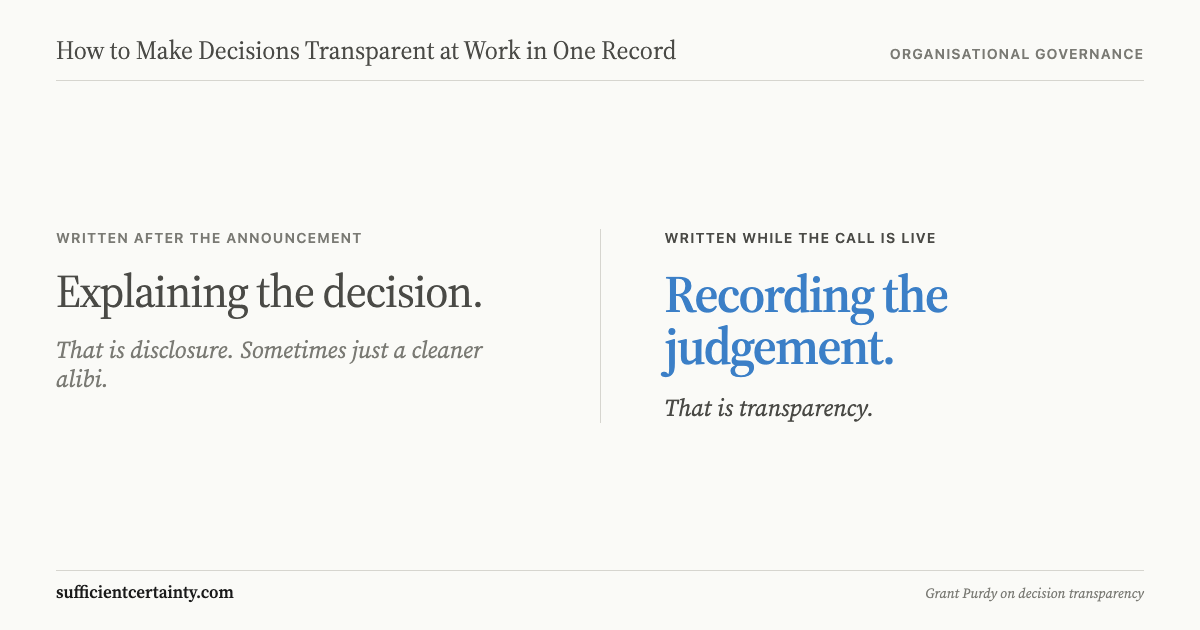
Making decisions transparent at work fails when nobody recorded the reasoning while the call was still live. A transparency policy published after the fact is reconstruction, not transparency. The record must exist before the outcome arrives, or the team will always suspect the explanation was written to fit the result.
A director I worked with had just told 70 staff that a software rollout was dead. The vendor had been chosen in February, the steering group had met six times, and the note to staff said the program had been paused after careful review. By lunch she had eight replies asking who made that call, and what had changed after three months of being told the work was on track. That is the real problem behind how to make decisions transparent at work.
Most advice tells you to explain the decision better after the shouting starts. I think that is backwards. If nobody wrote down who was making the call and what the call depended on, you are not fixing transparency after the event. If the trigger for reopening it is missing as well, you are writing a better alibi. The same gap is what makes explaining a decision to your team so uncomfortable when the moment arrives.
Transparent decision-making at work is the practice of recording who owned a decision and what it depended on, in a form other people can inspect.
Transparent decisions start before the announcement
It starts before the announcement because the announcement is just disclosure. The hard part is keeping a record while somebody can still challenge the call. Once the decision lands badly, the sponsor starts cleaning up the story and the senior person who nodded it through becomes hard to find. Comms then gets asked to turn uncertainty into reassurance, which is a ridiculous brief and very convenient for the people escaping ownership.
The U.S. Government Accountability Office found exactly that inside the Patent Trial and Appeal Board. Judges and stakeholders could not reliably tell who had reviewed draft decisions or how much management had shaped them, which meant the influence inside the process stayed hidden even when a final decision was visible.
A rationale can be polished until it squeaks. That does not make it honest. Show me the assumption you were leaning on, and show me why you stopped looking for more information when you did. If those two things are absent, the document is just office politics after a wash.
Take the decision you are about to announce and write down the assumption it rests on before anyone asks you. Start the Walk →
How to make decisions transparent at work with one short record
I keep the record to one page because anything longer becomes a hiding place. Start with the call and the person who owned it. In serious organisational governance, that ownership has to be visible. When the name is missing, the paper is already lying, and committee chairs often prefer that blur because it lets them borrow authority without carrying blame.
Then write the live assumptions, not the whole folder. On a payroll migration, the live assumption might be that the new system can handle award complexity without a custom build. On a hiring freeze, it might be that attrition will carry the work for one quarter. That is what turns a file note into a usable decision record. It is also where consultants love to get decorative. A 40-page appendix looks impressive right up until the decision fails on the one assumption nobody wrote plainly.
We called the next part Sufficient certainty when Roger Estall and I wrote Deciding, because adults decide under incomplete knowledge and should stop pretending otherwise. The question is not whether you knew everything. The question is what you needed to know before acting, and why that was enough at the time. I use the same test in the Universal Decision-Making Method, and it is where records often become suspiciously vague.
Finish with the review trigger and the person watching it. I want one threshold and one event, not a hymn to adaptability. A 15 per cent cost jump should force a review; so should a regulator turning a draft rule into a real one. Without that, the team has no fair way to tell whether the decision has stopped being good.
The U.S. GAO found the same weakness in the Bridge Investment Program. Final selection memos existed, but many sampled score narratives were too thin to support the scores, which is precisely how you end up with a decision that looks official and still cannot survive a sensible challenge.
What stays confidential when you make decisions transparent at work
Plenty can stay confidential. Personal salary details stay private. So do privileged legal advice or parts of a live negotiation. Transparency breaks down only when confidentiality is used to hide the logic of the choice.
The European Medicines Agency handles this sensibly. It publishes a defined core package, labels redactions, and requires justification for them. That is adult transparency. People can see the boundary, which is more than most organisations manage internally.
Inside an organisation, I would keep a shareable record for the reasoning people need and a bounded confidential annex for the material that would breach privacy or wreck the bargain. Say what category was withheld and why. Most staff do not need the whole dossier. They need enough to see that the call was not pulled from a hat, and enough to know what would change it. That is also where people muddle governance vs management and pretend ordinary explanation is somehow dangerous. Do not hide behind the word sensitive, which is the oldest trick in the managerial toy box.
Even the open-book management camp stops short of publishing everything. The National Center for Employee Ownership's summary points to firms that share usable numbers while still holding back individual salaries, which is sensible.
How to repair a decision that has already landed badly
If you are trying to work out how to make decisions transparent at work after staff pushback, start by reconstructing the record honestly. The usual move is to blame communication, because that is cheaper than admitting the decision basis was thin and nobody wrote it down. If the reconstruction embarrasses somebody senior, good. That usually means status was doing work that the reasoning could not. Name the person who made the call. Then write what the organisation believed at the time and what evidence was still missing when it acted.
This is awkward because it shows whether the decision was ever sturdy. I would rather have an irritated team reading an honest record than a soothed team reading fiction. People can live with uncertainty. What they resent, rightly, is being asked to carry the consequences of a choice whose reasons keep improving after the event.
Sometimes the reconstruction gets uglier the longer you look, because the executive sponsor's story improves with every retelling and the adviser who sold another governance layer still cannot point to the actual judgement it was supposed to support. Comms is then left polishing indecision into confidence, which is a rotten job and usually a doomed one. Say plainly that the record was not kept. Then admit what is now being reconstructed, and attach the new monitoring to named people.
Most searches for how to make decisions transparent at work begin after trust has already taken a dent. I would not answer that with a culture program or another transparency charter, because the people selling those fixes usually benefit from keeping the machinery vague. Record the next contested decision while it is still live, and leave the weak points visible so the explanation afterwards does not have to be invented.
You could announce the decision and spend a week explaining reasoning you never wrote down.
Work through your decisionNo sign-up. Just pick your decision and start.
Grant Purdy is the co-author, with Roger Estall, of Deciding (2020), and the architect of the Universal Decision-Making Method.