
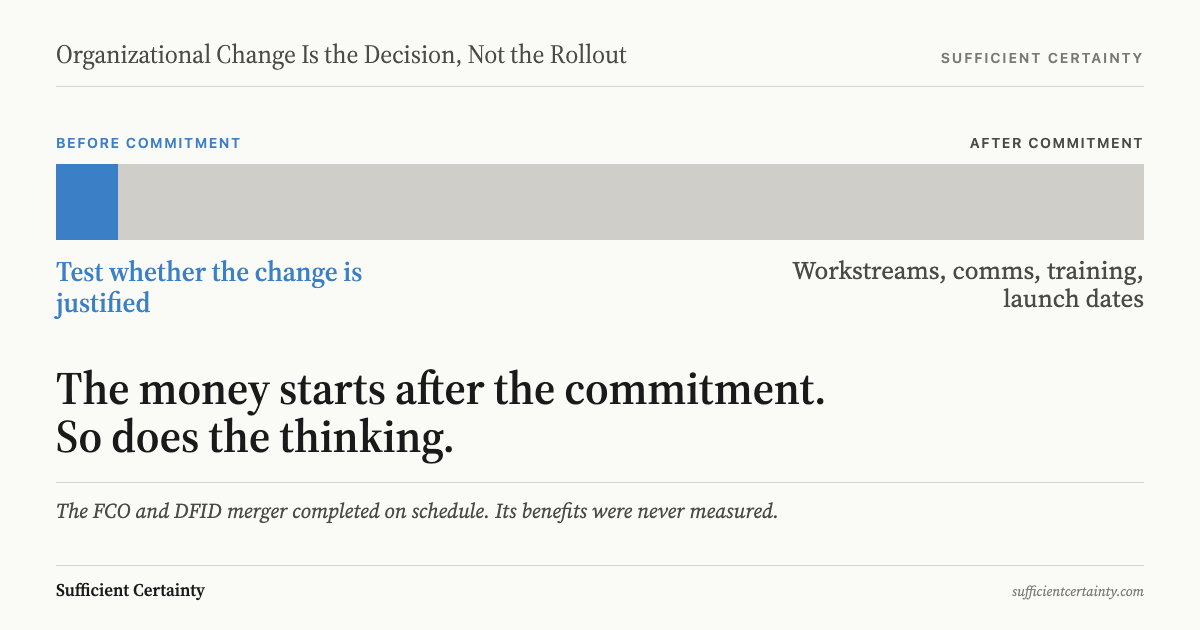
Organizational change is the decision to alter how an organisation works. The rollout is what follows. Most organisations treat the rollout as the change and skip the step where someone tests whether the original decision was sound enough to deserve the disruption it is about to cause.
Organizational change is the decision, not the rollout. Most organisations treat change as a communications challenge that starts after someone has committed. The harder question comes earlier: is the commitment itself sound, what assumption does it rest on, and what must be true for the new state to hold. Skipping that question is how change programmes fail.
Organizational change usually reaches you in a meeting where the executive announces the restructure as settled and hands you the plan. The budget line has moved, the launch date is already in the deck, and your part of the conversation starts with dates and staffing. If you are sitting there, start by asking whether the change itself ever earned commitment.
That is the trap hidden inside most advice on this subject. The field teaches you how to move people, sequence activity, and calm resistance once the machinery is running. What it often skips is the sentence that should have been tested before mobilisation: what exactly is changing, why now, and what fact would justify stopping before the cost becomes sunk. If you need the wider frame for what change management can and cannot do, I have set that out separately. Here I want the prior question.
Organizational change is a deliberate decision to alter how an organisation is structured or how its work is done in order to produce a different result over time.
What organizational change actually is
The term belongs to the change itself, not the program wrapped around it. A merger is a change. So is replacing a core operating system, if it alters how the work gets done rather than merely swapping a tool. Communication packs and training schedules belong later. They may matter, but they are not the thing being decided.
This sounds obvious until you look at how the field describes itself. In his critical review of the field, Rune Todnem By noted how crowded the literature had become with competing models and assumptions, alongside the familiar claim that about 70 per cent of change programs fail. I do not read that as proof that people are bad at change. I read it as a warning that nearly all the effort starts after commitment, when the live question may still be whether the commitment was sensible.
The FCDO merger is useful because it separates visible completion from justified decision. In June 2020 the British government announced that the Foreign & Commonwealth Office and the Department for International Development would be merged. By September the Foreign, Commonwealth & Development Office existed. Years later, the National Audit Office said the integration portfolio had been completed, yet the department had not clearly articulated or measured the full range of benefits. A finished restructure can still leave the prior case unproved.
That distinction matters if you have just inherited a merger or a platform replacement. Your first job is to name the primary change in plain language. What authority is moving, or what part of the commercial logic is being rewritten? Until that sentence is stable, the rest is theatre. The Universal Decision-Making Method is useful here because it forces the question into ordinary words before anyone can hide behind jargon.
Write the change you want to make as a decision and test whether the organisation should do it at all. Start the Walk →
The forms of organizational change that matter
The split worth making in organizational change is between structural change, operating change and economic change, because each asks the organisation to carry a different bet.
Structural change rearranges authority. The FCDO merger is again a clean example. One department absorbed another and a new institution formally came into being in September 2020. The visible change happened. The audit office also said the benefits were not clearly articulated or measured, and that changes in cost tracking made value for money harder to assess. A completed restructure can still be a bad decision.
Operating change alters how the work is carried out day to day. You usually meet this form first, because it lands on your desk as a rollout plan. What that support work can and cannot do I deal with in organizational change management.
Economic change is harsher, because it changes how the organisation earns its keep. Adobe's move from boxed software to subscriptions was a business-model decision that touched finance and customer expectations. In its FY2015 Form 10-K, Adobe said subscription revenue rose from about US$2.08 billion to US$3.22 billion and net income increased 135 per cent year on year to US$629.6 million. The purpose was plain, and management could see whether reality was proving them right.
When organizational change is justified
A change is justified when the reason for it can be stated more clearly than the activity around it. I want to hear the purpose first. Then I want the change itself named in one sentence. After that I want the assumption doing the heavy lifting and the sign that would reopen the matter. A team should write down the same two things after a design sprint, before the winning prototype goes on the roadmap. If those stay fuzzy, what gets presented as commitment is only momentum.
That indulgence persists because the work after commitment is billable and the work before it is not. Program offices and change consultancies are paid to mobilise, while internal champions build careers on launch dates. Nobody earns a fee for a paper concluding that the restructure should not happen, so the field starts where the money starts, with sponsorship and comms and adoption. Roger Estall and I wrote Deciding because we had seen too many organisations mobilise hundreds of people around a sentence nobody had tested.
When a change is already under way, I rebuild the missing decision record before I touch the plan. What result was promised, and over what period? What exact shift in structure, work, or economics was supposed to produce it? Which assumption made that promise credible? What evidence was meant to show, early, that the case was holding? What fact would have required the sponsor to pause? If nobody can answer those in plain language, the organisation does not have a decision record. It has a mobilisation record.
Keeping the decision open long enough to do honest work on the assumptions is the step everyone wants to skip. What customer behaviour are we counting on, and what has to be true inside the firm for this to work at the promised cost? Once those are written down, a steering meeting has something it can test rather than a plan it can only admire.
That is also why I dislike the lazy use of "buy in". Agreement is not justification. You can get a room to nod at a bad proposal if enough career risk attaches to dissent. The better standard is whether the people closest to the work can explain the purpose of the change and the condition under which it would be reopened. If they cannot, the organisation has confused obedience with clarity.
When a proposed change has no such tracking behind it, I get suspicious. A new org chart may still be necessary and a new system may still be overdue. Necessity has to be argued, not assumed, especially once a budget and a date start bullying the room.
When to slow down or stop
A change of this kind is a business bet, and some bets deserve to be reversed or abandoned when the assumptions break. The hardest discipline here is granting permission to stop.
Microsoft's phone hardware restructuring in 2015 is blunt evidence. After buying Nokia's devices business, Microsoft announced on 8 July 2015 that it would cut up to 7,800 jobs, record an impairment charge of about US$7.6 billion related to the assets, and take another US$750 million to US$850 million in restructuring charges. Its Form 8-K said future prospects for the Phone Hardware segment were below the original expectations. Poor internal messaging did not produce that number. A large change whose original case no longer held produced it.
The Ministry of Justice's probation reform in England and Wales tells the same story from the public sector. The plan split probation work between a public National Probation Service and private Community Rehabilitation Companies. In its progress review, the National Audit Office said the Ministry had set itself up to fail, that the change achieved poor value for money, and that key contracts were terminated 14 months early. Size and expense do not confer justification. Sometimes the cost is the evidence that the original discipline was missing.
Once the change is live, monitoring matters more than the mood in the room. Someone has to watch the assumptions in real time and hold the authority to say the organisation is now carrying a different risk from the one it accepted. If the evidence turns, reopening the decision is management doing its job.
I have no patience for the habit of treating every pause as weakness. When the people closest to the work tell you the numbers do not support the merger or the promised benefit cannot be measured, they may be doing the most valuable work in the room.
You could staff the workstreams by Monday and never learn whether the restructure was warranted.
Work through your decisionNo sign-up. Just pick your decision and start.
Grant Purdy is the co-author, with Roger Estall, of Deciding (2020), and the architect of the Universal Decision-Making Method.