
Organizational change management is a support discipline, not a rescue operation. It can help an organisation adopt a change that was soundly decided. It cannot fix a decision that was never tested. When adoption stalls, the first question is whether the change was worth adopting in the first place.
Organizational change management is support for a decision that has been made. It is not a substitute for making the decision well. When the original commitment rests on untested assumptions, no amount of stakeholder engagement, training, or resistance management repairs the gap. The change fails not because people resisted it but because the decision behind it was unsound.
On 14 March 2010, Queensland Health went live with a payroll system after ten aborted attempts. Clinicians and other staff were then paid incorrectly or not paid at all. The later inquiry called the implementation catastrophic and described unambiguous warnings of serious functional deficiencies before go-live. This is where organizational change management usually arrives: after the decision has already been taken, when the consequences have to be carried by people who did not make it.
I have no objection to people being prepared for a change. I object to using preparation work as cover for a change that never earned commitment in the first place. If the system is not ready, the training plan is just a polite way of handing the problem to the workforce.
Organizational change management is the discipline of helping people and operating routines carry a chosen change while keeping implementation problems separate from decision-quality problems.
What organizational change management can actually do
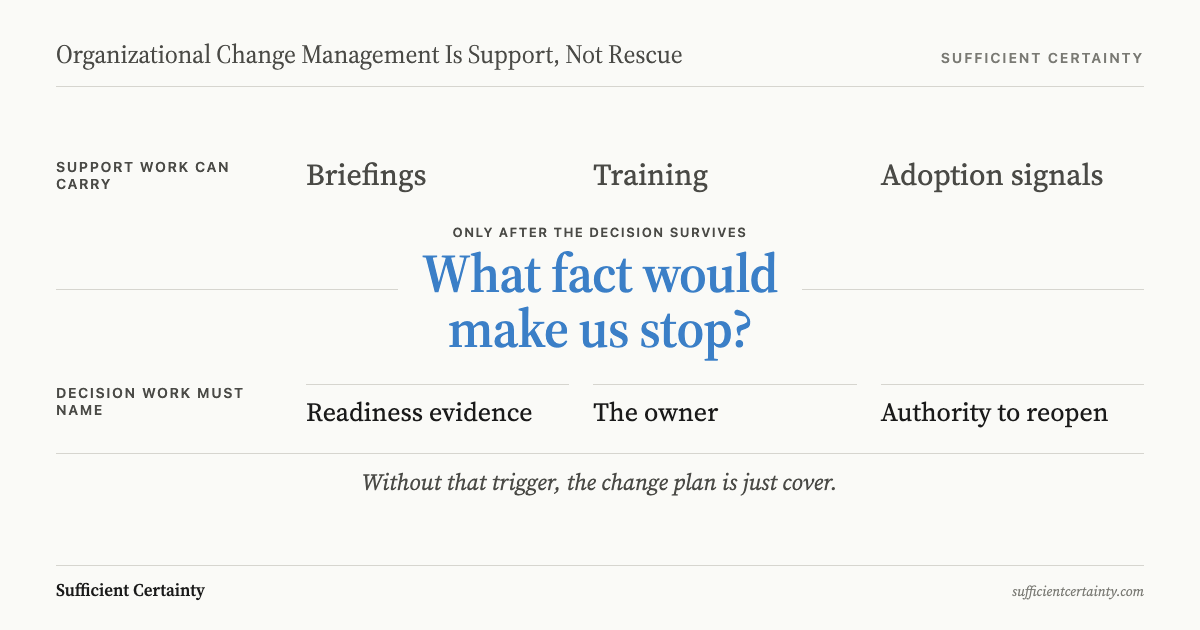
It makes a sound change usable in daily work. In practice, that means communication, training, manager support, adoption signals, and escalation. It helps people carry the decision without certifying it. The sponsor gets a cleaner problem once the work is labelled adoption. A bad premise becomes a training burden. A readiness gap becomes a communication issue. The manager who should reopen the decision can ask for another town hall and look busy while the real question slips out of the minutes.
A plant closure or production move owes people honest explanation and practical support. It also owes them a decision that has been tested before they are asked to live with it. That distinction is the line ordinary change management advice too often smudges, and it is where transition management should begin.
Once a program has a sponsor and a launch date, the awkward question about whether the decision is sound starts to feel disloyal. I have watched rooms relax as soon as the conversation moved from judgement to rollout, because town halls are easier to stage than defects and sentiment is easier to track than go-live evidence. That ease is how a weak decision becomes a shared injury.
When organizational change management becomes cover
It becomes cover when the rollout machine keeps moving after the readiness evidence has broken. The Queensland Health payroll case shows an organisation accepting a go-live decision the evidence did not support. The Queensland Health inquiry report said the payroll replacement went live after ten aborted attempts. The later working process needed about 1,000 employees to process fortnightly pays. The estimated cost was about A$1.2 billion over eight years.
In that setting, more briefings were not the missing discipline. The question was whether the payroll system was ready to replace the old one that week. A change team could record defects and prepare support material. It could not make a failed readiness decision true.
Healthcare.gov showed the same pattern in a different form. The U.S. Government Accountability Office found that CMS issued task orders while key requirements were still unknown, and performance requirements had not been verified before launch. Hard adoption was only the visible problem. The launch had inherited assumptions nobody had settled.
If nobody is willing to answer that, the change management plan is just cover. The useful test is ugly: what fact would make us stop? A committee that can name that fact still owns the decision. A committee that cannot name it has switched from managing change to protecting a date.
Separate rollout trouble from a bad decision and test whether the resistance points to support work or a call to reopen. Start the Walk →
Separate the change from the support work
In the Universal Decision-Making Method, the primary change is the operating choice itself. Communications and training are supports, not substitutes. That boundary gives the change lead a job worth doing. The lead can prepare training and expose weak assumptions. They should not be turned into the person who makes unresolved defects palatable.
The Australian National Audit Office's review of Defence's myClearance system is useful because support work was not the failure point. The failure sat in data quality, testing, and governance. At go-live on 28 November 2022, data quality problems affected 456 of 796 columns, or 57 per cent, and 90 defects were still outstanding. Auditors also found governance and reporting did not support informed risk-based decisions. An orderly support contract could sit beside a main decision that remained exposed.
A decent change lead should be allowed to say this plainly. "We can prepare users for the system described, but the system available is not that system." That sentence is uncomfortable because it returns the matter to the Deciders. It is also more honest than asking users to adapt around defects management has chosen not to face. The difference matters politically. If the change team owns every complaint, the sponsor gets a clean report and a disposable scapegoat. If the decision owner keeps ownership, resistance has somewhere useful to go.
Treat resistance as evidence before you name it resistance
When resistance appears, I start with the accusation itself. If the people closest to the work say the timing or system is wrong, I want to know which assumption their objection threatens before anyone calls it attitude. A force field analysis makes that visible by mapping what is actually holding the change back. If the operating setting has moved since approval, I treat the resistance as late-arriving information from the work itself. Confusion about the message usually means the decision is not clear enough to explain.
I dislike the phrase stakeholder buy in when it is used to domesticate dissent. People near the work often know the assumption that has failed before the sponsor does. Calling them resistant is an efficient way to lose the last good warning you have.
Revlon's 2018 SAP launch was not a public-sector go-live problem. In its 2018 Form 10-K, Revlon disclosed service-level disruptions at Oxford, North Carolina, and shipment problems representing about US$64 million of net sales. It also recorded US$53.6 million in incremental charges and disclosed a material weakness tied primarily to the ERP implementation. Staff adoption was part of the story, but the deeper issue was that the organisation did not have sufficient certainty that the operating system was ready.
That is why I do not separate adoption metrics from operating evidence. A high training-completion score tells me people sat in the session. It does not tell me the warehouse can ship or the controls can close. Those questions belong to the decision, not the campaign around it.
The same applies to a cultural assessment that reports declared values without testing them against operating behaviour. The profile may look like evidence, but it does not tell the Decider whether the culture described will hold under the conditions the change is about to create.
Sometimes alignment is just a workforce being asked to scale a bad call. J.C. Penney gives the non-technology version. In its 27 February 2013 results filing, the company reported full-year sales fell 24.8 per cent, comparable sales fell 25.2 per cent, and net loss was USD985 million. Ron Johnson cut coupons, reset pricing, and asked store staff to carry a retail bet the customer base had not asked for. That is why the language around resistance matters. It decides whether the organisation treats the signal as evidence or as a personnel problem to be managed away.
Put monitoring back with management
After launch, organizational change management should not become the organisation's conscience. Monitoring belongs with line management because only management can decide when a warning sign reopens the decision. It belongs inside the decision rather than after it. Someone has to know what would show that a key assumption has failed and how quickly that sign would appear.
After launch, the adoption report needs a management trigger attached to it. Slow attendance may belong with the change lead. Failed reconciliation or broken controls belong with the person authorised to reopen the decision. The signal has to land with someone who can do more than ask for another dashboard.
The GAO's evidence to Congress on Defense IT investments makes the same point in plainer numbers. The Air Force Expeditionary Combat Support System was cancelled after about US$1 billion had been spent, and the department had no high-risk dashboard rating for any of 93 major investments despite earlier cost and performance trouble. This is where governance structure and decision monitoring meet. The change team may collect adoption signals, but Deciders must own the triggers that say pause or stop. If no one is allowed to stop, the signal stays on paper.
You could run the rollout cleanly and still protect a decision nobody was allowed to stop.
Work through your decisionNo sign-up. Just pick your decision and start.
Grant Purdy is the co-author, with Roger Estall, of Deciding (2020), and the architect of the Universal Decision-Making Method.