
Too many choices paralyse a decision only when the person choosing has no criteria. The famous jam study proved the effect exists. The meta-analysis that followed proved it is conditional. Reducing options is cosmetic. The structural fix is stating what the decision is for before comparing alternatives.
Too many choices paralyse a decision only when the person choosing has no criteria. The famous jam study proved the effect exists, but the meta-analysis that followed proved it is conditional. Reducing options is a cosmetic fix. The structural fix is stating what the decision is for before comparing alternatives, so irrelevant options fall away naturally.
In 2000, Sheena Iyengar and Mark Lepper set up a jam-tasting display at Draeger's supermarket in Menlo Park, California. One version offered 24 varieties. The other offered six. The 24-jam display attracted more tasters, but only 3% bought anything. The six-jam display converted at 30%. The result was published in the Journal of Personality and Social Psychology, and within a decade it became the most-cited exhibit in every presentation about too many choices. Consultants loved it and made it a prescription: reduce options, simplify. It became an industry default. It is also wrong.
The cause is the absent Purpose, not the number of options. This is a structural problem, not an arithmetic one.
Too many choices become disabling when the options cannot be separated by a clear aim or decision criteria.
The jam study proves less than you were told
Nobody in the study had a stated reason for buying jam. Nobody had criteria. They were browsing. The 24-jar display did not paralyse shoppers because 24 was too many. It paralysed them because every jar looked equally plausible. Nothing distinguished one from another because nobody had asked, before tasting, what they wanted the jam for.
Organisations cite this study to justify "limit options" policies. They strip product lines and cut shortlists by fiat. The analogy flatters the consulting industry. A grocery experiment with strangers and condiments became the intellectual foundation for restructuring entire product portfolios. Nobody paused to ask whether the conditions of the experiment bore any resemblance to the conditions of the decision. That question would have killed the engagement.
Too many choices paralysis is conditional, not universal
In 2015, Alexander Chernev and his colleagues published a meta-analysis covering 99 choice-overload experiments and 7,202 participants. Choice overload, they found, is not an iron law. Four conditions determine whether more options help or harm. The critical one: whether the person deciding brings clear preferences to the decision. The choice-overload industry did not update its slide decks. Where organisations manufacture exactly those conditions for themselves is the subject of choice overload.
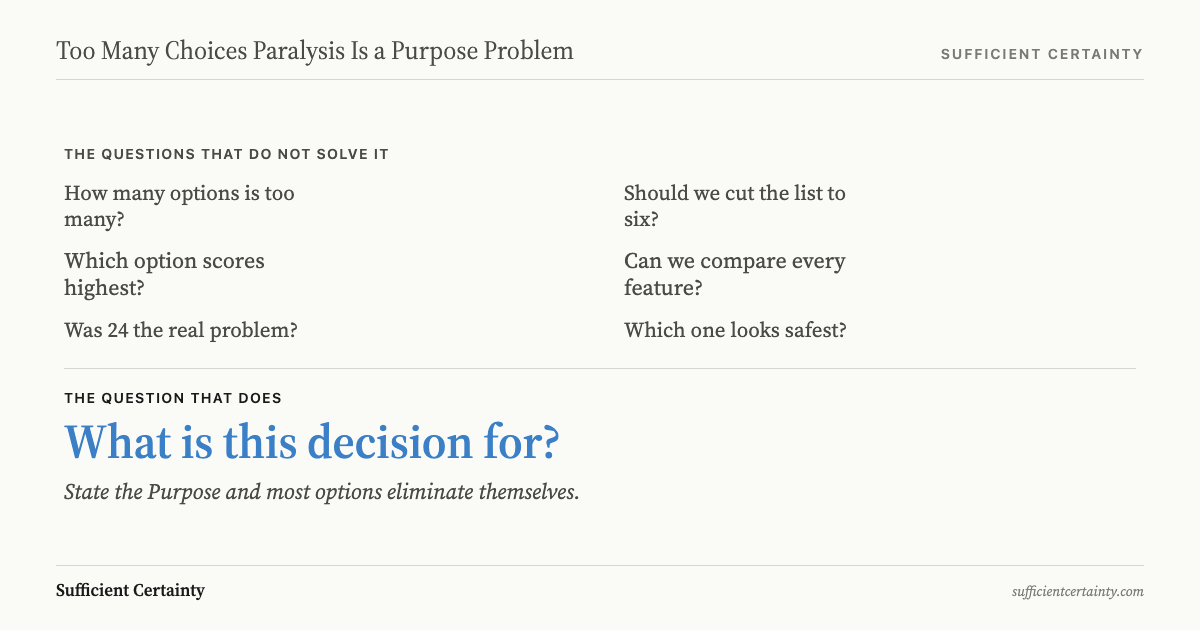
When people had clear preferences, larger choice sets did not produce overload. Overload occurred specifically when participants lacked clear criteria for choosing. "Clear preferences" in Chernev's framework maps directly to what I call Purpose in the Universal Decision-Making Method. Purpose is Step 1: what is this decision for? State it, and most options eliminate themselves. Omit it, and six options can stop you as effectively as sixty.
Chernev identified four conditions that determine whether more options cause overload. Three of them point to the same gap. Task difficulty rises when there is no basis for evaluating options. Preference uncertainty rises when nothing anchors a choice. Decision goal is absent when nobody stated one. Each is a different name for the same missing step. The fourth condition, choice-set complexity, matters only when the first three are already unresolved.
This is a finding the advisory industry has no incentive to publicise. There is no revenue in telling a client to state what the decision is for. There is considerable revenue in running a choice-architecture workshop or redesigning an options matrix. The condition that resolves too many choices paralysis costs nothing to state. It just requires someone to ask the question before the analysis begins.
Fewer options did not fix the problem at P&G
In the mid-1990s, Procter & Gamble cut Head & Shoulders from 26 variants to 15. Sales rose 10%. The case is cited in board presentations as proof that fewer choices produce better results. The lesson is simpler and more useful than that.
P&G did not eliminate 11 variants at random. They identified which variants served the same consumer need and collapsed the redundancies. Variants that served a distinct Purpose stayed; those that duplicated an existing Purpose went. Business schools teach this as a counting story: 26 was too many, 15 was right. The counting version is easier to teach and misses the point entirely.
I see organisations do the opposite regularly. They reduce options by fiat because someone read the jam study in a slide deck. Six months later the remaining options are still stuck in review because nobody stated what the decision was trying to achieve. Fewer options with no Purpose produces the same paralysis as more options with no Purpose.
I watched a financial services firm cut a product shortlist from twelve to four because a board member cited the jam study in a strategy presentation. Three months later the four options were still circulating between committees. Nobody in the process could state what the product was supposed to do for the customer. The shortlist was shorter. The decision was no closer. They had treated a Purpose problem as a counting problem, and the result was predictable.
Use the five steps to pin down the purpose behind the choice with too many options. Start the Walk →
How to escape too many choices paralysis
The method Roger Estall and I set out in Deciding starts with Purpose because of everything described above. State the Purpose and test each option against it. Options that do not serve the Purpose are out. Options that duplicate each other's contribution are redundant; pick one. What remains is the actual decision. It might be two options or twelve. The number is a logistics problem, not a psychological one.
A procurement team I worked with had 47 vendor proposals on the table. Their governance process had ground to a halt. Not because 47 was too many, but because no one had stated the Purpose clearly enough to eliminate the proposals that did not serve it. We stated it. In one afternoon the field shrank to three. Two of the three offered materially different approaches to the stated Purpose. The final decision took a week, not because it was difficult, but because the committee calendar would not accommodate it sooner. The 44 that fell away were not difficult decisions. They were obvious once someone asked what the decision was for.
Boardrooms I have sat in spent months cycling between five options with no stated Purpose. Organisations I have worked with evaluated thirty in an afternoon because everyone could answer one question before the analysis began: what is this decision for?
How to choose when the options keep multiplying
Purpose eliminates the options that do not belong. That is the step above. But what happens when seven options survive and each one serves the stated Purpose? You are no longer dealing with a filtering problem. You are looking at a field of plausible alternatives that parallel evaluation will not resolve. More criteria will not help. More scoring will not help. The practical question is different: what separates these options from each other?
The answer is almost never features or price. It is assumptions. Every option carries a set of beliefs about what will be true in the future. If two options depend on the same key assumption, they are not different choices. They are variants of the same bet. Group the options by the assumption they rest on. Test the assumptions. The field collapses.
I worked with a resources company choosing a technology platform for environmental monitoring across nine sites. The Purpose was clear: continuous compliance reporting to three regulators in two jurisdictions. Seven vendors had passed the initial filter. All seven met the stated requirements. The evaluation committee had been running parallel assessments for four months. Demos, reference calls, weighted scoring. Every vendor landed within a few points of the others. The managing director wanted a decision. The committee wanted more data. Somebody proposed cutting the list to three on gut feel, which would have solved nothing.
We stopped scoring and listed the assumptions. Vendors A and B assumed the company's existing sensor network could feed real-time data without hardware upgrades. Vendors C, D, and E assumed the board would approve a staged capital programme within the financial year. Vendors F and G assumed the regulatory standards would remain stable through the contract period.
Three groups. Three assumptions. We tested each one. The engineering team confirmed within two days that the sensor network could handle real-time feeds on the existing hardware. Vendors A and B stayed. The board had not discussed capital programmes and two non-executive directors had already signalled resistance to discretionary spending. Vendors C, D, and E were not rejected on merit. They were rejected because the assumption they required was unlikely to hold. The regulatory team had flagged that updated emissions standards were expected within eighteen months. Vendors F and G were betting against information the company already possessed.
Seven options became two. Not through more evaluation, but through fewer assumptions. The final choice between A and B came down to a genuine difference in implementation approach that the committee could examine on its merits. That conversation took one meeting. The four months of parallel scoring had produced nothing equivalent.
This is the step Roger Estall and I describe in Deciding as moving from tentative options to the assumptions that carry them. The method does not ask you to rank options against each other. It asks you to surface what each option depends on, judge whether you have sufficient certainty in each assumption, and set monitoring for the ones you act on. Options that share an untested assumption collapse into one group. Options that depend on an assumption you can disprove fall away together.
Most organisations do the opposite. They evaluate in parallel, score against identical criteria, and produce a cluster of near-identical results. The scores converge because the criteria do not address what actually separates the options. Features and pricing are visible. Assumptions are not, until someone names them. Rational decision making is not the process of weighing every variable. It is the discipline of finding the variable that matters and ignoring the rest.
If your shortlist is stuck, stop adding criteria. Ask what each option assumes. Group by assumption. Test the assumptions. The count resolves itself.
You could cut options again and still face your next choice without a purpose.
Work through your decisionNo sign-up. Just pick your decision and start.
Grant Purdy is the co-author, with Roger Estall, of Deciding (2020), and the architect of the Universal Decision-Making Method.