
Fear of making decisions is not a personality flaw. It is a rational response to a process that never defined what would count as enough evidence to act. When someone cannot tell which assumption their choice depends on, hesitation is sensible. Fix the process and the fear falls away without motivational intervention.
Fear of making decisions is not a personality flaw. It is a rational response to a process that never defined what would count as enough evidence to act. When someone cannot tell which assumption their choice depends on, the sensible reaction is to hesitate. Fix the process and the fear falls away without any motivational intervention.
A chief executive once showed me a board paper built to protect almost everyone except the person who had to sign it. Finance had wrapped the growth case in a 14-cell risk summary and investor relations had already drafted the market announcement. Each contributor could point to their own diligence if the deal soured (a fine arrangement if you wrote the paper rather than signed it). The live assumption was that a supplier would deliver on time, and nobody wanted to own that sentence. People around him called it a fear of making decisions. In my experience, it was the last honest response in the room.
Self-help sellers and advisers who earn their keep by soothing the Decider love to treat this as a private weakness. It is a profitable story because it leaves the machinery untouched. In the rooms I know, the trouble is usually unmanaged uncertainty. One ugly assumption is carrying the choice, and nobody wants to drag it into daylight because then somebody has to defend it. Fear is doing its job.
Fear of making decisions is the dread that arises when the consequences feel real and the basis for choosing remains unclear.
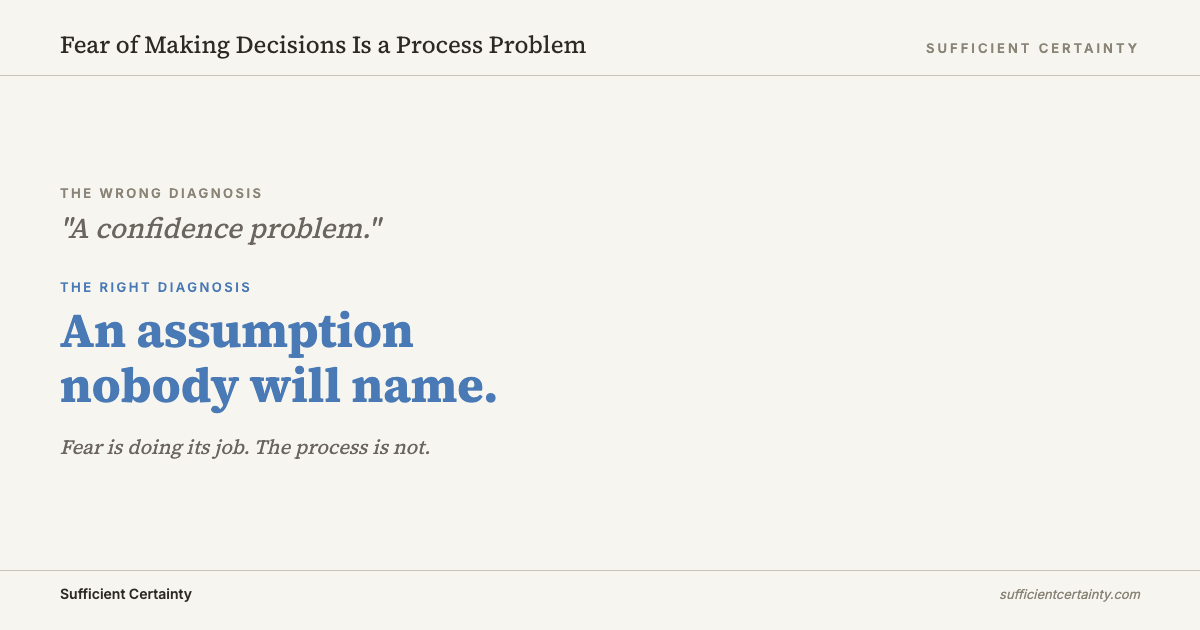
Fear of making decisions is usually uncertainty you cannot name
Most advice on this subject is consolation retail. It tells you to breathe and trust yourself. Sometimes it sells you a worksheet as well. Appel and Gerlach at least tested the useful question. In their 2025 study in the British Journal of Clinical Psychology, they experimentally increased and decreased intolerance of uncertainty, and indecisiveness moved with it.
I see the same mechanism whenever a paper smuggles its live beliefs into the wallpaper. Revenue is expected to hold. The supplier will deliver on time. Those are bets. Until somebody writes them down as bets, the person signing feels the exposure and everybody else gets to diagnose the signer. This is why I keep returning to assumptions in decision making. Once the assumption is named, the room can stop pretending the fear belongs to a defective person and start arguing about the wager itself.
Map the decision you keep delaying through five steps and name the assumption that fear keeps vague. Start the Walk →
The hesitation deepens when authority goes up
Authority does not cure uncertainty. It tells you whose neck the uncertainty lands on. That is why the 2023 study in Frontiers in Psychology matters. Shortland and his colleagues put 234 U.S. Armed Forces personnel through 16 least-worst scenarios. In higher-power conditions the decisions felt harder, and avoidant choices became more likely, especially when the scenario sat inside their own domain.
An operations leader deciding whether to shut down a line is not short of affirmations. If you want a second example, a chief executive staring at an acquisition is in the same bind. The downside is real, the uncertainty is still mush, and the advice industry is happy to call this anxiety while the broken process stays untouched. Corporate wellness pieties can hover around the edges for months. They still cannot tell the Decider which assumption is carrying the choice.
This is why fear rises as the pack gets thicker. Another annexure appears, and another heat map, while the decisive assumption is still floating around unnamed. That is the engine underneath data paralysis and the wider mess in the machinery of analysis paralysis. Extra paper looks industrious, which is convenient if you were paid to produce it (and somebody usually was), but it does not make the decision any safer.
The dread eases when assumptions are ranked
The National Academies committee on PFAS did one honest thing most institutions duck. In its 2022 guidance, it said decision-makers can fear acting too soon and fear waiting too long. It did not run the usual fraud of implying that one more round of science would make the decision painless. It set principles and forced judgment under permanent uncertainty.
In my experience, the work starts when we write the decision as a wager no one can hide inside. Roger Estall and I set out that discipline in the Universal Decision-Making Method and in Deciding. We name the assumptions the choice depends on and judge which ones matter. Either we test the weak assumption properly, or we change the option so it rests on less wishful thinking. If neither can be done, the decision is not ready.
I describe the mechanics in overcoming decision paralysis. The discipline is the same: write what would have to be true, judge what evidence exists, then decide whether the basis is sufficient or the option needs changing. When the room reaches that point, fear has an address instead of a haze.
People who live off process theatre do not enjoy that discipline. A named assumption leaves far less room to keep enlarging the paper trail.
Fear of making decisions becomes expensive when delay has no stopping rule
The UK National Audit Office said on 15 June 2026 that Westminster's restoration has no risk-free path. Parliament kept multiple pathways open because commitment had a political cost, and each year of delay adds between GBP320 million and GBP420 million to the bill. Maintenance is already costing about GBP1.5 million a week. That money bought political cover at public expense.
That is what fear looks like once it hardens into an institution. Nobody wants to own the consequences of moving early, so the public pays for moving late. Delay gets dressed up as prudence, which is one of the cleaner corporate frauds in circulation. A room without a stopping rule can call itself careful for years.
I have watched committees perform this ritual with very straight faces. Nobody says the obvious sentence: we are afraid to commit because one assumption still has no defensible basis. Instead they order another paper or send the matter away for review. That suits everyone whose professional standing depends on the paper trail growing longer. Procedure then acquires a moral glow it has not earned.
I do not try to suppress that fear. I interrogate it. I ask what assumption it is pointing at, and what would have to be true before the room has any business proceeding. Most of the time, that fear of making decisions is the last honest signal in a room that has dressed uncertainty up as paperwork.
You could dodge the next sign-off and let the unnamed assumption decide.
Work through your decisionNo sign-up. Just pick your decision and start.
Grant Purdy is the co-author, with Roger Estall, of Deciding (2020), and the architect of the Universal Decision-Making Method.