
I have sat in Friday meetings where a compliance lead needed an analyst for a statutory filing. While that request was still on the table, an operations lead wanted the same analyst to investigate a service fault, and a product lead wanted analysis promised to a customer. The question was how to prioritize when every team says urgent, after the person running delivery had allowed all three claims to stand.
When nobody chooses, the queue forms itself. The analyst tries to serve three sponsors and does justice to none. I have watched this pattern persist for weeks, with the loudest voice setting the order and the quietest work falling further behind. The organisation pays for it in missed filings, patched faults and broken promises, though nobody records those costs because nobody recorded the choice that caused them.
This is a competing priorities decision. Someone with authority over the shared work has to choose the commitment that will wait.
The word urgent stops carrying information when every team uses it. An urgent request should name a loss from delay, a date by which the loss becomes irrecoverable, and the commitment that would need to move. Most of what I see called urgent cannot meet even one of those conditions. The label describes the sponsor's discomfort, not a consequence for the outcome the organisation is protecting.
Competing urgency is the state in which several teams claim the same resource and each asserts that delay will cause loss.
Ask what delay changes
Set the protected outcome and the review period before comparing requests. I ask each sponsor what waiting will damage before the review date, and why that loss cannot be recovered inside the period. A deadline has meaning only when the sponsor can describe the loss that follows it. The claim must be clear enough for another sponsor to challenge.
A claim that holds up names three things: the outcome being protected, the loss that follows delay, and the date by which the loss becomes irrecoverable. A sponsor who can answer all three has earned a place in the comparison. A sponsor who can answer only the first is asking for preference, not priority.
Recoverability separates a hard choice from a merely uncomfortable one. I ask sponsors what can still be done if the request misses its date. A credible workaround that protects the outcome through the next review means the full request can wait. That answer often changes the order more than the deadline itself.
I have watched senior people use urgent for work that had waited too long. The label described their discomfort, rather than a consequence for the outcome the organisation was protecting. That distinction matters when the same person is needed elsewhere.
The United States Department of Defense had a larger coordination problem. Its 2011 Government Accountability Office report identified at least 31 entities involved in urgent-needs work, and estimated department-wide spending at least $76.9 billion. The report says the Army and Marine Corps separately developed counter-IED mine rollers. Uncoordinated urgent-needs routes obscured total cost and duplicated work; that is why I put competing claims in one record.
A prioritization matrix may help hold the comparison, but a score cannot choose the outcome the organisation will protect. The useful record keeps the claimed loss beside the commitment that would move.
List the requests competing for your team this week and write the cost of delay beside each one before the meeting decides. Start the Walk →
How to prioritize urgent work when teams compete
Name the accountable Decider before the sponsors argue. The Decider owns delivery across the competing areas through the next review date. A programme manager or project office gathers the evidence. The Decider chooses the work that loses its place and carries responsibility for that choice.
The rule is explicit. When more than one sponsor can state a credible loss from delay, the Decider chooses the request whose delay causes the most serious, irreversible loss to the protected outcome within the review period. The rule is a judgement about consequences, rather than arithmetic dressed up as one.
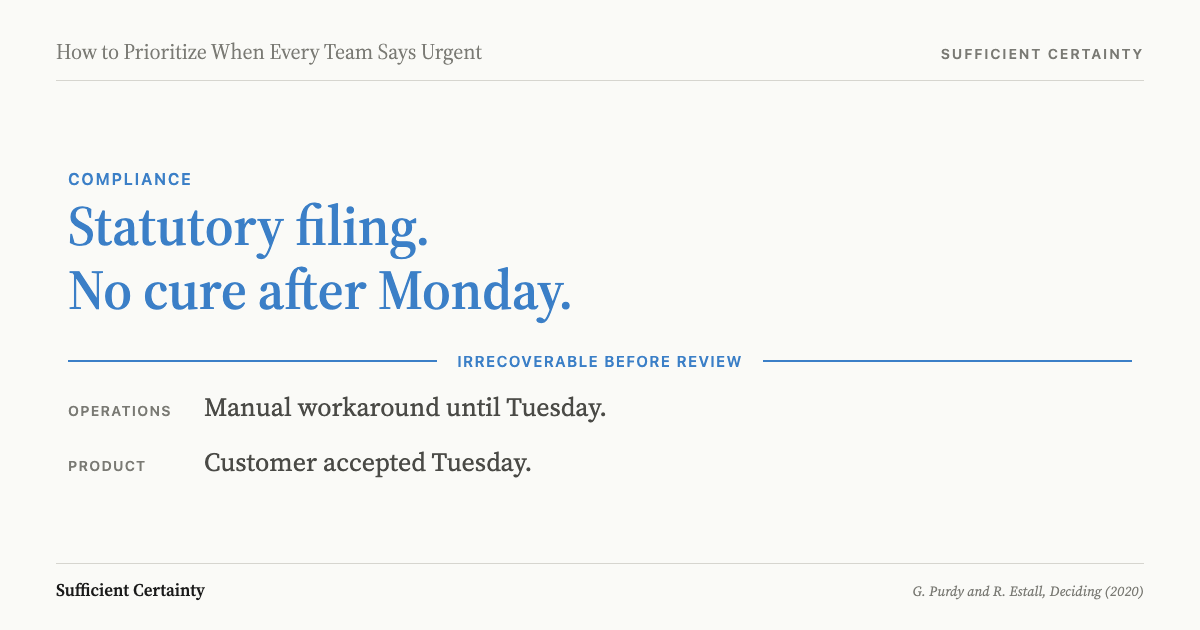
Take the three competing claims from the Friday I described above. The protected outcome is meeting legal and customer obligations through Monday morning. The compliance sponsor can show that the filing becomes a statutory breach at close of business on Friday, with no cure available in the review period. Operations can keep the service within its agreed limit by using a manual check until Monday. Product's customer has accepted Tuesday for the launch analysis. The Decider assigns the analyst to the filing, marks the launch analysis as not being done in this review period, and defers the full operations investigation while operations owns the manual check.
This is the point at which a meeting becomes a decision: the work that waits has an owner and a date for reconsideration. The Decider has not said that product or operations matter less. The Decider has chosen the loss that cannot be repaired before Monday.
Each sponsor must also name the person, dependency and time the request needs. I ask two questions once the claimed loss is clear: who is needed to do this work, and which current commitment changes when that person moves? A sponsor who cannot answer them has not yet made a request the Decider can resolve.
I have seen a Decider attempt this without a stated protected outcome. The three sponsors argued from their own domains. Compliance measured loss in fines, operations in service credits, product in revenue. Without a shared outcome against which to compare these losses, the loudest estimate won. A common protected outcome forces sponsors to translate their claims into the same terms.
The National Audit Office described the portfolio form of the same problem in 2015. Its briefing covered 149 major government projects with whole-life costs of GBP 511 billion and found no effective mechanism for judging whether departments had the capacity to deliver them. An important project can still wait when the people needed to deliver it are already committed.
The Friday decision record
By Friday, I would want one decision record, rather than separate updates from every sponsor. The record names the protected outcome, each sponsor's expected loss from delay, and the commitment that will move. The Decider and review date sit on the same line, with the person responsible for watching the named change event.
I have seen organisations keep a running list of urgent requests without recording what was deferred. The omitted sponsor then treats the decision as temporary and brings the same request back without a change in facts. The deferred commitment must be explicitly marked as not being done in this review period. A specific deferred commitment gives the next review a clear starting point.
The UK Major Projects Authority guidance calls for a view of resource loading and constraints before projects are committed. It also includes reshaping or cancelling work in the portfolio decision. These steps apply at the team level as much as at the programme level.
I have seen a project prioritization matrix make new work appear cheap after its operating demand had been omitted. The sponsor should estimate downstream specialist time before the Decider chooses, because that time belongs to the option being proposed. Monitoring has a separate job: it detects that the estimate was wrong after work begins.
Roger Estall and I built the record structure in Deciding around a principle: every choice must name its cost. The Universal Decision-Making Method sits behind this record. It leaves the responsibility for the trade-off with the Decider, where it belongs.
A record that survives its first challenge teaches the organisation something: the loss was real, the choice was justified, the facts supported both. A record that is overturned without changed facts teaches something worse.
When every team says urgent, set a review date
A priority stands until the scheduled review date arrives or a named event occurs. In the Friday example, Monday morning is the review date. The service moving beyond its agreed limit is a change event; operations watches for it and returns the decision to the Decider if it occurs. A customer withdrawal of the Tuesday agreement is another event that could reopen the order before Monday.
I set the review date close enough that deferred work does not drift into permanent neglect, and far enough away that the Decider's choice has time to take effect. For Friday's three competing claims, Monday is the right interval. A quarterly review would leave the operations manual check running indefinitely.
At the review, the Decider returns to the facts behind the choice. Has a changed fact altered the loss from delay or the capacity available? A familiar request with unchanged facts stays deferred. I have seen leaders reopen a priority because a sponsor lobbied harder, not because the facts changed. That undermines every future decision record.
Sophie Leroy's 2009 experiments examined people moving from unfinished work to another task. They found difficulty disengaging from the first task and poorer performance on the later task; time pressure affected that transition. The study gives the Decider a reason to compare a temporary containment action with an immediate reassignment. It does not supply a universal price for switching work.
I have seen leaders move the same specialists several times in a week, then find unfinished work scattered across the queue. Interruptions are sometimes necessary, but they are choices with consequences that belong in the record. The difference between a good decision and a bad outcome is relevant when Monday changes the facts: the decision was made on stated assumptions, and the Decider has a way to reconsider it.
You could run another triage meeting and still leave three teams waiting for one analyst.
Work through your decisionNo sign-up. Just pick your decision and start.
Grant Purdy is the co-author, with Roger Estall, of Deciding (2020), and the architect of the Universal Decision-Making Method.