
Problem framing techniques usually begin after the frame is already set. The useful ones test purpose in context before anybody starts fixing anything. A technique that skips the question of what you are actually deciding is not framing. It is decoration on a decision that somebody else already made.
I sat with a board that had a 27-page options paper, a Five Whys worksheet, and three months of delay already behind it. The team told me they had tried several problem framing techniques. I asked the only question that mattered: what decision are you asking the board to take today? Nobody in the room could answer it, which told me the machinery had been busy and the thinking had not.
Most teams do not lose the decision in analysis. They lose it in the sentence that claims to define the problem. In the Universal Decision-Making Method, those questions test Purpose, the live opportunity, and the surrounding Context before anyone is allowed to solve the wrong thing with confidence.
Most popular tools arrive after the frame has already hardened into a verdict. They ask why, or they open a workshop template. By then the dangerous work has been done. Somebody has chosen what counts as the problem, and the meeting spends the next hour polishing the disguise.
Problem framing techniques are the questions that test Purpose and Context before analysis begins, so the room solves the right decision instead of polishing the wrong one.
Why most problem framing techniques start too late
The Asian Development Bank note on the Five Whys and Atlassian's own 5 Whys play both assume the opening problem statement deserves trust. Keep asking why until a cause appears, then act. Fine, if the first sentence is honest. Often it is not. These late-framing tools survive because they suit workshop sellers and sponsors who want motion without exposure, since everyone gets to look industrious while nobody has to admit the brief itself may be wrong.
Atlassian's problem framing play keeps the room inside a customer-problem box. That may help with a product backlog. It does very little for a plant closure or a capital allocation call. Teams like the box because it leaves organisational Purpose outside the room, which is very convenient when the real argument is political and somebody senior wrote the first brief, usually the same person asking for a neutral process (a lovely phrase when the politics are doing the work).
Kees Dorst's Frame Innovation at least admits that framing is real work. What leaders under pressure do not need is another design ritual with sticky notes and solemn nouns. They need a short discipline that catches the moment a brief hardens into a verdict, before elegant workshop language starts protecting the wrong question.
This answer-first machinery does not survive because it is wise. It survives because it is safe. Nobody gets in trouble for commissioning another workshop. Someone may get in trouble if the room says plainly that the stated problem is nonsense, or worse, that it protects the people who framed it.
Run your live pricing problem through the five steps and test the purpose before the room starts fixing the wrong thing. Start the Walk →
The problem framing techniques I actually use
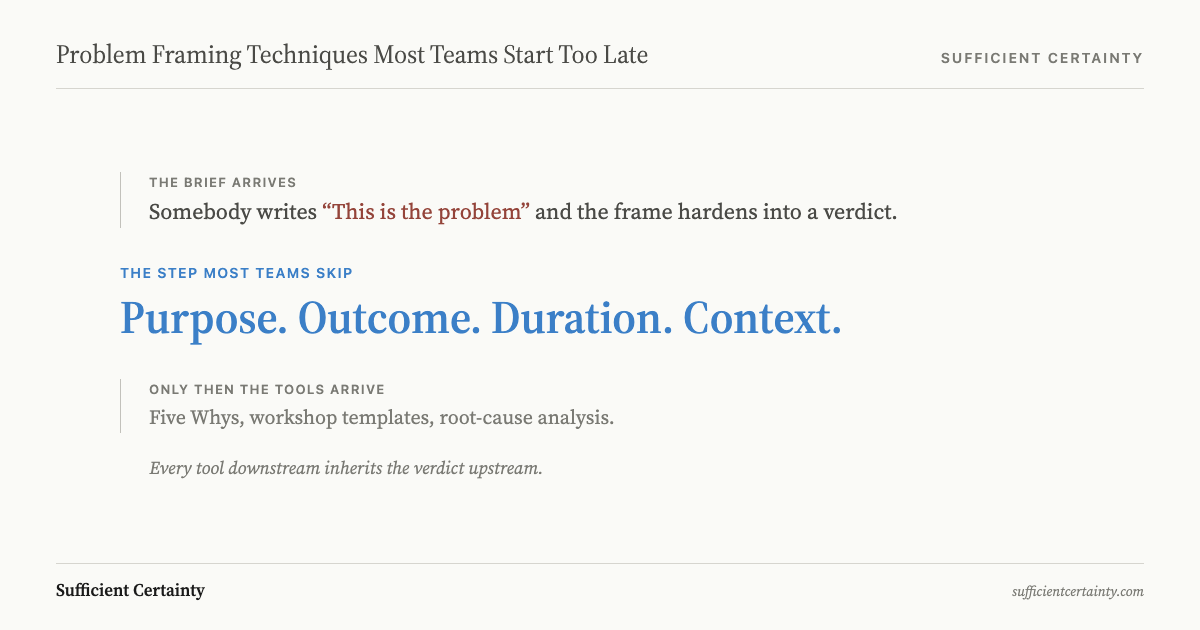
I write one sentence for the decision, then I try to break it. That is where problem framing techniques earn their keep. If the sentence shifts every time I ask why it matters or how long it has to stand, the team is not framing a decision yet. It is circling a discomfort.
I start with Purpose. I once chaired a public safety organisation that was spending about 0.03% of its budget on its legislated prime function. When we pushed that to about 0.5%, deaths fell by about 60% within two years. The earlier papers were full of effort and empty of judgement. They described activity that looked industrious and reassured the right observers, which is one of the oldest tricks in management, especially for observers who will never have to live with the result.
Then I test the live opportunity. Postal executives spent years talking as though their job was to manage the decline of letter volumes gracefully. That framing kept the institution emotionally employed by the old trade. The real decision was what the network was now for while it could still reach every address and be repurposed. In my experience, opportunity usually enters the room looking rude, because it asks whether the old story has expired and who is still earning a living from pretending it has not.
The intended outcome has to be plain. Improve competitiveness tells me nothing. Hold margin above a named level while entering a named segment tells me what success is supposed to look like. That is why I separate the decision-making process model from corporate wish-making. If the outcome cannot be stated clearly, the room is still choosing a mood, not a decision.
Duration matters just as much. A choice that only has to work for six weeks is a different animal from one that must hold for two years. People leave duration vague when they want a cheap answer now and someone else's headache later. I prefer that game to be visible before the paper is signed.
Context has to belong to this decision. I do not want a generic slide about the economy. I want a dated description of the conditions around this choice, inside the organisation and outside it, precise enough that we will know when it has changed. Too many teams do expensive complex problem solving against yesterday's circumstances, then act shocked when the answer goes stale before the ink dries.
How problem framing techniques change a live pricing decision
A pricing decision changes the moment you frame it properly, because what looks like arithmetic is usually a market-entry bet in respectable clothing.
I have watched rooms reach for production cost plus a margin as if that were a fact. It is an assumption. It rests on what inputs will cost later and how competitors will behave. It also smuggles in a view about how long the price has to hold. Rooms like cost-plus because numbers feel innocent (they rarely are), especially when nobody wants to discuss market position in plain English.
Once we wrote the Purpose down, the discussion changed. Pricing became a decision about how the organisation meant to enter the market and what customers were meant to infer from the product. Once we named the intended outcome, the number had to serve that aim rather than masquerade as physics. Duration then narrowed the sensible range, because a launch price that survives six weeks can be foolish over two years.
Context finished the job. Competitor reaction and buyer tolerance changed what counted as a viable price, so the arithmetic only earned its place after the frame was stable. That is the logic behind the Universal Decision-Making Method. One finance director complained that I had ruined cost-plus for him, which I took as progress. Roger Estall and I wrote Deciding because we had both seen too many pricing papers use a spreadsheet as camouflage for an unstated bet.
When to use Five Whys and design tools after the frame is set
Once the frame is sound, I will happily use Five Whys to chase causes, or a workshop template to examine a defined user difficulty. Then the tool serves the decision instead of replacing it. Use it earlier and it becomes cover for the awkward truth that nobody has yet said what choice is actually being made. A sound frame does not stay sound forever either. When the conditions move, the honest job becomes reframing problems rather than defending the wording.
If you want the broader structure behind these problem framing techniques, read the wider picture of problem framing. Skip this step and the reward is familiar: expensive analysis, and blame spread so evenly that nobody owns the mistake.
You could run Five Whys again and still not know today's decision.
Work through your decisionNo sign-up. Just pick your decision and start.
Grant Purdy is the co-author, with Roger Estall, of Deciding (2020), and the architect of the Universal Decision-Making Method.