
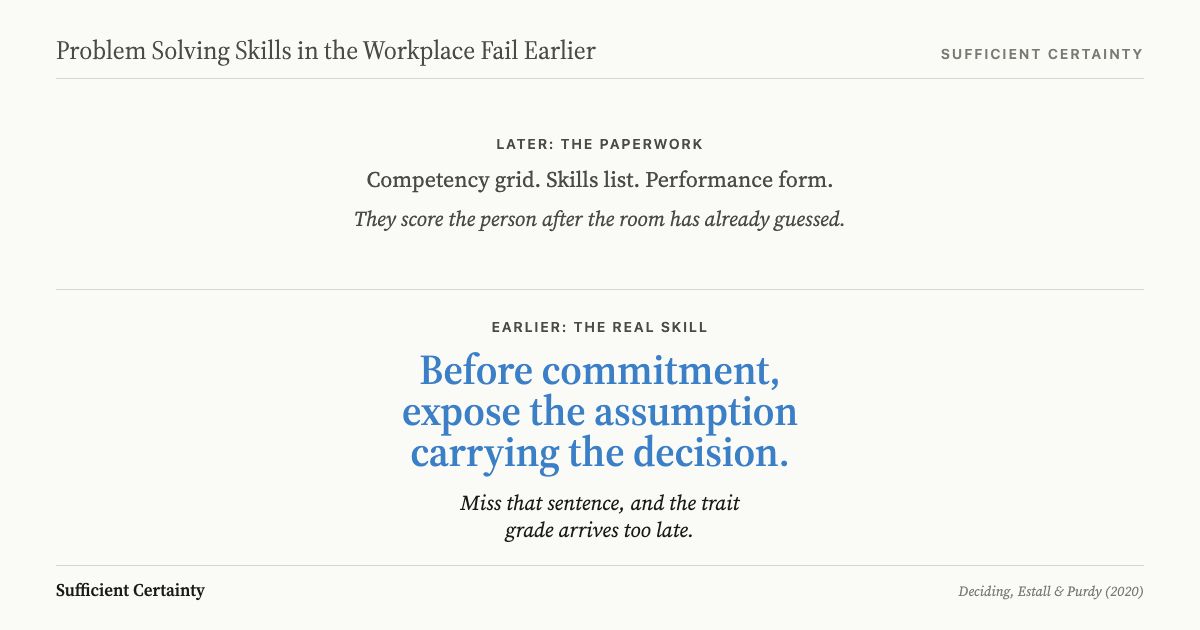
Problem solving skills in the workplace get measured on a competency grid and taught in two-day courses. Three months later the same managers approve a decision without testing the assumption doing the real work. The skill is graded. The bet is missed. The course changes nothing.
A chief executive I worked with sent 14 managers on a two-day course and came back with a new competency grid on the intranet. Three months later the same managers approved a warehouse change without ever saying the new supplier might buckle at Christmas volume. That is how most firms handle problem solving skills in the workplace. They grade the trait and miss the bet.
That is the whole point of the Universal Decision-Making Method: someone still has to say what the choice is betting on. I stop trusting a room when it sounds most fluent about a plan nobody has tested.
Adjective lists survive because they keep everybody comfortable. HR gets something to score and the course sellers get something to invoice. Nobody has to watch a live decision stripped of its wallpaper. Roger Estall and I wrote Deciding because too many clever rooms hid the only sentence that mattered, the one explaining what the preferred answer was relying on.
Problem solving skills in the workplace are learnable steps, not inborn talent, and the first step most teams skip is naming the assumption their proposed solution depends on.
Why problem solving skills in the workplace keep getting mislabeled
The World Economic Forum reports are a neat example. In 2016, "complex problem solving" sat at the top of the list. By 2025, the language had dissolved into a wider cloud of analytical and technology skills. Across the series the prestige stays, the wording slides around, and the act itself remains invisible. That suits cataloguers nicely, because a moving label can still be sold.
LinkedIn's 2024 list of in-demand skills does much the same. It puts problem-solving at number nine, drawn from profiles and hiring activity. Fine, if you want to know which words travel well on a CV. Useless, if you want to know whether a manager can stop a meeting and name the belief carrying the recommendation. Fog is commercially handy that way.
The same dodge shows up inside performance systems. A form asks whether someone "demonstrates strong problem solving". Lovely. Show me where the form records the decision they framed well, the assumption they exposed, or the trigger they set for reopening the call. It doesn't. The paperwork grades aura, then gets filed as evidence that the capability exists.
Examine one workplace decision and find the unchecked belief your training never touches. Start the Walk →
How problem solving skills in the workplace actually improve
When people actually improve, they do not wake up with a better personality. Yeung and Summerfield, writing in Philosophical Transactions of the Royal Society B, separate confidence judgment from error monitoring. In Singapore, Chew and colleagues taught 40 final-year medical students a short TWED checklist, and after one 90-minute tutorial the checklist group scored 18.5 against 12.5 for the control group on clinical cases under time pressure. In plain English, they were forced to ask what else might be true and what evidence cut against the first answer. Nobody became more gifted. They were made to do the bit the course brochure prefers to leave foggy.
In my experience the improvement appears almost immediately once the question becomes mandatory. A capable manager who has never had to say the sentence aloud can look woolly for years. Give that manager one rule, write the decision, then write the assumption it rests on, and the quality of discussion changes in an afternoon. The talent story flatters everyone, especially the people selling the course. The process story requires us to admit the course skipped the hard part.
That is why I get impatient with many problem-solving techniques in business. The laminated technique usually arrives after the manager has already mistaken the topic for the decision. If you want strategic problem solving in any serious sense, you start earlier, with the decision written plainly and the wager inside it exposed.
The strongest proof comes from surgery
The WHO Safe Surgery study covered 7,688 patients across eight hospitals in eight countries. Major complications fell from 11 per cent to 7 per cent, and deaths fell from 1.5 per cent to 0.8 per cent, after teams used a simple checklist. The checklist did not make surgeons wiser in the abstract. It forced the team to verify the live belief before the cut. The office versions are less bloody and no less real, as these problem solving examples in the workplace show.
I like surgical time-outs precisely because they are so unimpressive. A nurse asks the question, the surgeon answers, and everybody hears the same bet before the irreversible act. The paperwork fraternity, naturally, finds this less exciting than a colour-coded capability model. Yet it works because the question lands before the mistake hardens into history. The same small discipline is missing in a great deal of ordinary problem solving in the workplace.
Office failures rarely spill blood on the floor, which is why organisations tolerate them for so long. A plant expansion, an outsourcing move, or a pricing decision can sit on a bad assumption for months while the board congratulates itself on diligence. By the time the numbers bend, the sentence that launched the move has vanished under slides and status reports. That is not caution. It is amnesia dressed up as governance.
What I look for when someone claims this skill
I look for two acts. Can the person write the decision plainly? Can they say which belief makes the recommended answer look safe? In my experience, the skill becomes visible the moment the board pack loses its adjectives and gains that sentence.
The second thing I listen for is whether the person can tell me what would reopen the decision. If demand does not stay flat, if the supplier misses lead times, if the regulator shifts the rule, when do we stop pretending and look again? That is where problem solving skills in the workplace become visible. People who have them do not treat approval as the end of thinking. They leave a tripwire behind. Everyone else leaves minutes.
I once sat with a management team that had a fresh performance form, a competency grid, and a board paper thick enough to stun a goat. I asked which line in the paper had to prove true for the warehouse plan to work. They turned pages as if the sentence might leap out and rescue them. It never does. Those documents are built to look diligent. The bureaucracy had been fed, at least.
A client once warned his team that inviting Grant Purdy in would cost them a favourite adjective. He was right. The moment I ask what the recommendation is betting on, "strategic" usually dies first.
Trait language survives because it lets organisations perform judgment without exposing the bet they are asking other people to live with.
You could send managers to training and still miss the Christmas-volume assumption.
Work through your decisionNo sign-up. Just pick your decision and start.
Grant Purdy is the co-author, with Roger Estall, of Deciding (2020), and the architect of the Universal Decision-Making Method.