
Problem solving examples in the workplace share one pattern worth studying: the team solved the wrong problem because nobody questioned the opening assumption. Ron Johnson at JCPenney executed with precision against a diagnosis that flattered him and cost 19,000 people their jobs.
Ron Johnson arrived at JCPenney from Apple, scrapped its coupon culture in favour of "fair and square" pricing, and watched revenue fall by $4.3 billion in a year. More than 19,000 people lost their jobs. When people ask me for problem solving examples in the workplace, I start there, because he executed with missionary zeal against a diagnosis that flattered him and betrayed the business.
In the Universal Decision-Making Method, I treat the workplace problem as the live decision somebody is asking other people to live with, not the symptom or slogan that makes the brief sound tidy.
Roger Estall and I wrote Deciding because organisations keep making this mistake. I have spent nearly fifty years watching this, and saying it again will not embarrass me: once a bad problem statement is blessed, meetings stop thinking and start grooming the error. That is why problem solving examples in the workplace matter only when they show the assumption before the camouflage goes on, which is the narrower point inside strategic problem solving.
Problem solving examples in the workplace are real cases showing how teams that reframed the problem statement before testing solutions avoided building the right answer to the wrong question.
Why problem solving examples in the workplace start with the wrong question
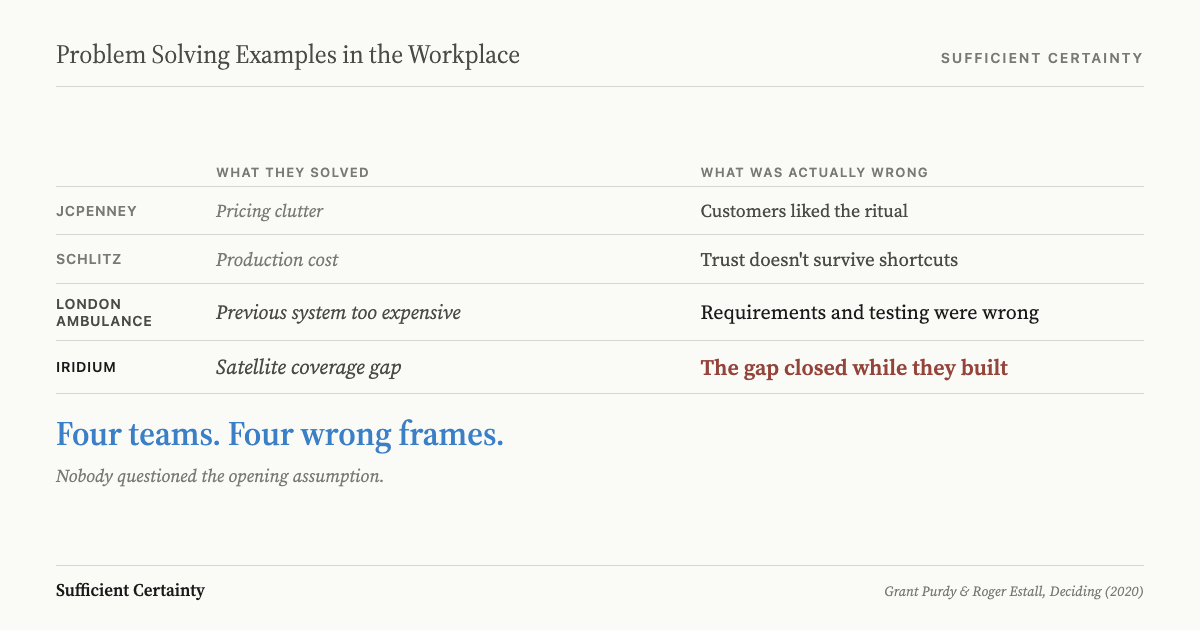
Johnson decided JCPenney's problem was pricing clutter. He thought coupons and perpetual markdowns were dishonest clutter, so he removed them and expected shoppers to applaud the cleanup. Same-store sales fell 25 percent, online sales fell 37 percent, and the chain posted a $1 billion net loss in his first full year, as Steve Denning wrote in Forbes. He also brushed aside test marketing because Apple had not needed it (which must have sounded magnificent in the room). That frame served Johnson and the executives charmed by Apple mythology, not the people actually trying to buy socks on sale.
The hidden assumption was plain enough to embarrass anyone who bothered to say it aloud: JCPenney shoppers wanted to behave like Apple shoppers. They did not. They liked the coupon hunt, the markdown ritual, the little win at the till. In retail, when managers confuse the ritual they dislike with a problem the customer wants fixed, they start solving against their own revenue. I see the same defect in problem solving techniques in business when a tidier price board gets treated as strategy and shop-floor staff are told to clap for a theory their customers never asked for.
Put the workplace problem you are trying to fix through the five steps and check whether the opening question is wrong. Start the Walk →
When cost cutting solved the wrong problem
Schlitz offers a nastier example because management decided speed and cost were more important than the taste that made the brand worth buying. Esquire recounts how Schlitz pushed Accelerated Batch Fermentation, cut brewing time to as little as 15 days against Budweiser's 32, and ended up with thick, sludgy foam when drinkers opened a chilled can. Angry consumers forced the brewer to secretly destroy 10 million cans and bottles, and sales crashed from 24.2 million barrels in 1976 to 6.2 million in 1981. I call that fraud dressed up as efficiency.
Management had framed the problem as production economics. The real problem was whether a beer sold on trust could survive executives treating flavour as expendable and the customer as inattentive. Those are opposite questions. In my experience, this is how brands get murdered in conference rooms: somebody protects the margin for a quarter and assumes the market will keep swallowing the insult.
The London Ambulance project proved that cheaper was not the issue
London Ambulance Service made the classic public-sector mistake of deciding the next dispatch project had to be cheap because the last one had been expensive. A previous system had failed at about £7.5 million, so management insisted on a sub-£1 million replacement, rejected bids above £1.5 million, and launched on an 11-month political deadline with 81 known software defects (always a comforting count in emergency dispatch). The system collapsed after eight days, with reports of 11-hour waits and an inquiry later linking the breakdown to up to 46 preventable deaths, as summarised by Erich Musick's account of the inquiry record. Management bought deadline comfort and called it thrift, but people died waiting for ambulances that never came.
The first project had not failed because it cost too much. Dispatchers and crews were barely involved, and requirements and testing were weak. Management wanted the appearance of control more than the real thing. I see this confusion at the seam between problem solving and decision making: a launch decision does not become less reckless because procurement language is doing the hiding.
Problem solving examples in the workplace get dangerous when nobody revisits an assumption
I think of Iridium as a board defending a problem the market had already started solving for free. Motorola conceived the satellite-phone system in 1987, spent about $5 billion building it, and arrived in November 1998 with a handset that cost $3,000 to $4,000 while terrestrial coverage had spread and calls still ran about $7 a minute. The venture drew only about 10,000 subscribers against a forecast of 500,000 before filing for bankruptcy in 1999, as Sydney Finkelstein's Tuck case study sets out.
The live assumption, that cellular networks would not close the coverage gap before launch, should have been reopened again and again over those eleven years. Instead Motorola prestige and the size of the spend kept a dying premise on life support. People like to give that instinct a polite label such as sunk cost bias, but in Iridium the uglier truth is better: the board kept defending yesterday's bet because admitting the market had moved would have humiliated the adults who backed it.
What good examples actually look like
Good problem solving examples in the workplace show the instant somebody stopped the meeting, named the live decision, and asked what had to be true before everyone else was told to live with the answer.
The bad ones, every case above, end with other people paying for a question management was too vain, or too frightened, to frame properly. I have been saying that for decades and the supply of bad frames has not slowed down.
You could launch the fix fast and watch the real workplace problem stay put.
Work through your decisionNo sign-up. Just pick your decision and start.
Grant Purdy is the co-author, with Roger Estall, of Deciding (2020), and the architect of the Universal Decision-Making Method.