
Psychological biases sound like a harmless seminar topic until you watch a carried-forward assumption destroy something expensive. The bias is never the root cause. The root cause is a process that let an untested assumption travel from one decision into the next without anyone noticing it had changed address.
I dislike the phrase psychological biases because it sounds like a harmless seminar topic. Ariane 5 broke apart about 40 seconds after launch, at roughly 3,700 metres, because software carried over from Ariane 4 was still running on assumptions that no longer held. That is what this problem looks like when it leaves a textbook and gets near a real decision. Representativeness bias works the same seam in boardrooms: the new case resembles the old one, so the old assumptions ride along unexamined.
That is the useful definition. I am not interested in diagnosing personalities. I am interested in the assumption the room just smuggled in and called judgment.
Roger Estall and I wrote Deciding because we had seen too many organisations bless a conclusion before they had inspected the bet underneath it. Most readers know the term already. I care about where it bites. If the room has imported a preference or a scrap of inherited paperwork and nobody says so, the decision is already tilting.
Psychological biases are patterns of flawed thinking that gain power from untested assumptions, and lose it the moment those assumptions are written down and checked.
Why psychological biases stop sounding academic when the decision is real
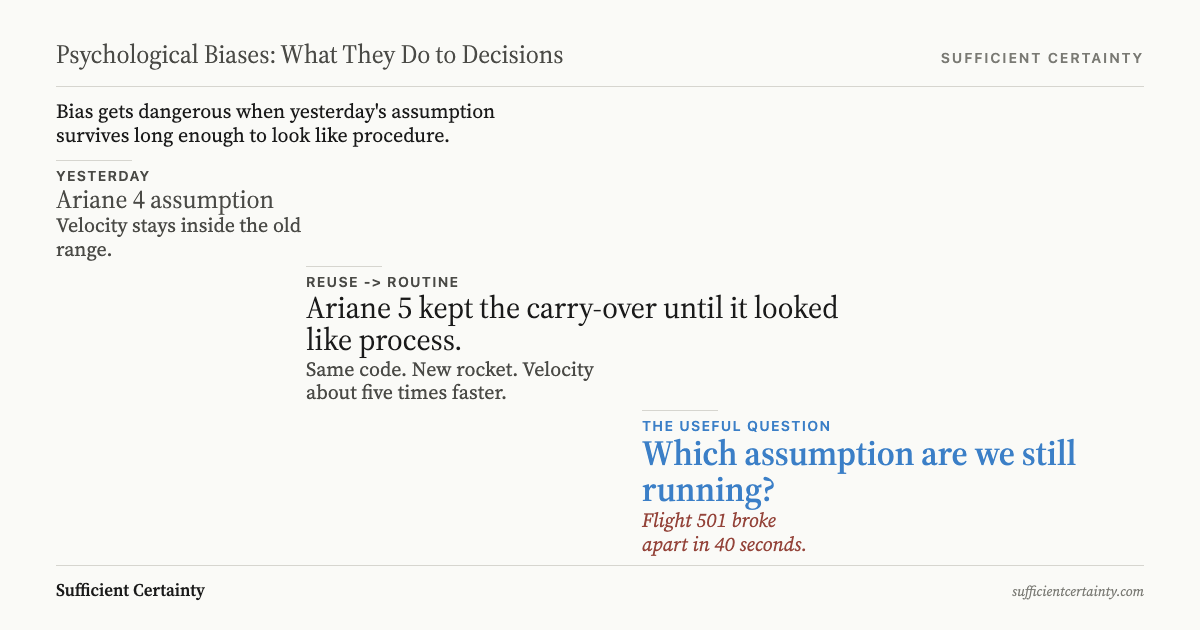
The official Ariane 5 inquiry report is worth reading because the logic is so painfully ordinary. Ariane 5's horizontal velocity built up about five times faster than Ariane 4's, yet a realignment function from the older rocket was left running for commonality reasons. The relevant variable was not protected from overflow because the team had not fully analysed what value it could take after lift-off. They needed a harder conversation about which assumptions had been carried forward and why.
I have seen the same shape in boardrooms, only with less fire and better catering. A supplier model from the last expansion gets reused because it once looked sensible. A committee paper keeps a line of reasoning because it survived the previous quarter. That is where psychological biases become dangerous. It is the live end of cognitive biases in decision making, the point where an inherited judgment starts behaving like a fact.
Where psychological biases enter the room
Berthet's 2022 review in Frontiers in Psychology screened 3,169 records, selected 79 articles, and found recurring bias effects across professional judgment, with overconfidence appearing most often. Professionals show the defect again and again. That was never the mystery. The mystery is why organisations still pretend that knowing about biases and heuristics is a countermeasure.
Calling somebody biased is lazy. In the Universal Decision-Making Method, the live work starts at Recognise assumptions and gets tested again at Sufficient certainty. I want the room to state what it is presuming and what evidence would puncture the preferred answer. Once that is written down, the air usually changes.
Test the decision on your desk through the five steps and see which assumption gives bias room to operate. Start the Walk →
Why psychological biases survive expertise
The World Development Report 2015 did something I respect: it turned the lens back on the experts. In one exercise, 42 per cent of World Bank staff thought most poor Nairobi residents would agree that vaccines were risky because they could cause sterilisation. Only 11 per cent of the Nairobi respondents agreed. The point is simple: distance lets experts mistake remoteness for knowledge they have not earned.
The same chapter notes that groups can correct more than individuals when the group is built properly. Most organisations are not built properly. They run awareness sermons and call that discipline. That arrangement suits the people paid to keep the sermon going. The 2025 study by Midtgard and Selart, based on 119 managers in Scandinavian organisations, found that illusions of control and beliefs about change processes pushed strategic choices toward shareholder value even when capability building was the live issue. Nobody in those studies thought they were doing anything but weighing the evidence. If the last crisis is all anyone remembers, you are already sliding toward availability bias.
How I test bias in a live decision
In my experience, the cleanest test is to stop the meeting and ask for one sentence on the table: what has to be true for this answer to work? Then I ask a second question: what evidence, if it arrived tomorrow morning, would force us to rethink it? That sounds simple because it is simple. It is also the moment the meeting stops pretending. The people who had been speaking in polished abstractions have to name a bet. The people hiding behind process have to say whether the process has actually checked anything, which it often has not.
Take a decision to consolidate two distribution centres into one, the kind of problem that lands on an operations manager's desk sooner or later. Management says demand will stay soft and customers will tolerate the disruption. I would write those assumptions where everyone can see them, then ask which one is carrying the recommendation. Usually one assumption is doing nearly all the work. Once that becomes visible, the decision changes shape. At that point the grand strategy deck boils down to one live assumption with consequences, much like the cases behind these cognitive bias examples.
The next move is where many rooms start wriggling. If soft demand is carrying the recommendation, I ask what evidence supports that claim now and what monitoring signal would prove it wrong within 30 days. If nobody can answer, the recommendation has not earned the confidence being claimed. It may still be right. It is simply not ready. That is the difference between a decision and a performance of decisiveness, which senior teams often confuse when the slide deck is expensive.
Colleagues call me impatient with workshops that tell people to watch for bias and then send them back to the same template. Roger Estall and I wanted a method that made concealment harder, which is where overcoming cognitive biases actually begins. Write the assumption down and half the room becomes uncomfortable, especially the people who were hoping to smuggle preference through as expertise. Oddly enough, consultants and governance staff rarely volunteer for that discomfort.
Psychological biases do not retire when the meeting ends. They go into the monthly paper and the approval template, where they can sit for years looking official. Design monitoring matters because new evidence arrives after the applause. If nobody reopens the call, yesterday's bad assumption becomes today's process, which is exactly how poor decisions acquire a policy manual and a custodian. That suits the custodians of process very nicely, because the template does not blush when it is wrong.
You could spot your favourite bias and still carry the old assumption into Monday's decision.
Work through your decisionNo sign-up. Just pick your decision and start.
Grant Purdy is the co-author, with Roger Estall, of Deciding (2020), and the architect of the Universal Decision-Making Method.