
Cognitive bias examples are not history lessons. They are live warnings for anyone running operations. Every case below passed its approval checkpoint while carrying an assumption nobody tested. The bias is never the root cause on its own. The root cause is a decision process that gave it a clear road.
Flint switched water sources to save about $5 million over two years. BP read a failed test as permission to proceed. WHO sat with Ebola from March 2014 until August 8, 2014 before declaring a public health emergency. LTCM borrowed as if its models could not be wrong. NASA watched foam strikes become routine until Columbia broke apart and killed all seven crew on February 1, 2003. If you are still wondering what psychological biases do once they leave the lab, every case below is the answer.
I have spent enough time around incident reviews to know that risk management is a belief system. Belief systems start with the answer more often than people admit. They keep insurers in premiums and regulators in paperwork. They keep academics publishing and consultants returning. Most organisations do not make decisions. They ratify conclusions that have already been reached. Roger Estall and I built our method because I got tired of watching the ceremony pass for thinking.
Cognitive bias examples are documented cases where a decision passed every approval checkpoint while carrying an assumption nobody tested.
Why these examples matter in operations
Sarah, if you run operations in a manufacturer, these cases are not history lessons. They are live warnings. Every supplier switch and maintenance deferral contains the same trap. The bias is not the problem on its own. The problem is a decision process that lets bias move through the room unchallenged. I wrote the wider map of cognitive biases for exactly this reason, sorted by which process checkpoint each type of bias actually breaks, and Roger and I built our method to do something about it.
The method forces teams to name the real decision, state what they are assuming, and set a tripwire before anyone signs off. I am not interested in heroic decision-makers. I am interested in ordinary teams who stop fooling themselves soon enough to change course. The cognitive bias examples above all had that moment, the point where one direct question would have changed the outcome.
Cognitive bias examples from Flint and BP
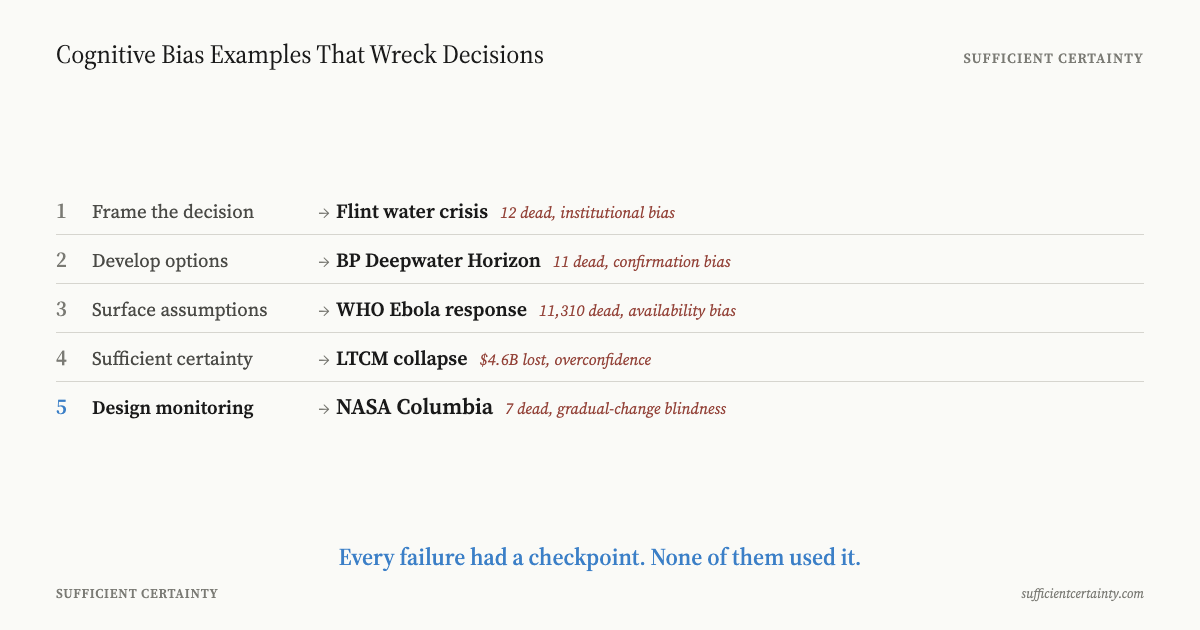
Flint is what happens when Step 1 is broken. The Michigan Civil Rights Commission report shows officials treating the 2014 water-source switch as a budget problem, not a public-health decision. Once the frame became, "how do we save money," corrosion control looked like a technical footnote instead of part of the decision itself. It was no footnote. Lead leached into water, Legionnaires' killed 12 people and sickened more than 87. I see this move all the time. A plant risk gets framed as a cost target, then everyone acts shocked when the cost comes back wearing steel boots. Institutional bias starts before anyone compares options.
BP shows the next failure. In the Deepwater Horizon paper on negative pressure test interpretation, anomalous data was read to confirm the preferred conclusion, proceed. That is Step 2 corrupted by confirmation bias. It is also why most option sets in big organisations are fake. One option is real, the others are there to make the paperwork look balanced. On April 20, 2010, the blowout killed 11 workers, injured 17, and released about 4.9 million barrels of oil. Evidence had stopped being evidence. It had become decoration for a conclusion that management already liked.
Run your next operational approval through the five steps and inspect which checkpoint Flint, BP, and NASA would recognise. Start the Walk →
Cognitive bias examples from WHO, LTCM, and NASA
The WHO Ebola Interim Assessment Panel is Step 3 in plain view. WHO had notice in March 2014, but the emergency declaration did not come until August 8, 2014. The outbreak went on to reach 28,616 cases and 11,310 deaths. The panel described a response shaped by the mental availability of earlier outbreaks that had burned out, along with the political bruising from H1N1. That is availability bias. We drag the last vivid event into the present and call it judgment. I do not care how senior the room is, memory is not a method. If this one shows up often in your business, read availability bias.
The LTCM case described by Mark Stein sits at Step 4, sufficient certainty. The fund treated model-based confidence as certainty, then used that supposed certainty to justify extreme borrowing. In 1998 it lost about $4.6 billion, then fourteen banks assembled a $3.6 billion rescue under Federal Reserve pressure. I have been making this argument about risk for years. I learned it the dull way. In Deciding, Roger and I make the same point: models can inform a decision, but they do not remove the need to decide under uncertainty. When someone says, "the model says," I usually hear, "please do not ask another question." A marvellous arrangement, if your bonus arrives before the loss does.
NASA's Columbia Accident Investigation Board report shows Step 5 failing after years of warning. Foam shedding had occurred on 65 of 79 prior missions. Because the shuttle kept returning, the abnormal became normal. That is gradual-change blindness, and it is one of the most dangerous cognitive bias examples in any industry. Then on February 1, 2003, Columbia disintegrated and killed all seven crew. I want monitoring designed before the reassuring story hardens. In operations, this is the machine that vibrates a little more each month, the defect that stays just inside tolerance until it does not.
What we do differently now
Roger and I did not build the Universal Decision-Making Method to make people bias-free. That fantasy has kept plenty of training firms well fed. We built it to catch bias early enough that people can still decide well, which is all overcoming cognitive biases has ever meant in practice. For Sarah, that means taking one live decision on Monday morning, the one already half-approved in the corridor, and walking it through the five steps. What are we assuming because it feels familiar. How will we know early if we are wrong.
That short walk beats another bloated risk register every time. I have seen organisations create 29 special labels for different types of risk. Twenty-nine. Not one of them helped anyone make a better decision. If you want to sharpen the discipline further, look at sunk-cost bias next, the one that keeps teams pouring money into a failed bet because they cannot stomach the loss. Notice whether anyone in the room has said what would make them stop.
You could dismiss these cases and carry the same untested assumption into your next approval.
Work through your decisionNo sign-up. Just pick your decision and start.
Grant Purdy is the co-author, with Roger Estall, of Deciding (2020), and the architect of the Universal Decision-Making Method.