
Cognitive biases do not cause bad decisions on their own. They succeed because the decision process gave them a free pass. Fifty years of naming and cataloguing biases has not stopped a single one. A process that forces the hidden assumption into the open before commitment hardens is the only countermeasure that works.
Psychology has catalogued over two hundred cognitive biases, from anchoring to the sunk cost fallacy. You can name every one of them and still walk into your next board meeting and fall for all of them. A cognitive bias in decision making is a systematic deviation from sound judgment caused by an assumption that was never examined. It is not a personality flaw. It is a gap in the decision process where an assumption slipped through without scrutiny.
In 2011, Daniel Kahneman, Dan Lovallo, and Olivier Sibony published a paper in Harvard Business Review identifying the nine cognitive biases that most damage business decisions. McKinsey, one of the most capable consulting firms on earth, produced the best countermeasure the industry could offer: a twelve-question checklist for boards to ask before approving a major decision. Good questions. Also questions that competent boards were already supposed to be asking. The checklist added awareness. It did not add structure. It did not change a single step in how the decision was actually made.
Fifty years of behavioural economics, and the prescription has not moved: know the names, watch for the patterns, ask better questions. The cognitive bias industry catalogues biases the way an entomologist pins beetles. Hundreds of specimens, carefully labelled, no mechanism for catching them in the wild. I am Grant Purdy. I have spent nearly fifty years helping organisations make consequential decisions, and the ones that fail are not the ones that lack awareness of their biases. They are the ones that lack a decision process for catching the assumptions those biases smuggle past the room.
Cognitive biases are the habits of letting untested assumptions steer organisational judgement while they still feel like common sense.
What a cognitive bias actually does to a decision
Every popular account explains cognitive biases as quirks of human psychology. Anchoring is a mental shortcut. Confirmation bias is a preference for evidence that supports what you already believe. These descriptions are accurate and entirely unhelpful. They describe the mechanism without touching the point where the bias enters a real decision.
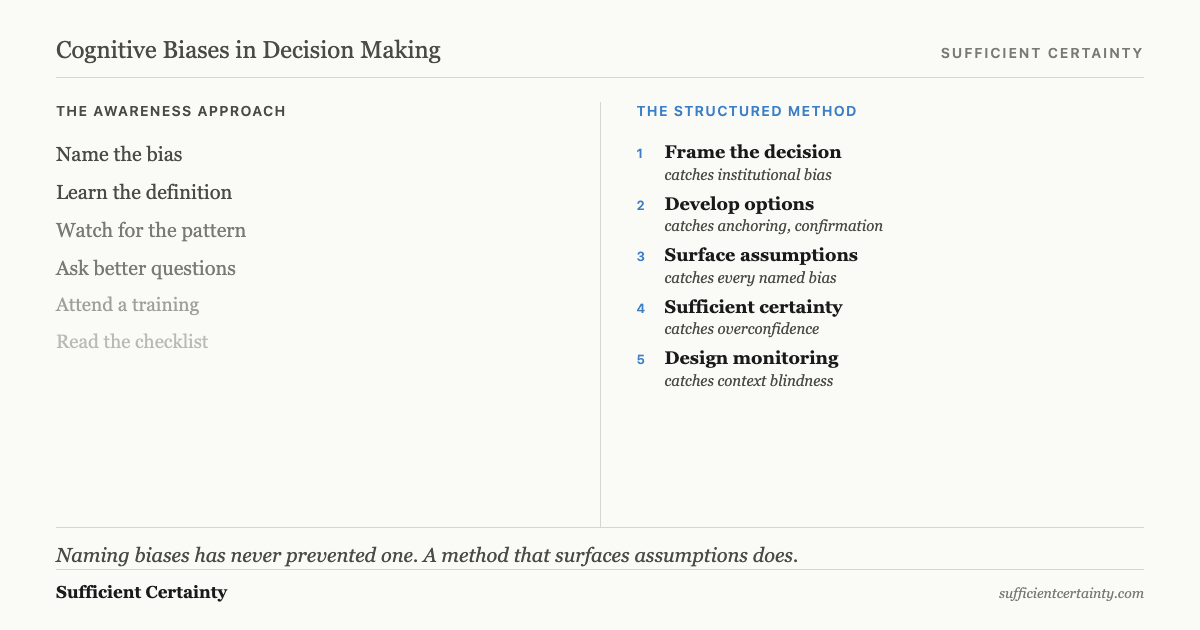
The point of entry is always an assumption. Anchoring smuggles a reference point into the evaluation: the first number you hear becomes the floor of your judgment, not because you are weak, but because the reference point was never identified as an assumption and examined on its merits. Confirmation bias smuggles a preferred conclusion into the evidence-gathering: you search for supporting data, not because you are dishonest, but because the preferred conclusion was never surfaced as something that might be wrong. Analysis paralysis and decision fatigue are often the residue of biases operating unchecked: the Decider senses something is wrong but cannot name the assumption causing it, so they ask for more data or defer the decision entirely.
The broader pattern holds across all biases and heuristics: a shortcut earns a track record, gets promoted to authority, and soon nobody can remember why that cue was trusted in the first place. Intuitive decision making runs on the same rails: compressed experience that works until the terrain changes and nobody notices.The vocabulary does not change the mechanism. Psychological biases, the term the textbooks prefer, do their damage the same way: an assumption enters unnoticed and stays untested.
Representativeness bias is the cleanest example. A case resembles a past success and the resemblance quietly stands in for probability. Nobody tests whether the conditions that made the original work are present this time.
Every cognitive bias operates by inserting an unexamined assumption into the decision. That reframing matters because it points to a countermeasure that is structural, not motivational. You do not need to become less biased. You need a decision process that catches the assumptions biases rely on.
Where cognitive biases hide in the decision process
The Universal Decision-Making Method that Roger Estall and I set out in Deciding has five steps. Each catches a different cluster of cognitive biases, not by naming them, but by forcing the assumptions they rely on into the open.
| Decision step | Biases caught | How |
|---|---|---|
| Frame the decision | Institutional bias, exclusion bias | Forces the question itself to be examined before analysis begins |
| Develop options | Confirmation bias, anchoring | Prevents the group from locking onto a single preferred option |
| Recognise assumptions | All named biases | Every bias smuggles an assumption; surfacing assumptions catches the bias |
| Sufficient certainty | Overconfidence, maximum certainty | Demands evidence proportional to consequence |
| Design monitoring | Context blindness, gradual-change blindness | Catches biases that develop after the decision when context shifts |
The third step is where the method does what awareness cannot. Psychology tells you anchoring exists. The method asks: what reference point are we using, and why do we trust it? Psychology tells you confirmation bias is common. The method asks: what are we assuming to be true, and what evidence would change our mind? The entire System 1 vs System 2 thinking framework suffers from the same limitation: it names the fast-thinking pattern without giving anyone a checkpoint to catch it.
No page-one result for cognitive biases in decision making maps specific biases to specific steps in a named decision method. They stop at "be aware." The sunk cost fallacy is not a knowledge problem; everyone knows about it. Sunk cost bias persists because the assumption "we have invested too much to stop" is never surfaced and examined as an assumption. The same pattern holds for availability bias, where the assumption "what comes to mind easily is what matters most" bypasses scrutiny entirely. A method that requires you to name your assumptions catches the data paralysis and decision drift that awareness training does not.
The distinction that matters is not which bias label applies but which process checkpoint failed. The four types of cognitive bias that map to method steps separate what psychology catalogues by mechanism from what a decision process can actually catch.
When real organisations skip these checkpoints, the results fill cognitive bias examples that looked reasonable inside the room until they looked monstrous outside it.
Run your next decision through the five steps and catch the assumptions a bias checklist never reaches. Start the Walk →
Framing: the bias you built into the question
Boeing needed a narrow-body aircraft to compete with the Airbus A320neo. The decision was framed as a competitive response: how do we get a fuel-efficient aircraft to market before Airbus takes our customers? That frame excluded safety trade-offs from the start. The 737 MAX's MCAS system, designed to compensate for engine placement that changed the aircraft's handling characteristics, relied on a single angle-of-attack sensor. A redundant sensor would have added cost and time. Within the competitive frame, a single sensor was adequate. Within a safety frame, it was not. Three hundred and forty-six people died in two crashes before anyone revisited the frame that produced the decision.
The framing bias did not enter at the engineering stage. It entered at the question. "How do we compete with Airbus quickly?" is a fundamentally different decision from "How do we build a safe narrow-body aircraft that also competes with Airbus?" Once the frame excluded safety as a primary criterion, no amount of downstream analysis could recover it. The engineers who flagged concerns about single-sensor MCAS were raising a safety question inside a competitive frame. The frame won.
Step 1 of the Universal Decision-Making Method treats the frame itself as an assumption to be examined: what are we actually deciding, what purpose does this decision serve, and what have we excluded by framing it this way? Problem framing is not a preliminary exercise. It is the decision that shapes every decision after it.
The frame also opens the door to halo effect bias. A rising share price or a famous brand name starts carrying claims it has not earned, and the frame bends to accommodate the prestige before anyone has tested the evidence underneath.
The broader pattern is that cognitive biases in business survive not because individuals fail to spot them, but because the target, the scorecard, and the status hierarchy have already decided which answer is safe.The assumption that was never spoken
A manufacturer I worked with was pricing a new product. The team had a number in mind: the competitor's price, minus ten per cent. That number was an anchor. It set the floor and ceiling of every subsequent discussion about margins, volumes, and channel strategy. Nobody in the room identified it as an assumption. They treated it as a starting point, which is precisely what an anchor does.
When we applied Step 3 of the method, recognise assumptions, the team listed what they were taking as given. "The competitor's price reflects the market's willingness to pay" appeared on the list. So did "our cost structure supports a ten per cent discount." Neither assumption had been tested. The competitor's price reflected their own cost structure, not the market's valuation. The discount assumed volume targets that required a distribution channel the company did not yet have.
Once the assumptions were visible, the pricing decision changed fundamentally. Not because anyone attended a seminar on anchoring or read a case study about confirmation bias in pricing. Because the decision process forced the anchor into the open where it could be examined against evidence. That is the difference between awareness and a countermeasure. Awareness tells you to watch out for anchoring bias. A method tells you to list your assumptions, and the anchor has nowhere to hide. The same applies to confirmation bias in decision making: knowing it exists does not stop you protecting an early answer.
Certainty you have not earned
You cross the road every day. You do not treat it as a decision. You do not examine your assumptions about traffic speed, driver attention, or your own reaction time. You have done it thousands of times without incident. That familiarity is overconfidence bias operating exactly as designed: past repetition creates the feeling of certainty where none has been earned.
Step 4 of the Universal Decision-Making Method asks a specific question: do we have sufficient certainty to proceed, given the consequences of being wrong? For crossing the road, the consequences are severe and the certainty is lower than it feels. For a routine purchase order, the consequences are modest and the certainty is probably adequate. The question scales with the stakes. Overconfidence does not.
I have watched boards approve capital expenditures running into hundreds of millions with less scrutiny than a homeowner gives a kitchen renovation. The pattern is identical: we have done this before, it worked last time, it will work now. When I ask what level of certainty this decision requires, the room goes quiet. They have not asked the question because overconfidence made it feel unnecessary. Decision making under uncertainty is not about eliminating uncertainty. It is about knowing whether you have enough certainty for this decision, at this consequence level, right now.
Overconfidence bias thrives in exactly this setting because it does not look like a flaw. It looks like a careful room agreeing it knows enough, before the evidence says so.
Three conversations that catch what awareness cannot
Roger Estall and I identified seven structured conversations in Deciding that catch cognitive biases during a decision. Three belong here. The remaining four are re-visiting earlier decisions when new information arrives, providing context so that people making the decision understand the full picture rather than just their slice of it, actively encouraging other views rather than waiting for dissent to volunteer itself, and maintaining clarity of purpose so the original reason for the decision does not drift under political pressure. Each is a discipline in its own right, and each gets fuller treatment in the spoke articles below.
The first is the naysayer. Appoint someone whose explicit job is to challenge the group's emerging direction. The role must be structural and protected, not theatrical or personal. If nobody in the room is tasked with disagreeing, nobody will. Social pressure is not a minor force in group decisions. It is the dominant one.
The second is "best idea wins": the argument determines the outcome, not the person making it. A Dutch research study found that groups led by junior members consistently outperformed those led by senior members on decision quality. The junior leaders lacked the positional authority to suppress challenge. That finding is counterintuitive only if you assume seniority equals competence. What seniority actually provides is the power to end the conversation before the weak assumption gets named.
The third is musing: thinking aloud before conclusions harden. When someone says "I am not sure about this, but the sales projections assume we keep the current distributor," they are surfacing an assumption that a polished presentation would have buried. Most organisations have trained that instinct out of their people. The half-formed thought is often the one that catches the bias the finished slide deck conceals. The same principle applies to emotional decision making: the feeling carries an assumption, and suppressing it protects yesterday's commitment from scrutiny.
These are not tips from a management poster. They are structural countermeasures embedded in the Universal Decision-Making Method, designed to catch the cognitive biases in decision making that awareness training has not managed to reach. The practical work of overcoming cognitive biases is running those conversations on a live decision, one at a time.
Start with one decision
Pick a decision you are currently facing. Run it through the five steps. Frame it. Develop genuine options. List every assumption each option rests on. Ask whether you have sufficient certainty, given the consequences of being wrong. Agree what to monitor after you commit.
Notice what surfaces. The anchor you were using without realising it. The conclusion you had already reached before you started gathering evidence. The assumption everyone shared and nobody questioned. That is what cognitive biases look like when they are caught by a method, not named in a catalogue.
You could walk into the meeting certain, and miss what everyone else is seeing.
Work through your decisionNo sign-up. Just pick your decision and start.
Grant Purdy is the co-author, with Roger Estall, of Deciding (2020), and the architect of the Universal Decision-Making Method.