
Problem framing examples that matter are not tidy workshop stories. They are cases where a forty-page board paper and a risk register thick enough to stop a door still led to the wrong answer because nobody tested the opening question. The frame was wrong. Everything built on it inherited the error.
Most problem framing examples on the internet are tidy little workshop performances. I have sat with directors holding a 40-page board paper and a risk register thick enough to stop a door, and still had to tell them the room was solving the wrong problem.
Once the frame is wrong, the analysis becomes evidence that the organisation did its homework on the wrong decision.
When people ask me for examples, I do not send them to coloured canvases or sponsor-approved "neutral processes". I send them to public failures, because that is where bad framing stops sounding clever and starts sending invoices, usually to people who never approved the frame (which is how these arrangements are usually sold).
Roger Estall and I wrote Deciding after watching the same little arrangement repeat itself: the sponsor wanted approval and the consultant wanted the brief to survive, while the board was expected to mistake motion for judgement. That is why the first step in the Universal Decision-Making Method is to Frame the decision, and why I keep separating problem definition and problem solving. Until the frame is plain, the room is not deciding, it is arranging cover.
Problem framing examples are cases that show how the first question in a decision decides what evidence counts and what consequences get overlooked.
Problem framing examples get expensive long before they look absurd
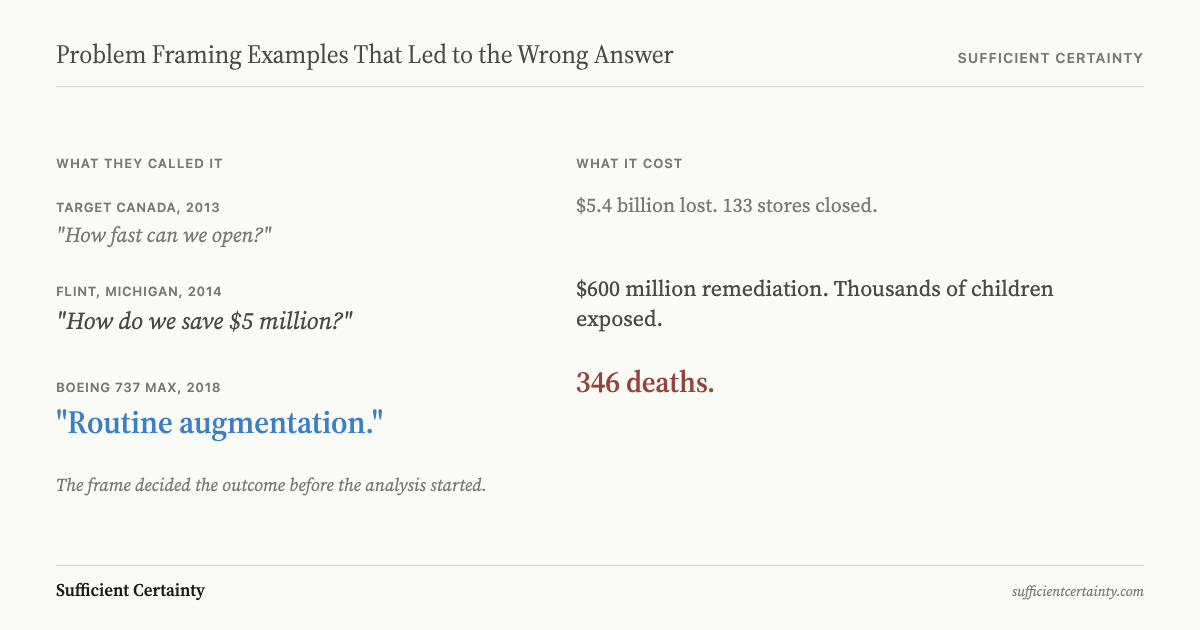
Target entered Canada in 2013 by taking 220 Zellers leases and opening 133 stores in less than two years. By early 2015 the venture had lost $5.4 billion, 17,600 people had lost their jobs and all 133 stores were heading for closure. I do not buy the comforting version of this story, the one where a sound plan was ruined by execution. Execution was serving the frame it had been handed.
Executives chasing rollout speed benefited from calling Canada an extension of the American model. Once the move is dressed up as rollout, haste looks disciplined, familiar systems travel north without much argument and anyone asking "are we entering a different market?" can be treated as a drag on momentum (which is executive language for "stop slowing the rollout"). Target's annual reports archive and its 2014 earnings announcement record the financial wreckage. The more revealing point is managerial convenience: "how fast can we open?" is a far easier question to defend than "what does this market require of us?"
In my experience, that is how framing failure usually behaves. The first sentence makes the later blunders look reasonable. Empty shelves and disappointed customers were the bill for pretending Canada was "more Target" instead of a market-entry decision with its own suppliers and customers. If you want useful problem framing techniques, start by asking whether the opportunity really is an extension of what you know, or a different decision wearing a familiar badge.
Put the question behind your current problem into the five steps and catch where framing has already chosen the answer. Start the Walk →
Flint let officials hide behind a savings story
Flint is harsher because the frame protected the people defending the savings story while exposing the people drinking the water. Michigan's emergency manager approved the 2014 switch from Detroit water to the Flint River to save about $5 million over two years. Corrosion control would have cost roughly $100 a day. It was not used. Later inquiries found 43 homes above the EPA action level of 15 parts per billion, thousands of children were exposed to elevated lead and remediation costs ran beyond $600 million.
The Flint Water Advisory Task Force and the Michigan Civil Rights Commission make the fiction hard to miss. Once the decision was framed as a savings exercise, chemistry was demoted to a technical detail and public health entered the room late, if at all. That arrangement served officials who needed to defend thrift and process, because "we saved money" sounds much better in a memo than "we changed the water source without protecting the pipes".
I have seen softer versions of this for years. A plant decision gets called a budget decision, then somebody acts surprised when the budget wins. Reopening the frame, which is what I mean by reframing problems, would have forced the live question into daylight: how do we keep the water safe while changing source?
Boeing let schedule economics pose as engineering judgment
Boeing's MCAS decision shows how much trouble a polite frame can hide. The company treated MCAS as a routine augmentation so certification could move quickly and airlines would not have to pay for simulator training. Managers protecting schedule and training economics had every reason to keep that label in place. Once the system is called routine, deeper scrutiny starts looking like delay, and delay was the one thing the program was organised not to tolerate.
The Joint Authorities Technical Review and the House hearing record show what followed. Assumptions that shaped MCAS lost visibility inside the design and certification process. A system that could repeatedly force the nose down was allowed to depend on one angle-of-attack input, and pilot documentation was treated as a secondary nuisance. Lion Air 610 and Ethiopian Airlines 302 killed 346 people. After the first crash, Boeing still leaned first on pilot blame, which is what organisations usually do when the original frame is still paying salaries.
I do not regard this as one bad technical choice floating free of the business. The business question had already colonised the engineering question. Once managers decided to preserve common type rating, avoid simulator cost and protect schedule, calling the result routine became the easiest story in the building. That is how a frame turns an aircraft decision into paperwork. The design follows the sentence that won the meeting.
What these problem framing examples should force you to test
Each case had smart people and enough paperwork to impress a board pack addict. None of that helped, because the frame was already telling the system what counted. That is why the wider guide to problem framing starts earlier than most advice pieces do. I want the room to write a dated sentence in plain English saying what decision is being taken, whose Purpose it serves and how long the judgement has to hold. If the room cannot do that, it is not ready to analyse anything. It is laundering a preference and calling the paperwork governance.
You could solve the next problem beautifully and still answer the wrong question.
Work through your decisionNo sign-up. Just pick your decision and start.
Grant Purdy is the co-author, with Roger Estall, of Deciding (2020), and the architect of the Universal Decision-Making Method.