
Saying no at work and having it respected has nothing to do with phrasing and everything to do with what sits behind the refusal. The difficulty sits before the conversation: the person refusing has no frame strong enough to make the refusal stick. Name what your team exists to do, rank the work against that Purpose, and the no becomes automatic.
The standard advice sells two promises: softer language and a ready-made alternative. Communication coaches and assertiveness-workshop vendors have built a secondary economy around polishing the phrasing of a refusal, while the structural reason the refusal collapsed is not their concern; the next booking is.
The scripts hold up on the page. They do not hold up when a senior stakeholder with budget authority and a deadline walks into the room and asks why the project she endorsed has been declined by someone who can cite nothing beyond a full calendar.
I have spent nearly fifty years in rooms where this plays out. I once asked a committee chair why he approved a program expansion he privately called pointless; his answer was that nothing written down said he should not.
The gap was in his organisation's records, not in his vocabulary. No stated Purpose, no ranked set of priorities with the assumptions behind each ranking visible to anyone in the room.
The refusals that held had one thing in common, and it was never the phrasing.
Saying no at work is the act of refusing a request on the basis of a stated decision about what matters more, not personal preference or capacity.
What fifty-three yeses cost
Marissa Mayer became Yahoo CEO in July 2012 and completed fifty-three acquisitions totalling approximately $2.3 billion in four years. The strategy was branded MaVeNS, an acronym that papered over the absence of a single clear purpose.
Yahoo would be everything to everyone simultaneously. The acronym gave the appearance of coherence to what was in practice a portfolio with no governing frame.
Activist investor Starboard Value publicly criticised $1.3 billion of the spend as producing no measurable revenue improvement. Yahoo projected 2016 revenue to decline by up to seventeen per cent. Mayer sold Yahoo's core business to Verizon in 2017.
Each of the fifty-three acquisitions addressed a real market opportunity; none was irrational in isolation. They were catastrophic in aggregate because there was no Purpose to test them against, and each acquisition consumed integration resources that reduced the organisation's capacity to refuse the next one.
I once sat on a program board that approved every business case scoring above a threshold of seventy. Each approval was defensible on its own terms, and within eighteen months the portfolio was collapsing under the weight of competing priorities that were never ranked against a single stated outcome.
You cannot push back on work that someone senior has endorsed when the endorsement rests on nothing more than a score. That pattern is not limited to billion-dollar portfolios. It repeats everywhere the approval process produces a number and nobody has recorded what the organisation is actually for.
Name what your team exists to do and test whether the next request you receive falls inside or outside it. Start the Walk →
Why saying no at work fails without a frame
When Steve Jobs returned to Apple in September 1997, the company was ninety days from insolvency and selling roughly 350 products across dozens of categories. Jobs drew a 2x2 grid on a whiteboard with consumer and professional on one axis, desktop and portable on the other.
Everything outside those four quadrants was cut, and the product line shrank from about 350 SKUs to approximately ten. The company's stock grew roughly 9,000 per cent over the following fourteen years.
At the 1997 WWDC, he said what every manager who has tried the polite refusal already suspects: "Focusing is about saying no."
That grid was the simplest possible prioritisation matrix, and once it existed, the refusals were automatic. No middle manager at Apple needed to explain to a product team why their line was cancelled; the grid explained it.
I have watched the inverse in organisations that skip the framing step. Every request arrives looking reasonable because there is no stated Purpose to test it against, and the person receiving the request has nothing to point to except their own workload.
A workload argument is a capacity claim, and capacity claims lose to seniority every time. That is the mechanism every polite-refusal article on the internet leaves unexamined.
Saying no at work follows the frame
By 2003, LEGO had diversified into theme parks, clothing, and television programming. Revenue was falling thirty per cent in two years, and the company posted losses of nearly $300 million.
When Jorgen Vig Knudstorp became CEO in 2004, his first move was to restate the Purpose: LEGO was a construction-play company. Everything that did not serve construction play was divested or shut down. The number of unique brick elements was cut from 12,400 to approximately 7,000.
That is a forty per cent reduction in product complexity, and it required nothing resembling an assertiveness workshop.
Knudstorp did what the Universal Decision-Making Method calls the first step: he framed the decision by naming the Purpose and the desired outcome. Nobody in the building needed to be individually brave because nobody was delivering a personal opinion. They were delivering an organisational position.
First profit after the restructure was €61 million in 2005. By 2006 the operating margin had reached 15.6 per cent, and by 2021 profits had grown to $1.9 billion. The turnaround began with the frame, not with better communication.
Roger Estall and I wrote in Deciding that the first step in any structured decision is to state the Purpose and Context. Without those two declarations, every option looks plausible and the person tasked with refusing carries the entire weight alone.
I have seen the same dynamic in organisations a fraction of LEGO's size. A general manager names what the business is actually for, and within a quarter the pet projects that nobody could refuse individually are quietly shelved. The frame has made the refusal an act of housekeeping rather than an act of confrontation.
Bent Flyvbjerg's database of more than 16,000 projects found that 91.5 per cent failed on cost, time, or both. The approval process for most of them included a scoring matrix. I have never seen a scoring matrix refuse a project; I have only ever seen it rank one above another.
A project matrix that ranks without testing assumptions produces approvals, not decisions. The five steps exist precisely because ranking is insufficient; the third and fourth steps, recognise assumptions and then test them, are the ones most approval processes skip entirely.
That is the difference between a no that gets overridden and one that gets respected. The respected refusal does not rest on the person delivering it. It rests on a decision the organisation has already taken, recorded where anyone can read it.
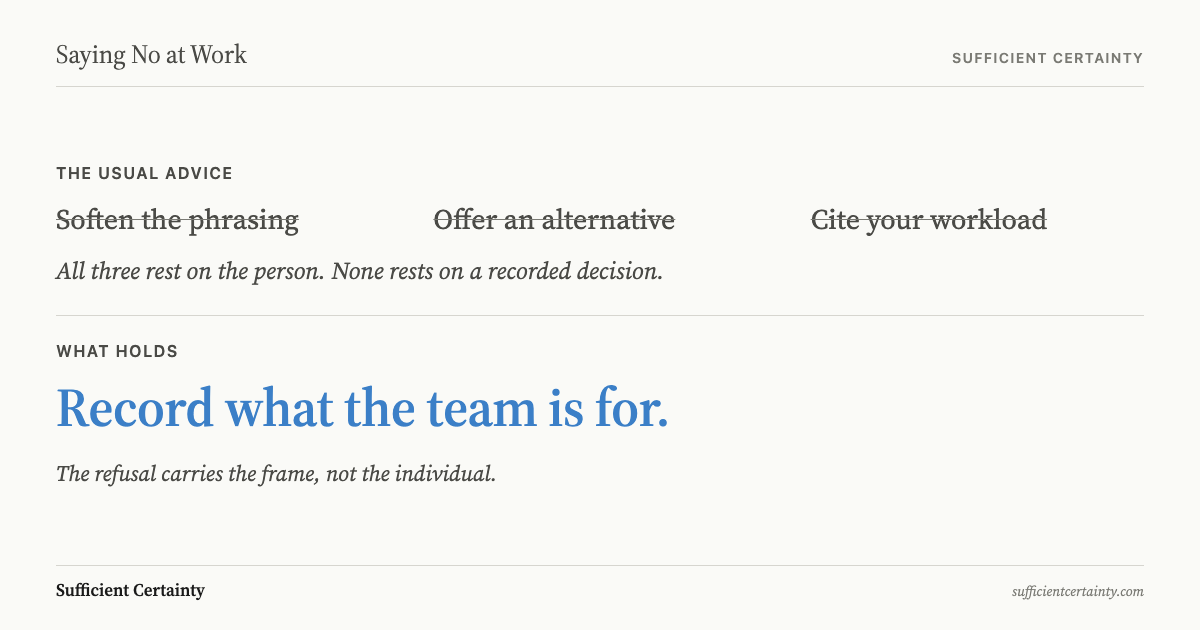
Name what your team exists to do. Rank the work against that Purpose. When the next request arrives, test it against the frame. If it falls outside, the refusal is not yours to carry. It belongs to the decision your organisation has already made. That is how saying no at work earns respect: not through softer phrasing, but through a recorded decision that does the refusing for you.
You could try the polite refusal again and still leave no recorded decision behind it.
Work through your decisionNo sign-up. Just pick your decision and start.
Grant Purdy is the co-author, with Roger Estall, of Deciding (2020), and the architect of the Universal Decision-Making Method.