
A scenario planning framework earns its keep when it sits inside a decision method, not beside it. Most frameworks map futures and stop. The one step that matters is naming the assumption the investment depends on, then setting the trigger that reopens the decision when the assumption moves.
I once sat with a board facing a $40 million plant request and a 64-page scenario pack built around four futures. The meeting was six days away. After two workshops and a consultant deck, nobody could tell me which assumptions had to hold for the investment to pay back. That is where a scenario planning framework usually fails: nobody names the assumptions the investment depends on.
In my experience, the exercise goes off the rails the moment the room starts admiring the futures instead of testing the decision. A scenario planning framework should help a Decider act under uncertainty. Too often it produces respectable fiction, coherent futures and polished language, while the live question is left untouched: what would have to be true for this option to work?
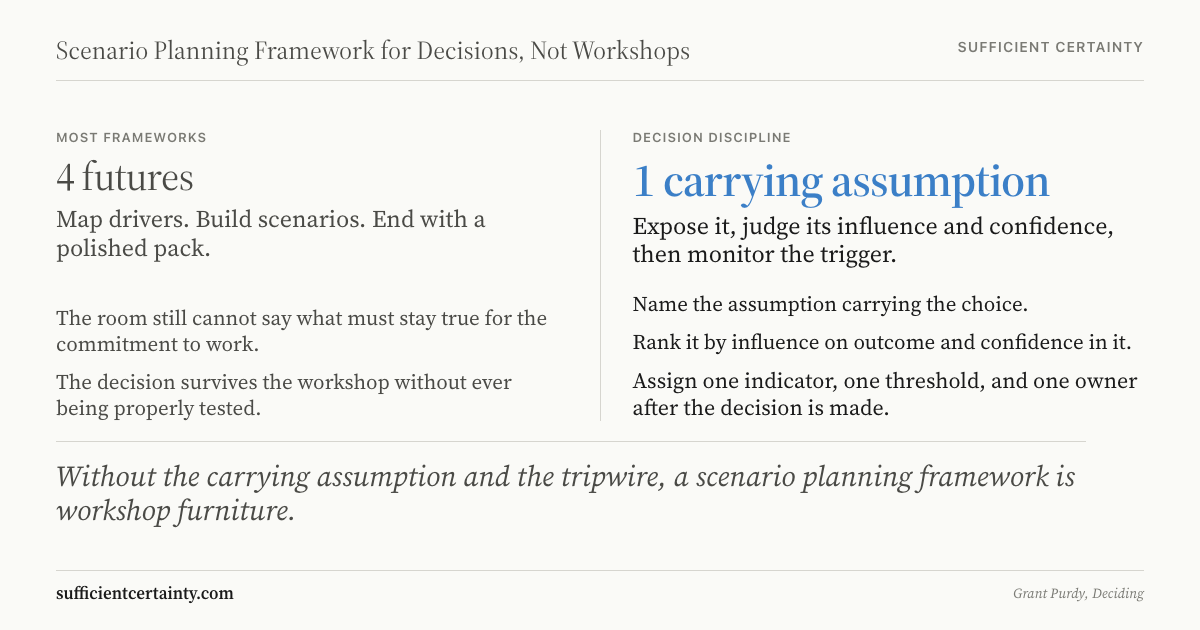
A scenario planning framework tests whether a live decision survives more than one future by exposing the assumption carrying the choice.
Most scenario planning frameworks stop before the decision
GBN, the UK Futures Toolkit, and Three Horizons all help people talk about futures, which is exactly why consultants and internal sponsors can stop there with everyone looking industrious. The hard question still sits untouched: which assumption would sink the decision now on the table?
| Framework | What it gives you | What is usually missing |
|---|---|---|
| GBN five-phase model | interviews, scenarios, and monitoring | A hard test of which assumption would break the current decision |
| Three Horizons | A timing lens for core and growth bets | Any way to judge if the bet survives uncertainty |
| Futures Toolkit | driver mapping and stress-testing | Influence-confidence judgement tied to one accountable decision |
The apparatus is better than the average strategy offsite, but it still circles external drivers and tidy stories about the future. The decision itself often gets special protection, as if the point of the exercise were to make the proposal look thoughtful rather than find out whether it stands up. Once the room has four scenarios and a neat grid, the proposal acquires a kind of diplomatic immunity.
That omission is the whole job. A capital decision or product launch only deserves the label of careful work when the Decider can say what must stay true for it to succeed. Without that, the scenarios are just scenery, useful mainly as evidence that a workshop occurred.
That is why I have little patience for workshops that end with a two-by-two matrix and a pleasant feeling that the team has thought broadly. A matrix can be expensive and completely evasive. If your team still cannot say which assumption matters most, the critical uncertainties matrix has simply arranged the confusion into quadrants.
The missing move is embarrassingly plain. Write the preferred option in one sentence, then list the assumptions underneath it. After that, stop pretending they are all equal. One assumption will usually carry most of the outcome. If nobody can tell you which one it is, the workshop has produced motion without judgement.
Run your current investment decision through ranked assumptions and identify the future that would actually cancel the plan. Start the Walk →
The Shell story shows what a framework is for
Shell's own account of its scenario work still matters because the scenarios altered decisions before the oil embargo made the old demand story absurd. Shell had presented six scenarios in September 1972; when crude jumped from about $2.50 to $11 during the 1973 shock, managers were not starting from zero.
Shell is the classic case because the exercise changed refinery-sale and non-replacement decisions before the shock arrived, which is the only standard that matters. I still point people to what Shell actually did when they confuse scenario work with storytelling.
If the exercise leaves the commitment untouched, you have bought a better brief for the next meeting.
Rank assumptions, not futures
Roger Estall and I wrote Deciding after years of watching organisations treat present figures as future facts. The argument inside is simpler than most framework sellers make it: today's number often becomes tomorrow's assumption.
A demand forecast or an energy price can look solid on Tuesday. Give it twelve months and it has decayed into assumption. That is why I distrust scenario work that keeps the numbers on one side of the table and uncertainty on the other, as if they belong to different conversations.
Write the option plainly, then ask, "what are we assuming here?" I do not want another tour of possible worlds. I want the room to say what must hold for this choice to work. Then I want one harder judgement: which assumption carries the outcome, and how much confidence do we really have in it? That is the centre of the Universal Decision-Making Method, and it is the missing beam in most scenario work.
I am not asking for mathematical elegance here. Influence and confidence are judgement calls, and pretending otherwise only creates a fresh market for spreadsheets. I want the room to separate the assumptions that merely colour the decision from the one that can actually break it. Once that is visible, the next move is usually obvious: get better information or change the commitment before it hardens.
It does not surprise me that a 2023 review in Futures found the field confused and thin on proof. A field that keeps multiplying frameworks faster than it improves judgement starts to look less like a discipline than a market stall for methods.
This is why so much scenario planning feels busy but not useful: the machinery grows because it can be sold, which is awkward if your business model depends on the machinery rather than the decision.
I deal with the old false contest between forecasting and scenario planning elsewhere; here the point is simpler: both are inputs, and the decision still turns on the assumption carrying the commitment.
A scenario planning framework is incomplete without monitoring
The workshop only starts the job, because someone still has to name the few signals worth watching and the response that follows when one moves. I have set out that sequence in what to do after scenario planning. Without that, scenario work becomes one more corporate artefact that looked prudent on Tuesday and useless by Christmas.
I would keep the monitor phase from the GBN model and make it harsher. Every indicator needs a threshold and an owner. I do not want a shelf of scenarios that made everyone feel responsible six months ago. Once the Context has shifted, last year's scenario pack is about as helpful as last year's risk register.
When I say monitoring, I do not mean generic signposts like "watch the market". A scenario planning framework should leave the room with a named indicator tied to the assumption carrying the decision, plus the response that follows if it moves far enough. If demand softness is the weak point, say what number would make you pause capacity spend. If a regulation is carrying the bet, say who watches the draft rule and what happens when it shifts.
A framework that leaves you with four futures and no owner for the trigger has postponed the decision while pretending to improve it. I make the wider case for scenario planning elsewhere, but the test is the same: if nobody can name the assumption and the tripwire, the workshop was theatre.
You could admire the next scenario pack and miss what your investment needs.
Work through your decisionNo sign-up. Just pick your decision and start.
Grant Purdy is the co-author, with Roger Estall, of Deciding (2020), and the architect of the Universal Decision-Making Method.