
The question that ends most arguments about evidence is four words long. What does the data say? I have heard it across a board table, and once in a safety inquiry held after two people had already been hurt. It is rarely a request for information.
What follows it is a scramble. Somebody produces a chart describing conditions that have since moved, or a trial run at a fraction of the scale now being proposed. The figures are real enough. They have nothing to say about the thing being decided. If you are asking should data decide or just inform, you are standing in that gap, holding one decision and unsure which kind it is.
Search the question and you get a wall of explainers telling you to be data-informed rather than data-driven, then advising you to strike a balance. Not one of them will say where that balance sits for the decision you actually have in front of you.
The deeper mistake is answering the question once. An organisation picks a stance, prints it in a strategy deck, and then applies it to decisions that have nothing in common with each other. This is not a policy you adopt. It is a judgement you make again every time, and the honest answer moves.
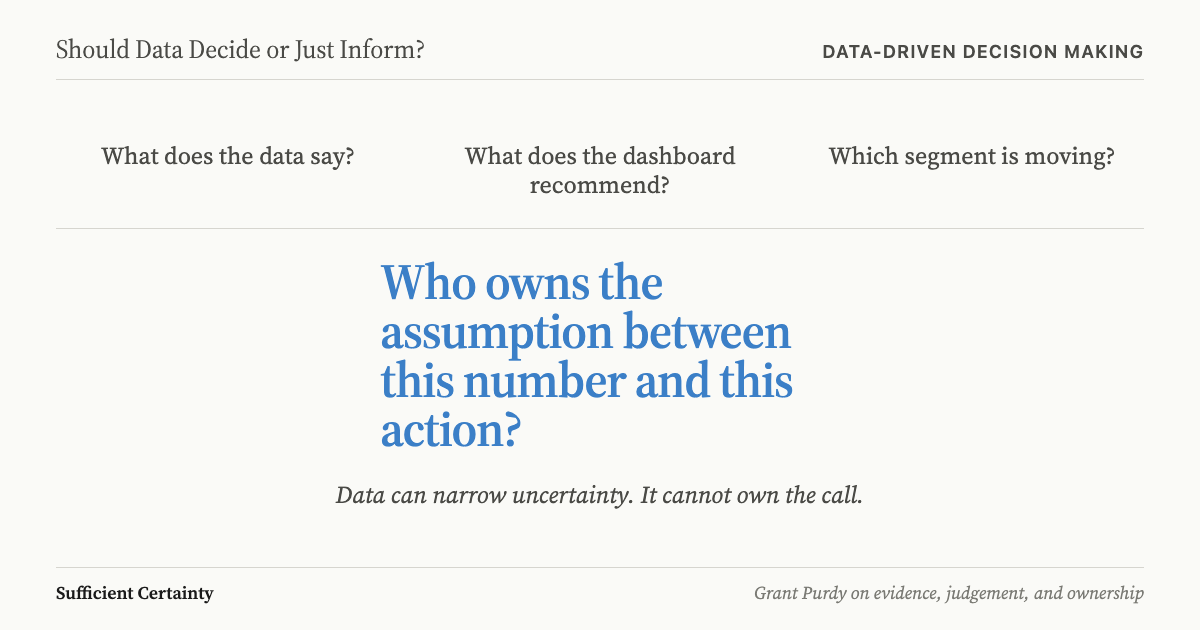
Data decides a question when the evidence covers the case at hand and being wrong is cheap; otherwise it narrows the options and a person carries the rest.
Should Data Decide or Just Inform? Start With What the Evidence Covers
The first question is whether your evidence has ever seen the situation you are about to create. A record of what happened under earlier conditions, even a systematic review pooling dozens of trials, is not a record of what happens next, and the gap between those two things is where most expensive calls go wrong.
That is not a data quality problem, though it gets treated as one, which buys somebody another fortnight of analysis. When a thing has never been done at the scale proposed, no amount of refreshing produces a number about it. Nobody says so, and the deadline quietly becomes the decision.
Where the evidence does cover the case, let the numbers run it. A pricing change on a channel you have tested four hundred times, with the same customers behaving the same way, is a question the data can close on its own. Convening a deliberation ritual there is not rigour. It is theatre, and it steals time from the decisions that needed it.
I mean that literally. If a channel has run the same promotion through the same segment every quarter for six years, the record has already answered the question, and convening people to discuss it will only add latency and a worse answer than the one you had. The evidence covers the case. Let it decide, write down that you let it and why, then spend the meeting on the decision that actually needed a person in the room.
I have watched boards get this backwards in both directions. One will agonise over a reversible tweak that the record settled long ago. The same board will then wave through a plant closure on a chart, as if the chart intends to sign the paper.
The European Commission's AI Act guidance draws the line more plainly than management prose usually manages. A recommendation stays a recommendation while a person still has to judge it. Apply it automatically and it has become a decision.
That is a useful test to run on your own data-driven decision making. The question is not how good the model is. It is whether anybody in the process still gets to say no, and whether they know the grounds on which they would.
Name the assumption sitting between your dashboard and the move you are about to make, before the meeting names it for you. Start the Walk →
What Does Being Wrong Cost, and Who Pays for It?
The second question is asymmetry. Some errors are cheap and reversible. Others land on one person and cannot be undone. Identical evidence supports very different amounts of automation depending on which of those you are facing.
The MACPAC review of automation in Medicaid prior authorisation shows the boundary drawn honestly. Straightforward requests can be approved quickly. Adverse calls go back to human clinicians.
The March 2026 session materials put it in plain English. The systems people were using could approve a request or send it for review, but they could not deny it. Notice the shape of that, because it is not a judgement about model accuracy at all.
Approval and denial run on identical data. The difference is who absorbs the error. A wrong approval costs a payer some money, and a wrong denial lands on a patient who cannot appeal to a spreadsheet.
Others wrote that boundary into law rather than trusting anyone's good intentions. By the time of that session, seven states regulated automation in prior authorisation, and six of the seven required a human clinician to review every adverse decision. What is being protected is not accuracy. It is accountability.
The U.S. Food and Drug Administration's boundary for clinical decision support works on the same logic. Software may enhance, inform or influence a clinician. It crosses over when it issues a specific directive, or when it operates where there is no time to think.
That second condition matters more than people notice. Take away the pause and you have removed the judgement, whatever the label on the screen still says.
Should Data Decide or Just Inform When the Workflow Is Automated?
Sort it wrong in the permissive direction and you get MiDAS. The Michigan Office of the Auditor General's report found a system set up to create and close misrepresentation issues without investigation or adjudication. The paperwork looked decisive. The judgement had vanished.
The numbers make the point better than I can. That audit put established overpayments at $6.6 billion. By March 2022 the agency had determined intentional misrepresentation on twenty-eight claims, worth about $342,000 between them. A machine had been raising and closing fraud findings at industrial scale, and almost none of them survived contact with anyone empowered to adjudicate.
Fraud adjudication fails both tests at once. The evidence never covered the individual case, and the entire cost of a wrong finding lands on the claimant. Automating it was not a technical mistake. It was a sorting mistake, made by people who preferred the throughput and did not have to live with the result.
The opposite failure is quieter and far more common. A ceremonial human gets parked beside the machine so the organisation can keep its speed and still claim a conscience.
The Joint Research Centre study on human oversight in AI-aided hiring and lending found that overseers were just as likely to follow advice from a discriminatory generic system as from one built to be fair. That is not oversight. That is a signature being collected.
The study ran to 1,411 HR and banking professionals across Italy and Germany, so it is not a small sample dressed up as a finding. The revealing part is what participants asked for afterwards. They wanted guidance on when they were supposed to override the recommendation. Nobody had given them a rule, so they went along.
That is the honest reading of most arrangements where a person sits in the loop. Nobody is sorting anything. It is why an organisation can build a confident data-driven culture, hold impeccable dashboards, and still have nobody willing to put their name on a page.
Most rooms have plenty of charts. What they lack is someone prepared to be quoted afterwards, which is why leaders avoid owning decisions and turn evidence into a search for cover rather than a record of who decided what.
How Much Evidence Is Enough: The Stopping Rule
Both questions collapse into one practical rule, and it is the part the balance advice never supplies. When Roger Estall and I wrote Deciding, this was the gap we were trying to close.
You stop gathering data when the remaining uncertainty is clear enough for the person making the call to own it. If the assumption carrying the decision is still doing all the work and nobody can defend it, you do not have enough. If that assumption is plain and you know what you will watch afterwards, you may already have enough, and another fortnight of analysis is delay dressed up as rigour.
In the Universal Decision-Making Method I Frame the decision first, then make the Decider name the assumption the choice rests on, then Design the monitoring that would reopen it. Where that sequence closes almost immediately, the numbers can run the decision and should. Where it does not close, they narrow the field and hand you the remainder.
Run the two questions in that order and most decisions sort themselves inside a minute. Does the evidence observe the situation you are about to create, or only an older one that resembles it? If this goes wrong, who absorbs the cost, and can it be undone afterwards? Anything that clears both is a decision the numbers can carry on their own. Anything that fails either one is yours, whatever the dashboard happens to be showing at the time.
The same test applies in predictive analytics in decision making. A forecast can help, and on a routine call it can settle the matter outright. It still does not volunteer to carry the consequences when it is wrong.
So should data decide or just inform? Both, on different decisions, and doing the sort is the actual work. What you cannot do is settle it once in a strategy document and stop looking, because the decision sitting in front of you this morning does not care what you concluded about data in general.
You could point at the dashboard in the meeting and own the call anyway when it fails.
Work through your decisionNo sign-up. Just pick your decision and start.
Grant Purdy is the co-author, with Roger Estall, of Deciding (2020), and the architect of the Universal Decision-Making Method.