
Social shifts that could break the launch are the assumptions teams avoid reopening because questioning them threatens the date. Customer behaviour changes while the plan sits in approvals. If nobody has written which behavioural assumption the launch depends on, the go-live meeting is checking the wrong things.
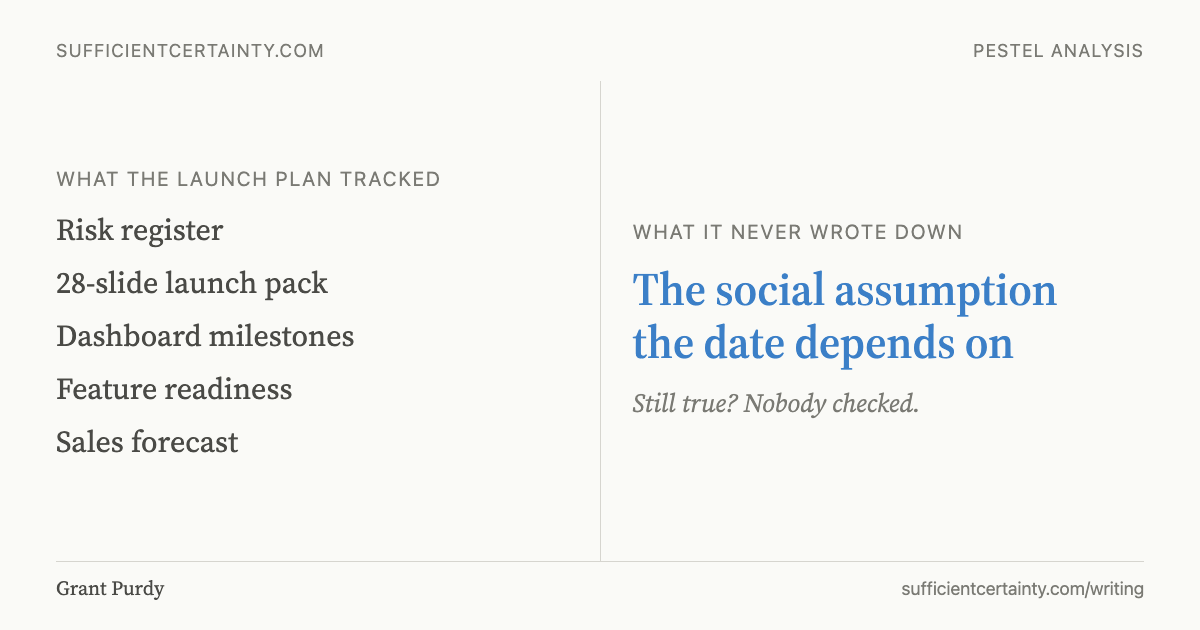
The social shifts that could break the launch are usually the assumptions teams leave out because reopening them threatens the date. I have sat in rooms six weeks before go-live with a 28-slide launch pack and a tidy risk register; the one assumption doing the real work was never written down, that customers still work and buy the way they did when the plan was built.
I once chaired a go-live review where the dashboard took ninety minutes and the customer routine took ten. The launch still looked disciplined right up to the miss. The failure usually sits further back, in a social assumption nobody bothered to test.
Social shifts that could break the launch are changes in behaviour or group norms that invalidate the assumptions a launch plan depends on.
Social shifts that could break the launch usually look ordinary
Remote work is the cleanest current example because too many launch plans still assume the office-centred week snapped back, even though the U.S. Census Bureau reported on 16 January 2025 that 13.8% of U.S. workers usually worked from home in 2023, up from 5.7% in 2019, and the Federal Reserve Bank of Minneapolis wrote on 25 June 2026 that remote work had hovered around 22% of employed workers in the prior two years, with large differences between states.
I sat with a retail launch team last year while they modelled office-density recovery as if it were settled; the people defending that fiction were not the customers but the ones tied to lease-heavy footprints and media buys built on lunch-hour footfall. I have also sat with B2B teams timing city-centre launches around Tuesday traffic because someone inside the business was still defending an office-heavy footprint. That is not market evidence; it is internal politics protecting sunk cost. Office-lease defenders prefer to call that a timing issue, because a timing issue does not force a write-down. If the customer is no longer where you assumed, at the hour you assumed, the plan is already false.
That is where a proper PESTEL analysis earns its keep, and where the Universal Decision-Making Method stops the launch room kidding itself: what must still be true about customer routine for this date to work?
Social shifts that could break the launch can kill adoption on sight
Google Glass hit a social-permission problem before the consumer launch had a fair hearing. On 16 May 2013, the Los Angeles Times reported that eight members of Congress asked Larry Page to address privacy issues around Glass. The same report cited a BiTE Interactive survey saying 38% of smartphone owners would not buy or wear Glass even if they could afford it, only one in ten would buy and regularly use it, and nearly half thought the product would be socially awkward or irritating.
Those numbers mattered because the objection was social, not technical: people did not want to wear a device that signalled status or competence while everyone around them wondered whether they were being recorded. That is a launch assumption. I have watched consumer teams call that a messaging issue (usually because messaging can be handed to creative) when the real problem was public permission.
By 15 January 2015, Time reported that Google would stop selling Glass to individuals through the Explorer programme, even as the product continued in workplace settings. That split is the lesson. The consumer launch failed because the social context was hostile, while an enterprise use case could still survive. Teams hide behind feature talk because public embarrassment is harder to model than price, and those are social shifts that could break the launch long before the feature sheet settles anything.
Write down the social assumption your launch date depends on and name the signal that would make you reopen it. Start the Walk →
Backlash is one of the social shifts that could break the launch
Brand moves can become social symbols faster than executives can brief the sales force. The Associated Press reported that Anheuser-Busch InBev's U.S. revenue fell 10.5% in the second quarter of 2023 after the backlash over the brand's transgender promotion, that the group's U.S. market share fell more than 5% to 36.9% in April 2023, and that Bud Light's retail sales were down 26% year on year in the month ending 22 July. Executives discover, late and expensively, that audiences assign meaning faster than brand teams do.
The case matters here because it shows how fast a launch assumption about audience meaning can fail. I sat with a brand team years ago that treated interpretation as something to tidy up after approval; once the audience fixed the meaning, the media plan no longer mattered. I have watched executives ask for another creative cut when what they really needed was to reopen the assumption. Those are social shifts that could break the launch because the audience is judging the meaning, not the mechanics.
This is why the social factor in a launch plan is never just demographics. It includes identity and the public cost of association. If your rollout depends on a message being read as inclusive or harmless, you are relying on social interpretation. Brand teams often park that question in "creative" because "creative" can be blamed later, whereas an explicit assumption would force a harder decision now. Anyone working through PESTEL analysis should treat it as a hard assumption.
Put the assumption in the launch decision
By the time sales reports reveal the social shifts that could break the launch, the team is already explaining a miss. WeWork is what happens when office-density assumptions are treated as permanent demand rather than a condition to test. In November 2023, the Associated Press wrote that the company had reached roughly $47 billion in private valuation, operated 777 locations in 39 countries in its latest filing, and entered Chapter 11 with about $18.7 billion in debts against $15.1 billion in assets as of 30 June 2023. Lease liabilities consumed about two-thirds of operating costs. The company had treated short-term sublease demand as permanent, and when remote work cut the need for overflow desks, the revenue model broke before anyone revised the forecast. That is the same mistake behind launch bets that assume office traffic will carry demand.
Roger Estall and I make the same point in Deciding: write the social assumption in plain language, with the evidence behind it; then state the signal that would make you reopen the date. I once watched a launch team refuse to record the assumption because the sales director owned it. After that, every dashboard update existed to protect the date. If the assumption is important and shaky, the launch date is false precision. Reopen the decision.
That discipline sits inside the Universal Decision-Making Method. The PESTEL analysis guide shows where the social band belongs in a launch decision. A dashboard can report progress against a false assumption with perfect accuracy. Monitor the assumption until launch, because once the team mistakes it for a fact, the dashboard protects the date instead of the decision.
You could launch on a social assumption that expired before the go-live meeting.
Work through your decisionNo sign-up. Just pick your decision and start.
Grant Purdy is the co-author, with Roger Estall, of Deciding (2020), and the architect of the Universal Decision-Making Method.