
PESTEL analysis for marketing scans six categories of external factors and delivers a completed grid. Every campaign failure I examine traces back to a factor that appeared in that grid and an assumption beneath it that nobody converted into a testable statement before the budget was committed.
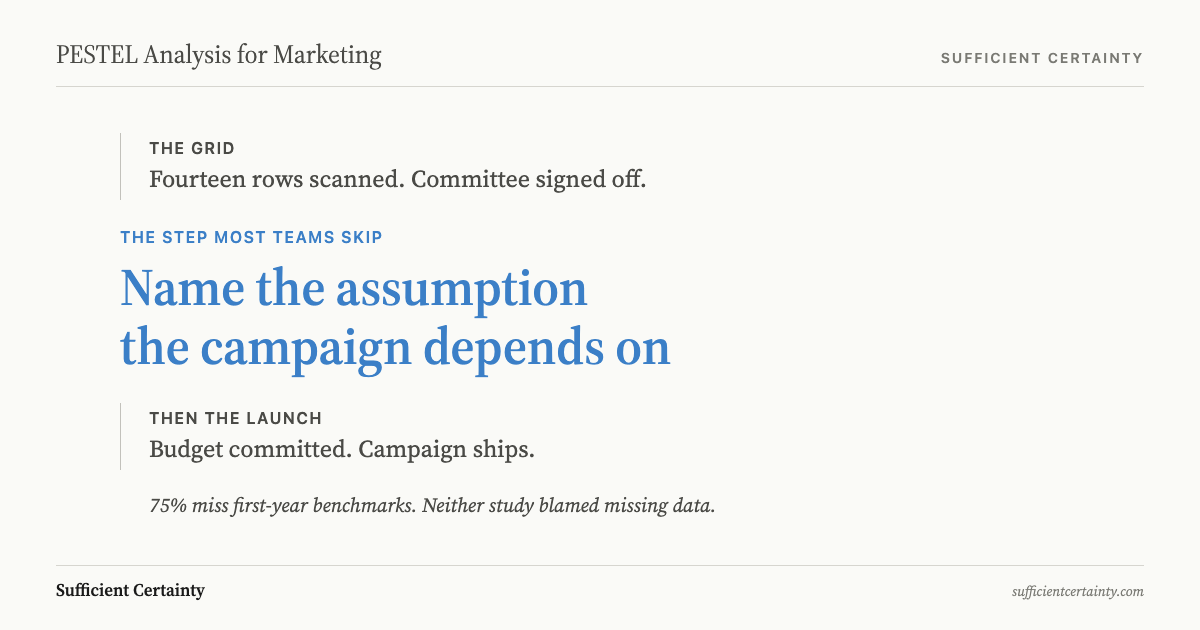
I once sat with a brand team whose PESTEL slide ran to fourteen rows; the slide that followed it said "Recommendation: proceed." The grid went into a deck, the deck went to a committee, and the committee signed off.
The people who built the deck were relieved the committee accepted it; the committee was relieved that somebody had done the scanning. Nobody in that sequence had an incentive to name the assumption the campaign depended on, because naming it would have meant the process was not finished, and everybody in the room needed it to be finished.
The teams that fail this way are not careless. They are thorough in the wrong dimension: scanning diligently, then deciding on autopilot, because the organisational process treats the completed grid as the end of the analysis rather than the beginning of the real question.
The gap between a completed PESTEL and a sound marketing decision is not a shortage of information. It is the absence of one step: naming the specific assumption the campaign depends on and deciding what to do if that assumption turns out to be wrong.
PESTEL analysis for marketing applies the six-category environmental scan to a specific campaign or market-entry decision, identifying external factors that could affect positioning, timing, or audience reception.
What a PESTEL analysis for marketing actually delivers
A marketing PESTEL produces a structured inventory of external conditions mapped across six categories, from regulation and economic climate to consumer attitudes and technology trends. That inventory has genuine value; it forces the team to look beyond the campaign brief and consider what is moving in the wider environment.
The problem is what happens after the grid is filed. I sat in a planning session in 2019 where a marketing director held up a completed PESTEL, said "we have done the analysis", and moved to approve a repositioning campaign without a single question about what the team was assuming about its audience. That is the routine: the grid becomes the finished analysis, not the starting material for a harder conversation.
I have reviewed enough real PESTEL examples to see the pattern repeated across industries: thorough scanning, followed by an untested leap to execution. Some teams attempt to close the gap by stacking a SWOT analysis on top, but running both frameworks before a market entry still produces two completed grids and zero tested assumptions.
Campaigns that scanned the factor and missed the assumption
In April 2017, Pepsi launched an ad starring Kendall Jenner in which she left a photoshoot to join a street protest and handed a police officer a can of Pepsi. The imagery directly echoed a widely circulated 2016 photograph of Ieshia Evans facing police in Baton Rouge during a Black Lives Matter protest. The ad was pulled within twenty-four hours.
I have sat in creative sign-offs that followed exactly this sequence: the social factors are listed in the deck and the finished spot is on the screen while nobody asks whether the audience whose actual struggle the ad borrows will see unity or appropriation. Any 2017 marketing PESTEL would have listed social-justice movements and racial tension as active Social factors. That box was easy to tick. The reception assumption baked into the creative was never named (the agency that produced the concept was not in the room when the backlash landed; agencies seldom are).
In early January 2018, H&M published a product photograph of a Black child wearing a hoodie printed with the words "Coolest Monkey in the Jungle." Within days, protesters vandalised six H&M stores in Gauteng province, South Africa. Celebrities including LeBron James and The Weeknd publicly condemned the image, and brand partnerships were severed.
I reviewed a similar case in 2015 where a retailer's home-market team had cleared copy that caused immediate backlash in three other territories; the assumption that local connotations transfer cleanly across borders had never been stated. The H&M failure is the same pattern at global scale: the assumption that this word-and-image combination carried no racial connotation across every market the company operated in, including South Africa with its distinct and recent history of racialised language, was never tested.
In June 2022, the United States Food and Drug Administration ordered Juul Labs to stop selling its e-cigarette devices and tobacco and menthol pods in the US, citing marketing practices that reached and appealed to minors. The order was administratively stayed in July 2022 pending appeal, and the FDA later reopened its review rather than enforcing an outright ban.
Juul's environmental scanning would have flagged regulatory scrutiny of vaping and youth-health advocacy as live Legal and Social factors for years, while Political pressure mounted alongside them. The FDA had signalled tightening intent since at least 2018.
I watched a similar arc in another regulated sector: the regulatory signal entered the environmental scan as a "watch item" and survived four consecutive annual reviews under that same label before arriving as an enforcement action while the strategy it targeted continued unchanged (the compliance function that flagged it each year did not, apparently, have the authority to make anyone act on it). That is what a PESTEL analysis for marketing looks like when it works precisely as designed: every factor visible for years, the assumption beneath the strategy never written down.
These are not isolated anecdotes. They are the social shifts that break launches, and two independent analyses of marketing and launch outcomes confirm the pattern is structural.
Joan Schneider and Julie Hall, writing in the Harvard Business Review, found that roughly 75% of consumer packaged-goods and retail launches failed to reach their first-year revenue benchmarks. They traced the cause to insufficient real-world testing of positioning and messaging before launch. A McKinsey study of large-company launches over a five-year period found that only 47% met or exceeded expectations.
Neither study blamed missing information. Both identified untested assumptions inside otherwise well-researched decisions. I have sat across from marketing directors who could recite every factor on their grid and could not state a single assumption the campaign depended on. That is the diagnosis the data supports: well-researched launch decisions failing on premises nobody wrote down.
Take the marketing factor your next campaign depends on and convert it into a testable assumption before the budget is committed. Start the Walk →
Turning a PESTEL analysis for marketing into tested assumptions
The method I developed with Roger Estall over several decades, and described in our book Deciding, treats every external factor as a premise rather than a finding. A Social factor such as "rising consumer sensitivity to racialised imagery" is not a conclusion; it is the beginning of a question. The question is: what exactly are we assuming about how our specific audience will receive this specific creative, given that sensitivity?
I have put this question to marketing teams from Melbourne to London, and the initial response is almost always silence, because nobody in the room has asked it before. That assumption can then be named and rated: how significant is it to the campaign, and how fast could the underlying condition change?
Where significance is high and confidence is low, the team can strengthen the assumption with audience testing or market-specific review, or change the decision to reduce its dependence on a premise it cannot confirm. Where neither is possible before launch, monitoring keeps the decision revisable.
A completed PESTEL is also a snapshot, and the conditions it records move after the scan is filed. In 2018, I reviewed a market-entry decision where a regulatory assumption had shifted twice between the date the PESTEL was submitted and the week the campaign went live; the team discovered this from their news feed, not from any monitoring process they had designed.
The method accounts for this by rating each assumption for volatility alongside significance: how fast could this condition change, and would the team detect that change in time to respond? A marketing campaign with a twelve-week lead time carries different volatility exposure from one launching next week, and the PESTEL grid makes no distinction between the two. That is a structural limitation of the grid itself.
This is what the standard PESTEL analysis omits. It maps the external environment without converting any factor into a testable statement about what the campaign relies on being true. The grid tells you what is happening around you; it does not tell you what you are betting on. The Universal Decision-Making Method closes that gap by adding the step the grid leaves out: naming the assumptions each option depends on and rating them for significance and volatility before the team commits.
Before the campaign ships
A PESTEL analysis for marketing becomes useful when the team treats each factor not as a completed finding but as the surface expression of an assumption. Every factor entry converts into a statement: "we are assuming that this condition will hold for the duration of this campaign." Some will be trivially stable and need no further attention. A few will be significant enough that the campaign's reception or regulatory viability depends entirely on them being correct. Those are the assumptions to test before launch, and to monitor after it.
The discipline requires one additional question in one meeting after the PESTEL is complete: what are we assuming about this audience and this regulatory environment that, if wrong, changes what we should do? Pepsi's creative team and H&M's product reviewers could each have asked it. Juul's strategists had years of visible regulatory signals to prompt it.
I raised this question in a launch review in 2017 and watched the room go quiet; the marketing director eventually said the assumptions were "implicit". Implicit means untested, and untested means the budget was committed on faith. That is the purpose of the exercise: converting faith into named premises the team can test before the money is spent and monitor after the campaign ships.
You could file the completed grid and commit the campaign budget on an assumption nobody named.
Work through your decisionNo sign-up. Just pick your decision and start.
Grant Purdy is the co-author, with Roger Estall, of Deciding (2020), and the architect of the Universal Decision-Making Method.