
Sound judgment in leadership starts with one question the room almost always skips: what assumption does this decision rest on? A board can ask for better judgment in every charter and competency framework it publishes. Until someone answers that question, the request is decoration.
In 2025 StepStone told shareholders it wanted directors who were "open and forthright" and would exercise "sound judgment and courage". Boards use this language constantly. When I see sound judgment in leadership in a proxy statement, I assume I am about to watch a virtue praised and a method omitted.
Roger Estall and I wrote Deciding because we kept seeing the same performance: thick papers and grave faces, with no plain statement of what the room was actually assuming. The trouble with boardroom talk about sound judgment is that the fog suits the people running the meeting, and the people choosing the next director, very well.
Sound judgment in leadership is the discipline of naming the assumption carrying the recommendation and recording the fact that would reopen the call.
What sound judgment in leadership looks like in practice
In practice I care about two questions: what is the decision, and what assumption is carrying the recommendation. If the paper cannot answer those, the rest is decoration. A room can sound serious for an hour and still dodge the only line that matters.
The gap shows up in real board data. In a late-2025 PwC and Conference Board survey of 524 C-suite executives, only 41 per cent rated their boards excellent or good, and 90 per cent said the assessment process could improve. Those figures tell me boards still confuse ceremony with judgment. People who worship decisiveness usually learn this after the damage invoice arrives.
Most director-selection prose is flattering sludge. It lets nomination committees sound exacting without asking the only useful question: when the acquisition paper lands, can this director spot the assumption carrying the deal. If not, the board has chosen a polite spectator and called it governance.
In my experience, the embarrassment peaks when the paper arrives with one recommendation and a ceremonial appendix of "alternatives considered". The appendix exists to imply a search, and sometimes to soothe the chair (a constituency never short of soothing). It rarely contains a live second option. The room is then invited to approve the preferred answer and compliment itself on diligence, which is a neat way to skip judgment while preserving the paperwork.
Why sound judgment in leadership fails in boardrooms
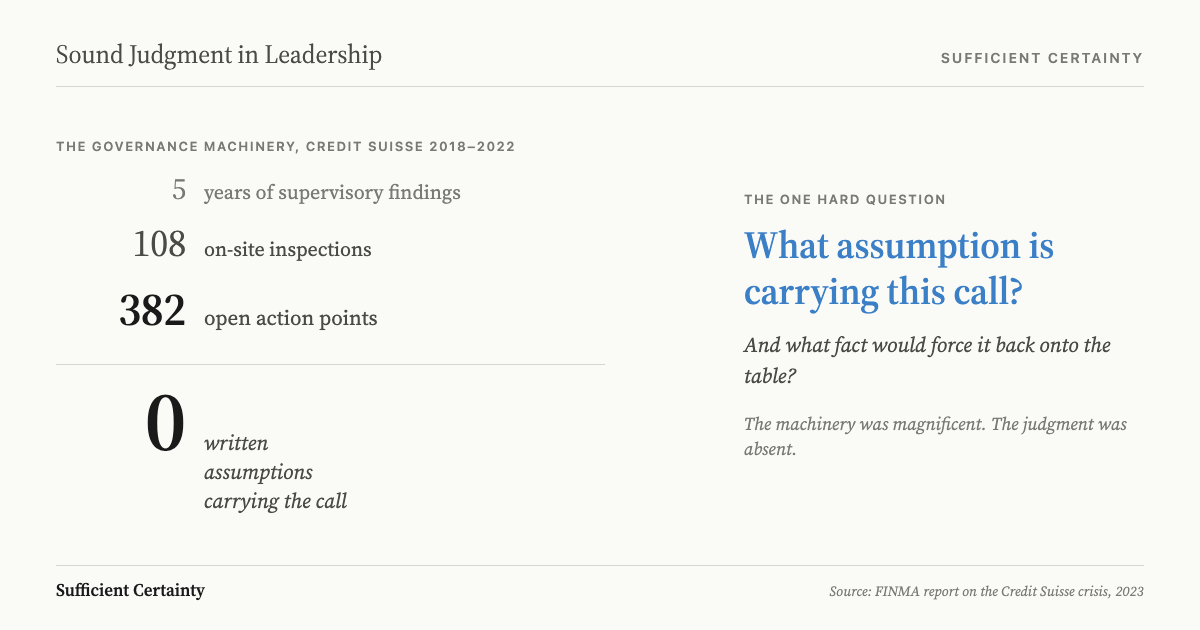
Credit Suisse did not collapse because nobody had heard of governance. In its post-crisis report, FINMA said the bank faced an imminent threat of insolvency in mid-March 2023, and UBS announced the takeover on 19 March 2023. Between 2018 and 2022, FINMA had already carried out 108 on-site reviews and opened 382 action points. Many were high or critical. Serious paperwork still did not produce a serious decision.
I have spent too much of my life around organisations that confuse oversight with thought. The machinery can be magnificent, which is excellent news for the people who sell more machinery next quarter. It is poor protection when a governing body will not reopen a live decision while there is still time to change it. FINMA's own conclusion was that Credit Suisse's governing bodies had failed for years to find long-term solutions to repeated scandals and risk-management problems. I would put it less politely: they kept admiring the apparatus while the underlying call kept rotting.
Press one leadership call until the hard question your board should vote on finally shows itself. Start the Walk →
Who gives sound judgment in leadership a chance
Sound judgment in leadership depends on whether anyone in the room is allowed to wound the cherished recommendation. The U.S. Office of the Comptroller of the Currency says in its Corporate and Risk Governance handbook that directors should exercise independent judgment and provide credible challenge. It also says decisions should wait when information is inadequate. That is plainer than most leadership programs manage.
I have never been impressed by a team that agrees too early. Early agreement usually means the wrong people are in the room, or the right people have learned the price of plain speech. A 2024 meta-analysis of team reflexivity found that leaders who support active participation give teams better conditions to examine their work. The academic phrasing is mild. The working version is harsher: if nobody can interrupt the pet recommendation, the leader is staging consent. It is also one reason judgment can be learned; people can practise challenge, and they can practise reopening a call.
Ownership matters. If six people can recommend the deal and one person has to live with the wreckage, only one of them should decide. In our language that person is the Decider. I have chaired enough difficult rooms to know what happens when the senior person speaks too early: everyone else starts revising their own thoughts to match.
The vote is halfway
Monitoring is where leadership talk usually falls apart. This is the part people skip when they talk about effective decision making in leadership, perhaps because a written trigger has a nasty habit of exposing wishful thinking later. Skip the trigger and the speech is all the board keeps.
The OCC handbook is blunt about monitoring. I would make it blunter. Before the board approves the acquisition or the plant closure, write down the fact that would drag the decision back for review. I have seen strategy papers run to dozens of pages and still duck that sentence, which is impressive in a perverse way.
StepStone said independent directors met in executive session at least quarterly. Quarterly executive sessions count for very little until they reopen a live assumption. That is where sound judgment in leadership becomes a discipline, or collapses into theatre. Boards keep writing "sound judgment" into role descriptions because the phrase flatters them. It becomes useful only when someone writes down the assumption carrying the call and the fact that would drag it back.
You could praise sound judgment and still miss the assumption carrying your recommendation.
Work through your decisionNo sign-up. Just pick your decision and start.
Grant Purdy is the co-author, with Roger Estall, of Deciding (2020), and the architect of the Universal Decision-Making Method.