
A strategic decision making tool should force the room to commit to a course of action and write down what would reopen that call. Most do the opposite: they score options, rank them, and leave the assumption underneath the preferred option untouched. The commitment is the hard part, and the tools were not designed for it.
I have watched this play out across nearly fifty years of chairing strategic reviews. The room arrives with a SWOT, a weighted matrix, a set of scenarios. Everybody knows how to score options. Nobody wants to say, out loud, that the forecast feeding every scenario is still a guess. The meeting ends with "we need a more structured approach," which means nobody is prepared to own the call.
Somebody is tasked with bringing a framework to the next meeting. They search for a method and find ten catalogues of SWOT, decision trees, and weighted matrices. What they will not find on page one is something that forces the room past analysis into commitment. I built the Walk to force that sentence into the open: one pass through the method, one Decision Document at the end.
A strategic decision making tool is a structured method that helps leadership teams evaluate a high-stakes choice, test the assumption it depends on, and reach a commitment they can defend when the data will never be complete.
What strategic decision making tools cover
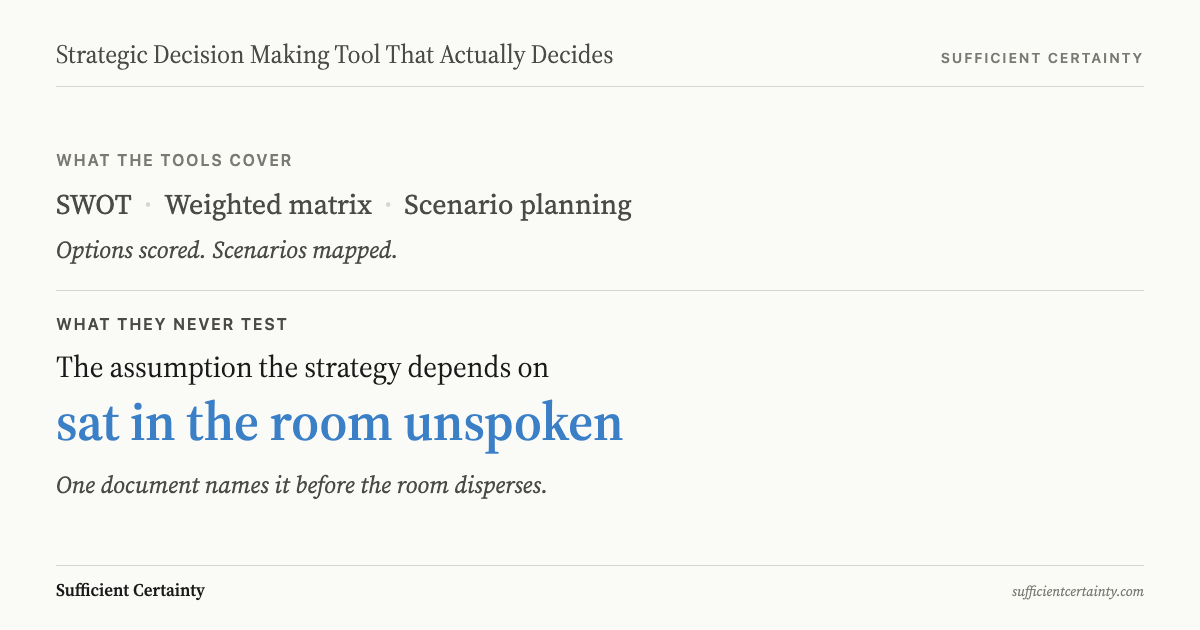
The tools that rank on page one of a search do real work. SWOT sorts what you already know into four quadrants. A decision matrix compares options on criteria the room agrees matter. Scenario planning maps branches from different futures. For a vendor selection or a bounded project choice, that analysis is often all you need.
I use SWOT myself. It is a sound sorting exercise when the question is straightforward and the data is reliable. Decision trees work when the probabilities are known and the branches are genuine alternatives. These tools fail not because they are bad but because they stop one step too early.
The problem is structural. Research published in the Ivey Business Journal identified nine categories of assumptions that strategic plans depend on and found that most organisations examine none of them systematically. Stakeholders routinely approve plans without scrutinising the foundations those plans rest on. The tools were designed without an assumption-testing step.
So the strategic planning process evaluates options inside a frame that was itself never questioned. The SWOT was thorough. The scoring model was weighted carefully. The review deck ran 40 slides. And the assumption that would cost the organisation real money if it turned out wrong sat in the room unspoken.
Write down the assumption underneath your next strategic commitment and name the evidence that would make the room reopen it. Start the Walk →
When a strategic decision making tool is enough
A SWOT or a weighted matrix is enough when the choice is bounded and the downside is containable. If the wrong answer costs you a quarter\'s margin on one product line, score the options and pick. The analysis tools were built for that job and they do it well.
I worked with a manufacturing team choosing between three suppliers for a standard component. The criteria were clear, the prices were within range, and the worst outcome was a mildly slower delivery schedule. They scored it on a weighted matrix and moved on in a morning.
That was the right call. The matrix was sufficient because every option rested on the same assumptions and none carried material risk. But when the same team later chose to close a production line and relocate 200 jobs, the matrix could not tell them whether their demand forecast for the new site was sound.
The Walk matters when the decision carries material consequences: when a wrong assumption reaches people, capital, or the organisation\'s licence to operate. For board-level decisions, the calculus is sharper: the assumption load is highest and the time to test is shortest. The judgement line is not about complexity. It is about what breaks if the assumption is wrong.
What strategic decision making tools skip
Hewlett-Packard acquired Autonomy for $11.1 billion in 2011, its largest-ever acquisition. The strategic decision making tools were thorough: financial modelling, due diligence teams across multiple advisory firms, and board-level governance. Within 13 months HP announced an $8.8 billion impairment charge and alleged serious accounting improprieties predating the acquisition.
The assumption that Autonomy\'s reported revenue and growth trajectory were real was never independently tested against evidence that was available before the deal closed. The financial model was built. The board approved unanimously. What nobody did was test the assumption beneath the model.
The Walk forces that separation. Options are one conversation; the assumptions underneath them are another. Step 3 of the Universal Decision-Making Method would have forced the room to write "Autonomy\'s reported revenue accurately reflects its business" as an assumption, map it on the significance grid as Critical, and either test it or accept the remaining uncertainty explicitly before the board committed.
Quibi raised $1.75 billion to build a premium short-form mobile streaming service. Jeffrey Katzenberg and Meg Whitman ran the company with backing from major Hollywood studios and Silicon Valley investors. Six months after launch it shut down with roughly 500,000 subscribers against a 7 million year-one target.
Every strategic tool confirmed the thesis because every tool started from the same unquestioned assumption: that a meaningful audience would pay for premium content designed exclusively for mobile commuting. The significance mapping in my method would have flagged that assumption as Critical: high influence on the outcome, low confidence in the evidence.
What separates these from routine failures is not carelessness. The people involved were competent and well-resourced. The strategic decision making tools they used were not built to surface the assumption the entire strategy depended on. The tools evaluated options within a frame. Nobody tested the frame.
What the Walk produces
The Walk produces a Decision Document. It fits on one page because every field earns its place: the decision and its Purpose at the top, the dated Context, the critical assumption named and tested for sufficient certainty, and the monitoring signal that would reopen the call if that assumption starts to fail.
Sufficient certainty is a judgement about whether the evidence is good enough for this decision, with the remaining uncertainty understood and owned. It does not mean all uncertainty has been resolved. It means the room has named what it does not know, weighed that against the cost of delay, and committed with its eyes open.
Had the HP Autonomy board used this method, Step 3 would have forced the room to name the revenue assumption, rate its significance, and either test it or accept the risk explicitly. Had Quibi\'s investors named their commuting-demand assumption and mapped it against freely available evidence about TikTok and YouTube, $1.75 billion might have landed differently.
The Walk exists because most rooms will not produce that document without structure; one pass through the five steps and the room walks out with a Decision Document it can defend. Everything else in the strategic toolkit evaluates options already on the table. The decision making tool that works is the one that tests whether the table itself is sound.
Roger Estall and I wrote Deciding after sitting through too many strategy meetings that produced thick analysis with no commitment attached. The document needs to be short; once it turns into a report, people start defending paragraphs instead of owning the call.
You could score every option in the strategic review and still leave the assumption underneath untested.
Work through your decisionNo sign-up. Just pick your decision and start.
Grant Purdy is the co-author, with Roger Estall, of Deciding (2020), and the architect of the Universal Decision-Making Method.