
A decision making tool for boards that works produces one record the directors can defend under challenge. Most board portals organise documents, not decisions. The missing piece is always the same: a stated assumption the commitment rests on, tested before the vote, with a trigger that reopens it.
I watched a board approve a capital expenditure in twelve minutes. The CEO presented six slides, two directors asked questions that were closer to compliments, the vote was unanimous, and the chair told the company secretary afterwards to "tighten this up before the next audit."
The board had a portal, a risk appetite statement, an audit committee and a governance charter. What it did not have was a decision making tool for boards that forced anybody in that room to say what the proposal was actually assuming and what signal would tell them the assumption had failed.
I built the Walk so that a board can move from proposal to Decision Document in a single pass, with every assumption surfaced and the monitoring signal agreed before the vote.
A decision making tool for boards is a structured method that requires directors to name the critical assumption underneath a proposal, judge whether the evidence supports the decision, and record the signal that would reopen the call.
Why a decision making tool for boards is not a board portal
Search for a decision making tool for boards and every result offers software: document distribution, electronic voting, meeting scheduling, secure messaging. Those products manage the logistics of board meetings; they do not test the reasoning behind the decisions the board makes. The distinction matters, because PwC's 2024 analysis for the Harvard Law Forum found that more than half of surveyed directors acknowledge difficulty expressing their views frankly in board assessments, and only 47 per cent of S&P 500 companies conduct individual director performance assessments at all.
I have seen all four patterns that PwC names in a single board meeting: the chair under time pressure, the committee already invested, the independent director with the relevant expertise staying quiet because the room does not reward dissent, and nobody asking whether the proposal's forecast will hold.
A portal that distributes board packs on time does not address any of these. A decision making tool that forces the room to name its assumptions and judge whether the evidence is sufficient does, because it shifts the conversation from "do you agree?" to "what must be true for this to work?"
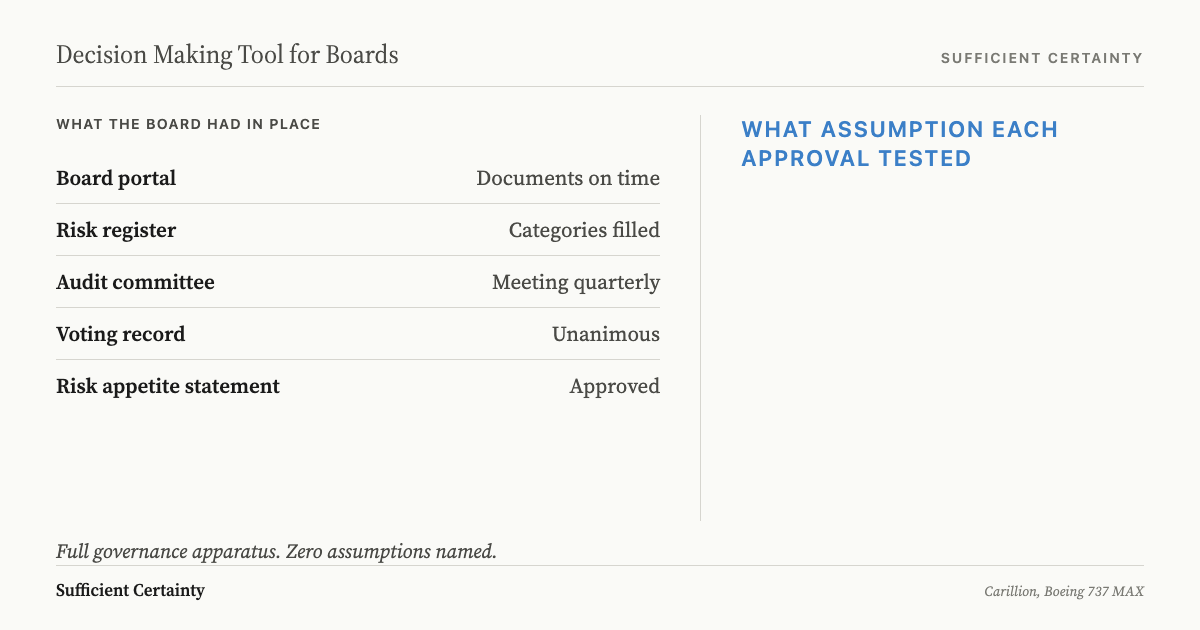
Governance apparatus that did not govern
Carillion had an audit committee, non-executive directors, external auditors at KPMG, and regular risk reporting. The apparatus created the appearance of oversight without testing the assumption underneath: that the financial position was real. When the Corporate Governance Institute reviewed the collapse, it described the non-executive directors as "tick-boxers and cheerleaders" rather than people who scrutinised management claims.
In July 2017 the company wrote down £845 million in contracts (70 per cent of total company value). By January 2018 Carillion was gone, leaving a £2.6 billion pension deficit, 450 public contracts in disarray and £148 million of cost to UK taxpayers. The parliamentary inquiry called it "a story of recklessness, hubris and greed."
I have reviewed governance arrangements that looked like Carillion's: the committee structure complete, the reporting cycle on time, the scrutiny absent. If the board had been forced to separate fact from assumption in the financial reporting, the question "are these goodwill valuations defensible?" would have surfaced that £1.57 billion rested on growth forecasts the board had never independently verified.
The Walk forces that separation; it does not let the room approve until the critical assumption has a name, the evidence has a verdict, and a director owns the reopen trigger. No decision making tool for boards saved Carillion, because the tool the board had was a portal, not a process.
Name the assumption underneath the next board proposal and write the signal that would reopen the vote. Start the Walk →
The assumption the board never tested
Boeing's board had dashboards, monthly CEO summaries, an Audit Committee and enterprise risk processes. What it did not have was a committee assigned to oversee airplane safety; Volkov Law's analysis of the House Transportation Committee report shows that every committee charter was silent on the subject.
After the Lion Air crash in October 2018 killed 189 people, the board was notified ten days later; its first formal meeting focused on profitability and efficiency, not safety. The CEO assured the board the aircraft was safe, and nobody asked what evidence supported that claim or what signal would trigger a different conclusion.
In my experience, that is exactly where boards fail: a CEO's verbal assurance replaces evidence, and the room treats confidence as a substitute for tested assumptions. The Ethiopian Airlines crash followed five months later. The Aerospace Safety Committee was not created until August 2019, after 346 deaths.
The missing step was not more information; Boeing had information. The missing step was a mechanism that forced the board to name the critical assumption ("pilot response to multiple alerts is manageable") and write the reopen signal ("what cockpit condition would trigger grounding?"). That is what the Universal Decision-Making Method requires before the board votes, and it is what the Walk produces: a dated Decision Document the board can defend, or when the assumption fails, the record that forces the conversation the room was avoiding.
What a board decision tool must actually produce
I want one page on the table before anyone commits. At the top: the decision and the Purpose that justifies it. Below that: the dated Context, so the reader knows how fresh the evidence still is (yesterday's fact can become today's assumption without anybody noticing, and board papers that present last quarter's numbers as current context are already stale). Then the harder half: the critical assumption and the person who must reopen the call if that assumption starts to fail.
De Bono's Six Thinking Hats and the devil's advocate technique are useful facilitation tools; they create space for dissent and they offset success bias. Nevertheless, they do not establish Purpose, they do not rank assumptions by significance, and they do not define monitoring. A facilitation technique can improve the conversation; it cannot replace the decision process. For operational choices where the downside is containable, those techniques are enough. For a material commitment where the board's duty of care is in play, the room needs the full assumption-to-monitoring loop.
The Walk takes a board through the full method in a single session: the decision framed against the organisation's Purpose, the assumptions the board is carrying surfaced and ranked, the evidence judged against the threshold of sufficient certainty, and a monitoring signal and owner agreed before anyone commits. At the end the board has a Decision Document it can produce in a review, an inquiry or an audit. No consultant required, no two-day offsite, no process that benefits from its own complexity.
Roger Estall and I wrote Deciding because the gap between what boards approve and what boards can later defend is where governance actually breaks.
The Decision Document stays short for a specific reason: once it grows into a board submission, directors sign the covering page and stop interrogating the assumptions underneath. A longer process protects the people who designed it, not the organisation that must live with the decision.
The Walk exists because directors have a duty of care that survives the vote, and a one-page record naming the assumption and its monitoring signal is the smallest artefact that discharges it.
When a board needs the full method
A matrix or a simple pros-and-cons table is enough when the choice is bounded and the downside is containable. A governance failure starts when the board treats those lightweight tools as sufficient for material commitments: capital allocation, strategic partnerships, regulatory submissions, executive appointments where the assumption load is high and the consequences of a wrong assumption reach beyond the boardroom.
When a board faces a material commitment where a wrong assumption reaches people, capital or the organisation's licence to operate, a matrix is not enough. The board needs the full method: state the decision and its Purpose, separate what it knows from what it is assuming, judge whether the evidence is sufficient for this commitment, and name the signal that would bring the decision back to the table.
I write about where that threshold sits in making decisions with uncertainty; the point is that the cost of more analysis is itself a decision cost, and boards that treat deliberation as free are making an assumption they have not tested.
You could approve the proposal in twelve minutes and still not know what the board was assuming.
Work through your decisionNo sign-up. Just pick your decision and start.
Grant Purdy is the co-author, with Roger Estall, of Deciding (2020), and the architect of the Universal Decision-Making Method.