
Transition management cannot save a bad decision. If the assumptions behind the change were never tested before approval, the handover team inherits a plan that may not deserve implementation. Testing the decision before it reaches the transition manager is the step most organisations skip entirely.
Transition management cannot save a decision that was never tested. Most transition planning focuses on moving people and processes from the old state to the new one. That work is necessary but it is downstream. If nobody tested the assumption the commitment depends on, the transition is optimising delivery of a choice that may already be wrong.
A transition manager usually arrives after the room has already congratulated itself. The sponsor has announced the restructure. The board paper has been approved. The date is in the calendar. The people who will do the work are now being asked to inherit the consequences. That is where transition management starts.
I have no objection to helping people through a real transition. I object to pretending that support work can make a weak decision safe after the applause. If the change was badly framed, the handover merely moves the damage from the board pack to the floor.
Transition management is the work of helping people move from an old way of working to a new one after a change decision has been made.
Transition Management Begins After the Decision
The useful distinction in the Bridges Transition Model is that change is the external event, while transition is the internal process people go through as they leave the old situation and learn the new one. Bridges names endings, a neutral zone, and new beginnings. People do not become new operators because a slide deck says the future state has arrived.
The trap is treating that human truth as if it settles the decision question. It does not. A manager may guide people through an ending and still be carrying a decision that should have been stopped earlier. I have seen that confusion give sponsors a splendid hiding place. That is the polite fraud in much change management work: it moves too quickly from judgment to support.
In the Universal Decision-Making Method, transition work supports a decision. It does not prove the decision was sound. If the decision is rotten, transition work only helps rot move through the organization with better stationery.
The Handover Is Where Assumptions Meet Reality
Crossrail is a useful case because the problem was not a shortage of ambition. The railway had to move from construction program to operating service. In August 2018, Crossrail Ltd announced that the central section would not open in December 2018 as planned. The National Audit Office later reported that funding had risen to GBP17.6 billion, about GBP2.8 billion above the 2010 funding level.
The phrase that matters is not delay. The NAO said Crossrail Ltd clung to an unrealistic view that it could complete the program to the original timetable, with damaging consequences. That is the handover lesson if you are willing to read it without the usual optimism varnish. The handover was not merely a communications challenge. The schedule itself had become a claim that reality was refusing to honour.
I would want the transition lead in that room to ask a blunt question: what must still prove true before we let passengers depend on this railway? If the answer is "we need everyone aligned behind the date," the organization has already slipped into theatre. Alignment around a false date is just coordinated self-deception.
Bring the handover decision into the open and write the stop trigger your team needs before it inherits risk. Start the Walk →
Good Transition Management Transfers Authority
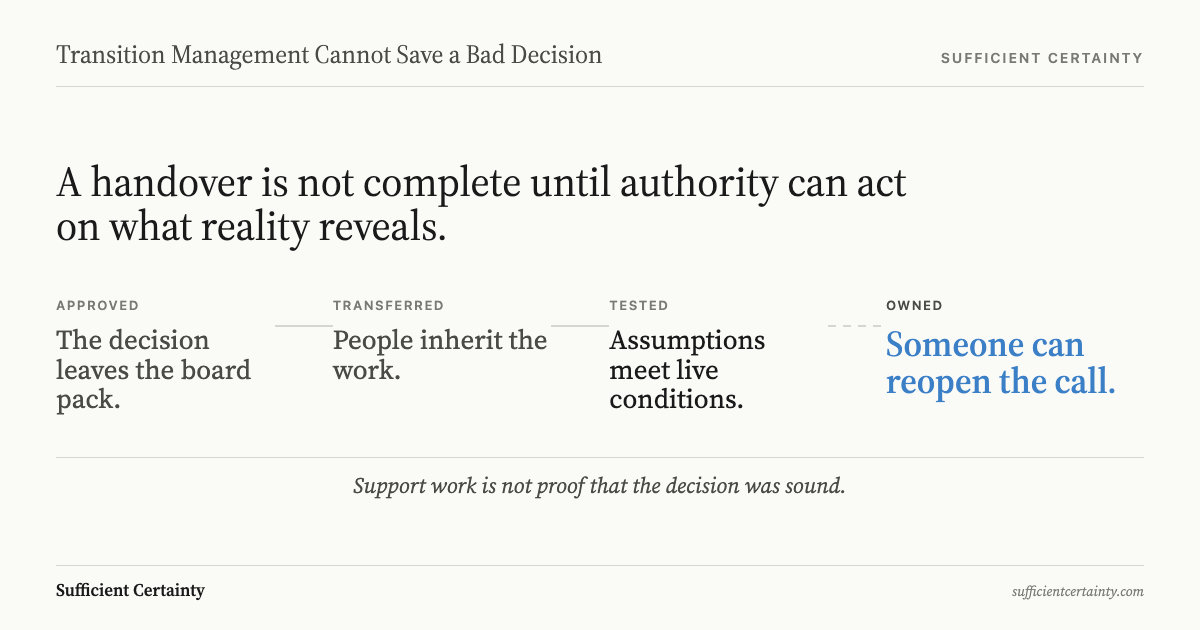
A handover is not complete when the old team has briefed the new team. It is complete only when information, responsibility, and authority have moved together. Healthcare understands this because bad handoffs can injure people quickly. The AHRQ chapter on handoffs in nursing defines the handoff as a transfer of information, responsibility, and authority during transitions in care. It also notes that some nursing units transfer or discharge 40 to 70 per cent of patients every day.
That is not a hospital-only problem. The same logic applies when a merger integration team hands work to line management, or a program team hands a new process to operations. If the new owner has information but no authority, the transition has failed. If the owner has authority but not the warning signs, the transition has also failed. The paperwork may be immaculate. Paperwork is patient. Reality is not.
This is why I dislike transition checklists that stop at communication, training, and role clarity. They make the easy transfers visible. They often miss the authority to act when the new arrangement starts misbehaving. A manager who can see a variance but cannot reopen the decision is not managing a transition. They are watching a slow accident with a branded lanyard.
Before handover, I would ask the new owner to translate the decision into operating language. What has ended? What work must now be done differently? What assumption would make them come back? Who can pause the rollout without begging the sponsor for permission? If the new owner can only repeat the announcement, the transfer has not happened. They have inherited a slogan, not control.
Transition Management Still Needs Stop Triggers
A transition plan should say what would count as evidence that the decision is drifting (the same discipline a change management plan owes its sponsor), who must see it, and who is allowed to act. Service levels, staff capability, supplier behaviour, safety signals, cost movement, and loss of ownership are all fair triggers. A dashboard that nobody can use to stop anything is decorative.
A useful trigger is specific enough to act on. "Adoption is low" is a complaint. "Fewer than 70 per cent of frontline staff can complete the new process without workaround by week four, and the operations director can pause the rollout" is a trigger. The point is not to make the plan pessimistic. It is to stop the plan becoming a costume for denial.
The London 2012 Games are a better example than a simple failure story. They were widely regarded as successful. The NAO post-Games review records 11 million tickets sold, 70,000 volunteers recruited and deployed, and a GBP9.3 billion Public Sector Funding Package. It also records markedly higher operational costs, including GBP500 million of additional venue security costs for which there was originally no provision.
That is the adult version of transition work. Success still leaves residue. The question after the main event is not whether everyone is relieved. The question is who now owns the legacy, the remaining uncertainty, the cost assumptions, and the commitments that were made while the spotlight was on. Those are not ceremonial leftovers. They are the conditions that tell you whether the handover is holding or whether the decision needs to be reopened.
This is where successful programs often lose discipline. During delivery, everyone knows who is in charge. After transition, ownership fragments into budget lines, job descriptions, vendors, and committees. The trigger has to survive that fragmentation. If the remaining cost exposure breaches the tolerance, or a promised capability does not arrive, the issue needs a named route back to a Decider instead of a polite tour through governance.
Context can still move under a sound decision after the handover. A neighbouring excavation can drop the water table and expose the assumption the foundation still depends on. The original decision did not become wrong on its own. The assumption changed. That is why monitoring belongs inside the decision, not in a post-launch ritual.
Do Not Let Transition Work Become Cover
The easiest way to misuse the discipline is to give it a problem it cannot solve. "People are struggling with the change" can be true and still conceal the deeper fact that the change is badly designed. "The handover is messy" can be true and still point back to a decision that never named its assumptions. "Resistance is high" can be true and still be useful evidence from the people closest to the work.
I would rather hear the ugly version early: the new system is not ready, the promised capacity is not there, the old process cannot be turned off safely, the team that now owns the work was never given the authority to change it. Those sentences make sponsors uncomfortable because they return ownership to the Deciders. They should be uncomfortable. That is what ownership feels like when the applause has stopped.
Used properly, transition management protects a decision while people, work, and authority move into the new setting. Used badly, it gives the sponsor a humane vocabulary for pushing an untested decision through other people's days. The difference is not the quality of the change poster. It is whether the organization named the assumptions before the handover and agreed what would reopen the decision after it.
You could inherit the handover and find the stop trigger missing.
Work through your decisionNo sign-up. Just pick your decision and start.
Grant Purdy is the co-author, with Roger Estall, of Deciding (2020), and the architect of the Universal Decision-Making Method.