
What is a balanced scorecard? It is a measurement system that translates strategy into objectives across four perspectives. It tracks whether a plan is executing. It cannot test whether the assumptions behind those measures are sound. That gap is where most scorecard implementations quietly fail.
Your CEO comes back from a strategy retreat with a board deadline and a paper full of KPIs nobody can define. That is usually when someone in ops opens a laptop and types: what is balanced scorecard.
That boundary gets lost fast. Once the sheet exists, people start treating green cells as proof and causal arrows as fact. A board pack can look disciplined long before anyone has checked whether the story under it still deserves belief at all.
A balanced scorecard is a performance system that turns strategy into objectives and measures, so management can track whether the chosen plan is being carried out.
What is a balanced scorecard?
Kaplan and Norton introduced the balanced scorecard in 1992 because finance reports arrive late. By the time profit tells you something is wrong, the quarter has gone and the money has gone with it. The scorecard tries to watch the work earlier by tying objectives and measures to a strategy map rather than waiting for the accounts to tell the story after the fact. The standard layout sorts those measures into four perspectives: financial, customer, internal process, and learning and growth.
They later wrote that 95% of a typical workforce did not understand the strategy, and 85% of leadership teams spent less than an hour a month discussing it. No wonder the scorecard spread. Many executive teams could not explain the plan without a laminated prompt, while strategy consultants, dashboard vendors, and executives who wanted the look of discipline all had something to sell.
When a balanced scorecard helps
It helps after the fight about direction is over and the question is whether anyone will actually do the work. In a study of 76 business units, the gains came when the scorecard kept managers working to the same plan week after week. Divisions stopped inventing their own numbers. Pet projects lost cover. The scorecard earned its keep when it forced follow-through on a strategy that had already survived a hard argument.
I have seen that matter. I once chaired a statutory public safety body that was spending about 0.03% of its budget on the very function it existed to deliver. We lifted that to about 0.5%, and within two years the loss of life from the event we were meant to prevent fell by about 60%.
The change came from making the measures answer to Purpose instead of to polite proxy numbers. Once that happened, money moved and teams stopped pulling in different directions. Used this way, a scorecard is a useful downstream discipline. It becomes dangerous when people start pretending it can do the thinking for them.
Set your scorecard beside the decision it is meant to support and see which green measure hides a failing plan. Start the Walk →
Where a balanced scorecard stops
Asked again, what is balanced scorecard in practice? It is a tracker of execution, not a test of the bet underneath. It assumes the objectives are right, the perspectives still fit, and the arrows on the strategy map still point the right way. Once those assumptions move, the scorecard has no native alarm for the idea itself.
The research describes it that way. A 2023 review of thirty years of evidence calls it one of the most influential strategy implementation tools of the past seventy-five years. A 2015 study of 7,600 managers found execution broke down less from missing metrics than from weak coordination and poor resource shifts. That is why a scorecard is not the same as data-driven decision making. One tracks commitment; the other should still question it.
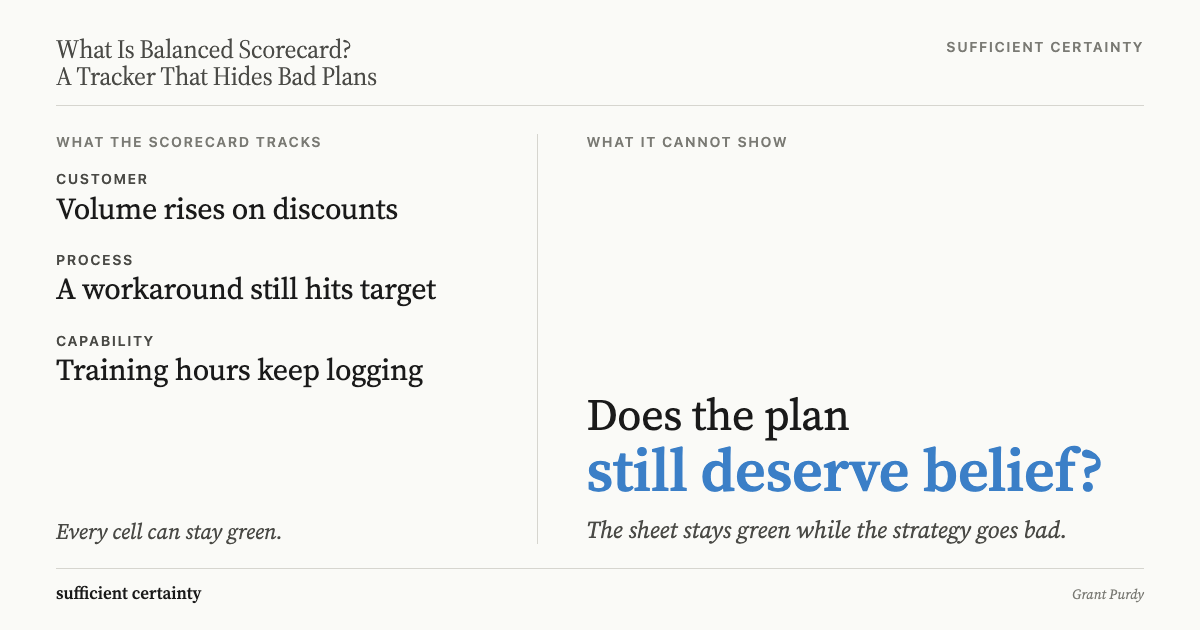
I have watched boards read a full page of green indicators as if the colour itself were proof. The customer line is green because discounting bought volume. The process line is green because staff found a workaround no one intends to fund properly. The capability line is green because training hours were logged. None of those signals can tell you whether the growth story underneath still works.
Scorecards go stale in a very specific way. The perspectives harden into compartments, so people keep feeding the same measures into the same slots long after the business has changed. The strategy map then calcifies. Causal links drawn in a workshop start being treated as laws of nature, even when buyer behaviour, channel economics, or the cost base have shifted. The board gets a cleaner sheet and a dirtier truth.
Quarterly review makes this worse. A fragile assumption may need watching every day, while a slow-moving one barely needs a quarterly line. Scorecards flatten that difference. They pull everything onto the same reporting drumbeat, which is neat for a pack and often useless for a live business.
What to do before you build one
Before you build one, decide what must be true for the plan to work. If you are still asking what it is before that work is done, treat it as the record of a plan you have already tested, not the device that tests it for you. Templates are popular with strategy consultants, dashboard vendors, and executives who want the look of discipline without the nuisance of judgement. The template lets a room fill cells before anyone has earned them.
Roger Estall and I wrote Deciding because too many organisations confuse reporting with judgement. In the Universal Decision-Making Method, measurement comes after the decision has been framed and after the live assumptions have been named. That order matters. Build the scorecard first and you lock the first story the room liked into a form people will defend for the next year.
Leave measures off unless they are tied to a live assumption. Most scorecards bloat because each function wants its own comfort number. Finance wants margin; HR wants training hours. Soon the sheet is a peace treaty between departments instead of a sharp record of the plan. Boards rarely need more lines; they need cleaner logic. A board that cannot explain why a measure is there should delete it. That is where most template builds fail.
A good scorecard line is tied to a live assumption and to the person who must act if it moves. If the number shifts and nobody knows what it means, or who must do something, you do not have monitoring. You have a board ritual. The right cadence changes by line as well. Some assumptions need continuous watching; others need a check only when the context shifts.
I have used scored reviews myself, so this is not an argument against numbers. In one client, a six-principle review rose from 13.3 to 31.8, and the lift mattered because the board could finally see which divisions still had weak monitoring and which key controls had nobody on the hook for them. The number pointed to work. It was not a medal for having a tidy dashboard.
The balanced scorecard hub page covers the wider structure. The fraud to watch for is scorecard-specific: neat perspectives, tidy causal links, and a strategy map that keeps glowing green after the assumption underneath has died. A balanced scorecard can stay green while the plan itself goes bad, which is the failure it shares with a plain KPI dashboard. That is not discipline. It is theatre with better formatting.
You could show the board green while the strategy underneath stops working.
Work through your decisionNo sign-up. Just pick your decision and start.
Grant Purdy is the co-author, with Roger Estall, of Deciding (2020), and the architect of the Universal Decision-Making Method.