
Balanced scorecard vs KPI is a debate about arrangement, not about truth. A KPI tracks one number. A scorecard groups numbers around strategy. Neither says the plan has stopped working. Most organisations report thirty lines and need three, chosen because they could prove the strategy wrong.
A performance manager showed me a dashboard with 17 KPIs, 14 green, two amber, and one overdue note from HR. She had a board pack due in five days and a chief executive asking for a balanced scorecard by quarter end. Sales were softening and nobody in the room trusted the green. For her, balanced scorecard vs KPI was a question about labels, and she wanted the answer to be a renaming job she could finish before Friday.
It is a question about levels. A KPI is one measure. A balanced scorecard is a way of arranging measures around a strategic story, which puts it a floor above the individual number rather than opposite it. If the story is stale, both will mislead you with complete sincerity.
That definition is the part page one gets right. The part it leaves out is the part that ends careers. A KPI can be perfectly chosen and still become a target people game. A balanced scorecard can be beautifully balanced and still report faithfully on a plan that stopped working two quarters ago.
Balanced scorecard vs KPI is the distinction between a framework that groups measures around strategic objectives and a single measure that tracks one result or performance driver.
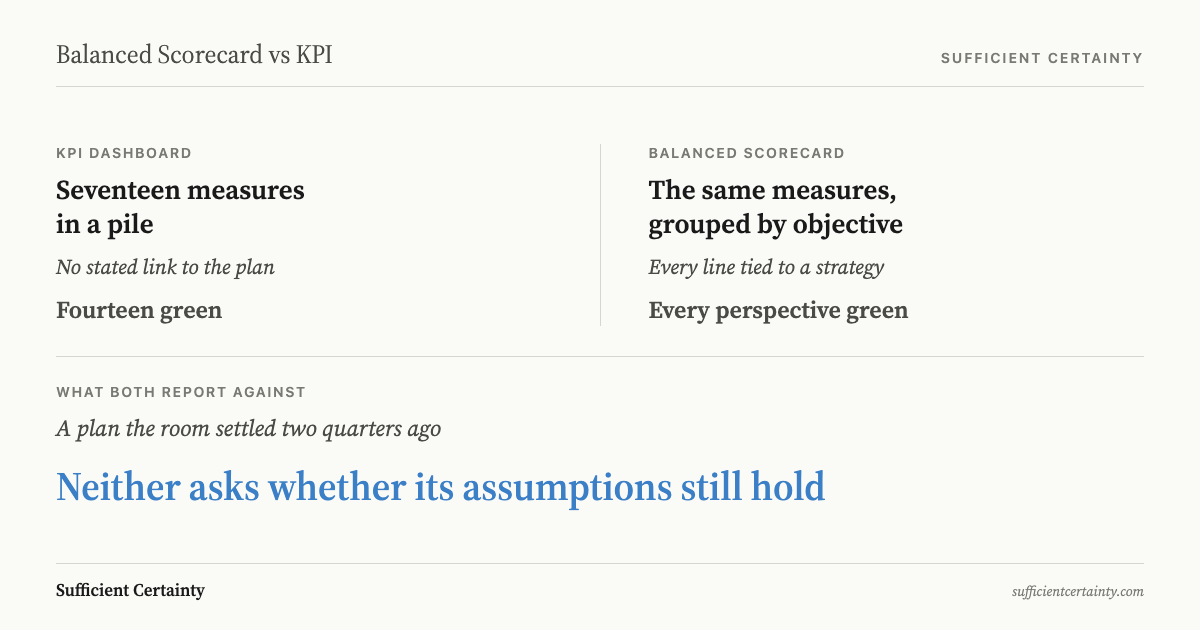
Balanced scorecard vs KPI has a short answer
Yes, you need more than your present KPI dashboard, if that dashboard is a pile of measures with no stated link to the plan. No, you do not, if every measure already ties to an objective somebody wrote down, in which case you are closer to a scorecard than the new vocabulary suggests and the job in front of you is renaming rather than rebuilding.
The distinction does buy something. Stan Davis and Tom Albright studied a commercial bank where one division adopted a full balanced scorecard and the other stayed with traditional financial KPIs. Over eighteen months, the scorecard division improved while the KPI-only division declined. That is the strongest evidence for the scorecard I know of, and it pays to be precise about what it proves. It proves a scorecard beats a loose dashboard at getting an organisation to actually do a strategy somebody already decided was right. It says nothing about whether that decision was any good.
I have watched the same effect in board reporting. The packs that worked were never the ones with the most lines. They were one page, with a comment box where the responsible manager had to write down what they thought was happening, and trend arrows instead of raw snapshots, so the board saw direction rather than a number frozen on the day the pack was assembled. Nobody needed a fifth perspective. They needed a manager willing to put a name beside a movement. Roger Estall and I kept returning to that habit while writing Deciding, because a measure is worth very little until somebody will say what they think it means.
That is why the broader balanced scorecard guide matters. A scorecard earns its keep when it stops each function defending its own favourite number and makes them all answer to one plan. It earns that keep after the argument about direction has been settled. The trouble starts when people assume it can settle the argument for them.
A KPI turns into a target and stops being a measure
A KPI fails early and noisily. It turns bad when one number is asked to carry a decision it was never built to carry. Divisional profit targets at Tesco stayed politically untouchable while sales weakened and the market shifted under the business. According to Ethics Unwrapped's account of the scandal, Tesco eventually overstated profit by hundreds of millions of pounds by pulling supplier income forward and booking it early. The number had stopped measuring reality and started issuing instructions.
I do not read that as a finance story. It is a measurement story. Once the profit KPI became sacred, the room stopped asking the prior question: does our margin model still hold in a market where discount chains are taking share and customers have changed how they buy? If nobody asks that, the pressure in the system has to go somewhere. At Tesco it went into the accounts.
This is why I have little patience for the lazy line that KPIs only turn dangerous when people pick the wrong one. People pick perfectly sensible numbers all the time. The danger starts when they forget the assumptions carrying the number. A KPI is narrow by design. It gives focus, then invites blindness.
So if your dashboard is green and your instinct says otherwise, do not sit with the feeling. Go and find out what the plan assumed when each measure was chosen, then compare the reported result with the work still waiting. A number that stays tidy while the market moves is usually measuring obedience to an old plan. That is the trap I keep describing in data-driven decision making: data becomes theatre when nobody asks what decision it is meant to reopen.
Test the plan behind your green measures and identify which target stays on the page after the strategy has failed. Start the Walk →
Balanced scorecard vs KPI stops helping when the plan is wrong
A balanced scorecard fails later and more politely. It covers more ground, so people trust it for longer, and that borrowed trust is what makes it dangerous once the strategic frame has gone stale.
Nokia had no shortage of measures. It tracked handset market share and shipment volumes down to the week. Timo Vuori and Quy Huy interviewed managers and engineers across the company and found, in their account of how the smartphone battle was lost, that the reporting system kept confirming the old picture of the market. The contest had moved to software platforms and app ecosystems while the numbers went on reading strength in handsets. The failure was not that the company could not act on what it knew; the measurement system never put it in front of anyone in the first place. A KPI-only dashboard would have missed that, and a balanced scorecard missed it too, with better coverage and nicer language.
Balanced scorecard vs KPI is a question of altitude. A KPI reports one thing and a scorecard reports several connected things, and neither reports whether the strategy connecting them is still true of the market you are actually in. Nokia's measures kept reporting from inside the old frame because nobody had built the habit of testing the frame.
English health targets make the same point in public administration. Gwyn Bevan and Christopher Hood showed in their study of target gaming that ambulance services and hospitals learned to hit the reported numbers while pushing delays and distortions somewhere the numbers did not look. The target improved on paper while the patient's experience of the system did not necessarily improve at all. Those measures were not weak because there were too few of them. They were weak because nobody was testing the assumption that hitting the number meant the purpose was being served.
If you want a plain-English definition of the framework itself, read what a balanced scorecard is. The point here is harsher. A scorecard is a record of strategy choices already made. It does not ask whether the financial and customer objectives sitting at the top of it are still the right ones for this business, and it does not tell you when a changed market has turned last year's strategic logic into this year's comfortable fiction.
It is worth asking who wants that fiction kept in place. The executive who commissioned the strategy is usually the one who signs off the measures that grade it, which is a marking scheme written by the candidate, and the division heads who negotiated their own targets get paid partly on the colour of the cells. Then there is the firm that installed the four perspectives, which has the refresh engagement already in the pipeline and no commercial reason to say the perspectives were the problem. Nobody in that arrangement is lying. They have nothing to gain from the sheet turning amber, and an organisation ends up with the reporting its incentives pay for. It is how a governance failure sits inside paperwork that looks entirely correct.
What a measure has to earn before it goes in the pack
I do not care much whether the room frames it as balanced scorecard vs KPI and asks which one to build. The more useful question is what any measure has to earn before it goes in front of a board. Four questions for choosing balanced scorecard KPIs make that selection test explicit. I want two things said out loud: which assumption this measure is meant to test, and what we will do if it moves. A measure that fails both is decoration, and it survives in the pack because striking it out would require somebody to admit it never did anything.
Organisations keep confusing the residue of a decision with the quality of the decision itself. In the Universal Decision-Making Method, measurement comes after the decision has been framed and after the live assumptions have been named. Build the scorecard first and the organisation locks the first story it liked into a form people will defend for a year.
Most organisations need three measures, not thirty. Take a plant running flat out with one supplier for a critical input. I want to know whether the controls that keep that supplier honest have been tested rather than asserted, and what the business loses in money and in days of lost output if that supplier fails next quarter. Where the board has a live governance question I add a reading of how much risk the business is now carrying against what it said it would accept, and not otherwise. Each of those exists because a decision depends on it. The rest exist because a template had rows.
Cadence deserves the same discipline. Some assumptions can move in a week and others barely move in a year, and putting both on one quarterly timetable is tidy and mostly useless. Monitoring paced to how fast each assumption can actually move beats monitoring that follows the committee calendar.
Which brings me back to the performance manager with the board pack due on Friday. She did not need a new framework by quarter end. She needed to strike out the eleven lines nobody could attach to an assumption, and to write beside each of the six that remained what the room had believed when it chose them, and whether anyone had checked that belief since. Do that before the room mistakes a green box for proof.
You could watch every measure report green for a plan you set last year.
Work through your decisionNo sign-up. Just pick your decision and start.
Grant Purdy is the co-author, with Roger Estall, of Deciding (2020), and the architect of the Universal Decision-Making Method.