
After a climate risk assessment, compare one site's operating limit with the climate conditions used in the assessment. In 2024, Network Rail developed a screening tool to help regions select route sections for adaptation planning. Its report shows the work between identifying exposure and choosing what to change.
For an operations executive, that work starts with a named operation. The investment proposal should explain which physical condition could stop it, and how the proposed adaptation would preserve it. The useful question is whether the evidence supports that particular commitment.
A climate risk assessment examines how climate hazards could affect exposed people or operations, considering their vulnerability.
Network Rail connected climate exposure to assets
Network Rail described its adaptation pathways climate risk screening tool in its Fourth Adaptation Report, published in December 2024. Case study 2 explains that regions needed to understand risks across the assets along their operational railway before designing adaptation pathways. The screening tool began that process.
It combined asset locations with weather data and climate projections. Route criticality and flood maps were included alongside the Integrated Climate Change Risk Assessment. Point assets received scores for individual weather hazards and a combined score. These results were placed on a network map.
Track needed a different treatment because it forms a continuous network. Network Rail divided it into sections two kilometres long and 500 metres wide. Combining the track and point-asset results allowed regions to prioritise sections for adaptation pathways development.
That is a useful distinction for an approver. An assessment can identify a location that deserves attention without establishing which intervention will preserve the required operation. The evidence needed to select a location differs from the evidence needed to approve its protection. The report describes screening as a starting point.
The report also sets out future adaptation work. Those plans are evidence of intended action, not proof that each proposed measure was delivered or achieved its intended effect. Nothing in this case establishes that Network Rail used the Universal Decision-Making Method. It is a documented example of screening that supports later choices.
Consider the proposed review of an exposed site in another organisation. This is an application for the reader, not another Network Rail finding. A flood exposure rating might justify further attention. Before approving a particular protection measure, the executive still needs to know which part of the site must remain usable under the assessed conditions.
Ask the operating team to state that requirement in terms someone can check. It could concern access to equipment during flooding, rather than whether the equipment itself stays dry. Ask the technical team which conditions its proposed design covers. Keep the service requirement beside that design evidence in the approval paper.
Set the required operating condition before judging whether the proposed adaptation is sufficient. Otherwise, a proposal can receive approval because it addresses the hazard named in the assessment. That leaves unanswered whether it protects the operation that justified spending the money.
The test for enough information concerns what could change the choice. For this decision, a local inspection could matter more than another summary of regional exposure. Specify what that inspection must establish before commissioning it. A request for more detail should have a clear consequence for the adaptation decision.
Keep the unresolved point visible even if the proposed measure remains the preferred option. State whether approval covers further design work or installation. These commitments require different evidence. Confidence sufficient to investigate a measure may be insufficient to install it. Name the commitment so the reviewer can judge the remaining uncertainty against it.
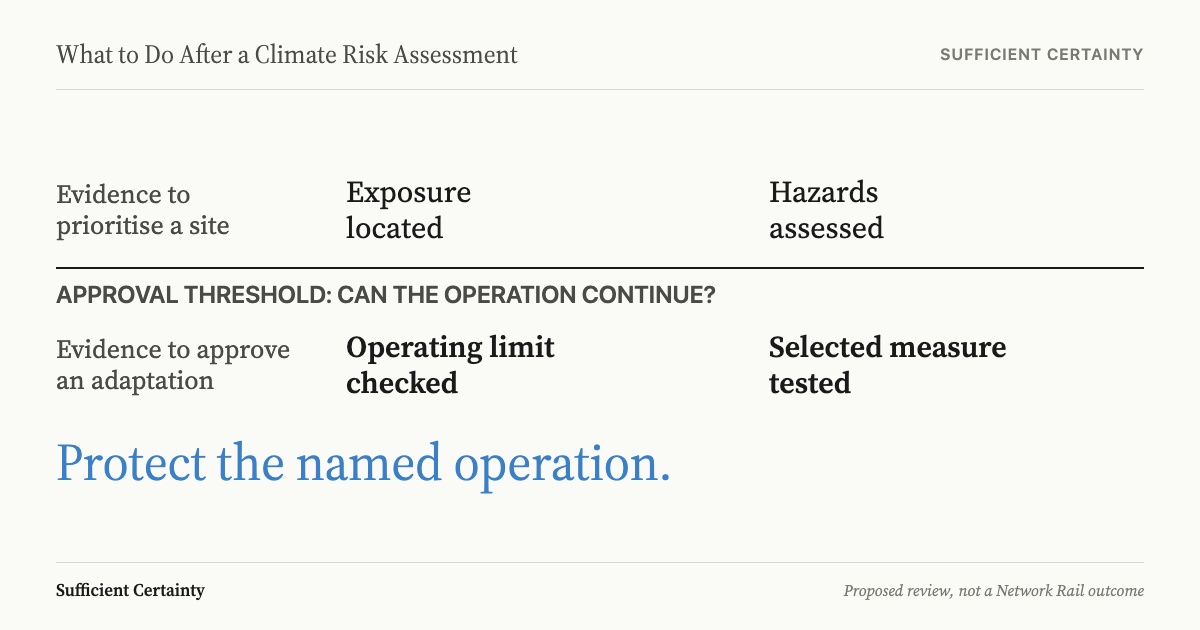
This case belongs within the broader risk assessment question: how will the findings change a decision? An asset map gives that question a location. The next task gives it an operating requirement and an investment proposal that can be examined.
Use the Walk to check whether the evidence supports the adaptation you are about to approve. Start the Walk →
How does the assessed scenario affect operation?
A completed assessment can give an executive a reasoned basis for comparing exposures. It can identify which sites need closer examination and show where several hazards affect the same operation. Preserve that work when preparing the adaptation proposal. The checkpoint should use the assessment's findings rather than start an unrelated analysis.
Read the scenario description alongside the period for which the asset must work. Record when the proposed adaptation would enter service. Then check whether the assessed conditions cover its intended use. A measure needed during the next operating period raises a different decision from a long-lived structure that will be difficult to alter.
The Environment Agency's adaptation planning guidance for permitted operations in England calls for attention to action thresholds and implementation timing. It describes phased measures that respond as conditions change. It also asks operators to consider whether earlier choices could prevent later changes.
The time needed to install a measure is part of deciding when action becomes necessary. Do not compare the assessment only with the date a physical limit might be reached. Ask whether design and installation could finish before that point, with the evidence available.
The timeline below shows a possible failure sequence for a proposed investment, not a Network Rail outcome.
Check the geographic coverage as well. The Environment Agency's flood assessment guidance for England distinguishes rainfall allowances from river-flow allowances. It also recognises that a neighbouring catchment may be the dominant source of flooding. This is a reason to verify the source of water affecting a site.
For the proposed investment, ask the technical reviewer whether the scenario represents the physical process that threatens the operation. An area-wide output may need local interpretation. The question goes beyond whether the model produced a plausible result. As with the review after scenario analysis, identify what was held fixed and whether it changes the decision.
More detailed climate data helps only when it resolves a material question about the proposed action. Ask which unresolved input could change the design or the choice to proceed. That question sets a useful boundary for further analysis.
Check the operating limit before selecting adaptation
Before the approval meeting, add a short comparison to the proposal. State the operation to preserve and the physical condition that would interrupt it. Put the scenario's timing and geographic coverage beside that condition. Then identify the evidence that the proposed measure will work within those conditions.
Keep each statement attached to its source. An equipment specification may support one operating limit. A local survey may support the condition of a drainage route. A model may describe future exposure. Treating each statement separately makes the assumptions behind the decision easier to challenge.
Approval needs enough evidence about the limit that could make the selected adaptation fail. If the operating limit is unknown, commission the check needed to establish it. If the scenario does not cover the relevant physical condition, ask for the specific additional analysis that would affect the proposal.
The chain above is a possible failure sequence for a proposed investment. It is not an account of Network Rail's results. It explains why a favourable assessment summary should not substitute for evidence about the chosen measure. The executive needs to see which link has been checked before funds are committed.
Compare the available actions against the same operating requirement. Maintenance or a change to operating practice may address the immediate need. A larger physical intervention may be needed for continued use. Keeping an alternative available may also have value. Ask what would make each option insufficient rather than assuming the largest project provides the best answer.
Apply the Universal Decision-Making Method to the actual commitment. Sufficient certainty here means the evidence justifies the proposed action, given its consequences and remaining uncertainty. It does not require a precise prediction of every future weather event. It requires a reasoned judgment about whether the selected response can preserve the named operation.
Record the condition that would require a change of course. It might be a revised local exposure estimate or evidence that an essential outlet cannot carry the assumed flow. Give someone responsibility for checking it. Monitoring the decision should leave enough time to prepare another response.
Approve a defined action with a stated limit and a reason to revisit it. The completed assessment then supports a commitment whose conditions are visible. The executive can explain why the available evidence was sufficient, what remains uncertain, and which finding would require another decision.
How confident are you that the proposed adaptation protects the operation within the assessed conditions?
Work through your decisionNo sign-up. Just pick your decision and start.
Grant Purdy is the co-author, with Roger Estall, of Deciding (2020), and the architect of the Universal Decision-Making Method.