
The most reassuring line in a scenario pack, the one saying the business survives the downside case, is often a finding about the model rather than about the future. After scenario analysis, and before the results reach the board or investment committee, question the frame: which variables every case held fixed, and where the severity of the worst case came from.
Scenario analysis runs a model under alternative sets of assumptions, usually base, upside and downside cases plus defined stress events, to see how outcomes change.
Taking the downside case to the investment committee
Once the cases are run, the work becomes a pack. The base case sits in the middle, upside and downside either side, and one or two stress cases below: a revenue fall, a rate rise, a lost customer, a funding market that closes. Each case is read for the numbers that decide things: covenant headroom, liquidity runway, the month cash goes negative.
This is the quantitative end of scenario planning. The scenarios are sets of inputs to a financial model, not the narrative futures of strategic foresight, which are covered in what to do after scenario planning. The output is a table of numbers, not a set of stories.
The pack then goes to whoever decides. For a company that is the board or its audit and risk committee. For a fund it is the investment committee. For a defined benefit pension scheme it is the trustee board. What they decide is sized off the bottom row: the liquidity buffer, the hedge ratio, the covenant package, the contingency plan. The downside case becomes the number every buffer is sized against.
Climate scenario analysis follows the same path. The Task Force on Climate-related Financial Disclosures (TCFD) set it out in a 2017 technical supplement on scenario analysis which recommended that organisations use, at a minimum, a 2°C scenario, alongside others relevant to their circumstances, to see how the business might perform under different future states. The results feed the organisation's disclosures.
What does a three-case model tell a board that a forecast cannot?
A forecast gives one number and invites an argument about whether it is right. Three cases change the question to how bad it can get and whether the organisation can live with that. The long-running debate over forecasting versus scenario work tends to obscure how much that shift is worth.
Scenario analysis also exposes the cliff edges a single forecast hides. A 10% revenue fall may cost nothing but margin. A 15% fall may breach a covenant, trigger a cross-default and hand control to lenders. Running the cases finds where those thresholds sit and how far the base case is from them.
Most usefully, it forces ranges onto paper. A downside case states, in numbers, what the modeller thinks a bad outcome looks like. Writing the range down is what makes it open to challenge. The trouble is that the challenge rarely happens.
Take the variable every case in your scenario pack held still, write down where its range came from, and decide what move in it would send the pack back before the committee votes. Start the Walk →
The base case in a darker coat
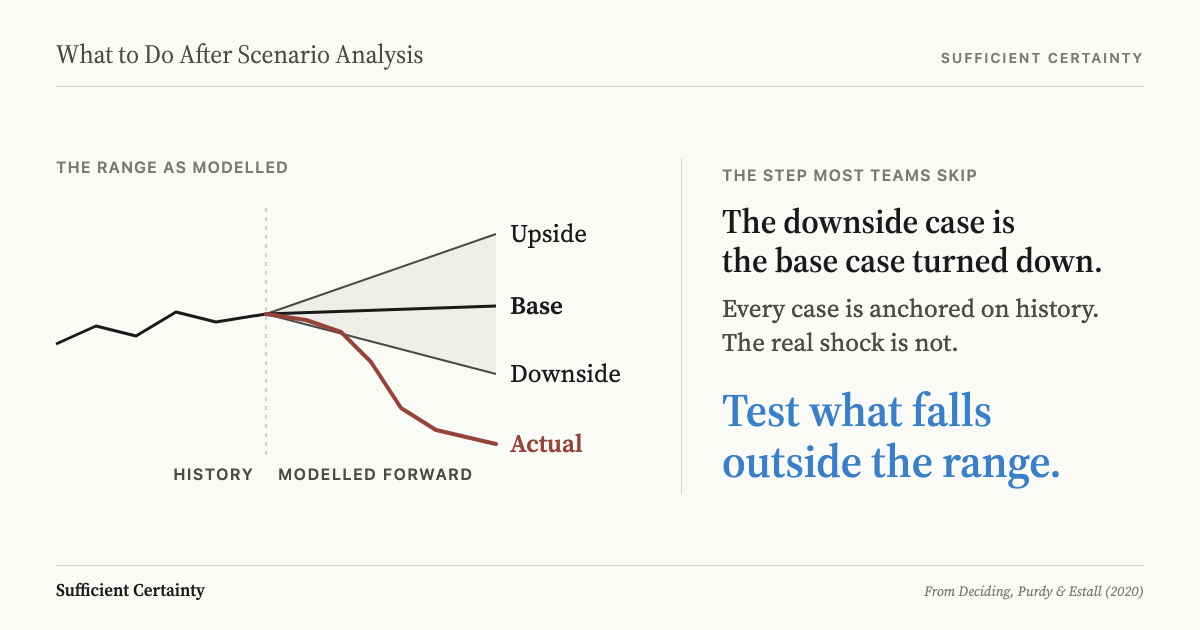
Look at how a typical downside case is built. It is the base case model with the dials turned: growth lowered, margin squeezed, rates raised, perhaps a correlation stiffened. The structure of the model, its drivers and the relationships between them are inherited unchanged. So is the time step. A model that runs in quarterly periods cannot show a shock that plays out in four days.
The dials are set by someone. Severity is usually calibrated to history: the worst year in the dataset, a percentile of past moves, the last recession. Otherwise it is set by what the committee will accept as plausible, which is history again, filtered through memory. Starting from a number and adjusting away from it is a well-documented habit, described in anchoring bias, and in scenario work the base case is the anchor.
The TCFD supplement sets out the standard such a pack should meet. Scenarios should be "distinctive", "not variations on a single theme", and they "are not forecasts or predictions nor are they sensitivity analyses." A downside built by flexing the base case's inputs is a sensitivity analysis with a narrative attached, and it carries the weakness set out in what to do after sensitivity analysis: the ranges tested are the ranges someone chose.
The scenario set inherits the frame of whoever built the base case. Surviving the downside tests the model against its own assumptions, not against the future.
The September 2022 gilt shock broke the 100 basis point frame
On 23 September 2022 the Chancellor announced the Government's growth plan. The 30-year gilt yield rose 160 basis points in a few days. By the evening of 27 September, according to the Bank of England's letter to the Treasury Committee, liability-driven investment (LDI) fund managers were warning that multiple funds were likely to fall into negative net asset value.
LDI funds use leverage to help defined benefit pension schemes hedge their liabilities. When yields rise, net asset value falls and margin calls follow, so the funds hold collateral buffers sized by scenario.
According to the House of Lords Industry and Regulators Committee's February 2023 letter to ministers, the chief executive of The Pensions Regulator (TPR) told the committee regulators had typically looked at shocks of around 100 basis points. The Financial Policy Committee's 2018 assessment had tested margin calls from up to a 100 basis point instantaneous rise.
That ceiling looked generous against history. The largest one-day rise in long gilt yields in data back to 2000 had been 29 basis points. September 2022 produced two days above 35, and a four-day rise more than twice the largest since 2000. The Bank concluded the move "far exceeded historical moves". The severity range had been drawn from the record, and the event was not in the record.
Size was the dial everyone turned. Speed was held still. The Financial Conduct Authority described the funds as "designed for calm times", with trustees given a week or two to provide money. TPR's Neil Bull called the speed of the rise "outside the realms of plausibility". When many funds had to sell the same gilts at once, their selling became part of the shock, a "self-reinforcing spiral" in the Bank's words.
Market intelligence from LDI managers, taken at face value, implied at least £50 billion of long-dated gilt sales within days, against average trading of about £12 billion a day in those maturities. On 28 September the Bank announced temporary purchases of long-dated gilts, running until 14 October.
In March 2023 the Financial Policy Committee judged that LDI funds should withstand a yield shock of, at a minimum, around 250 basis points. The Bank staff paper sized its systemic component to a shock "of a similar scale to the largest ever historical move", the one in September 2022. The frame moved only once history did.
From turning the dials to checking the frame
The step after scenario analysis is a check on the frame, made before the scenario pack goes to the investment committee or trustee board. It needs three things the pack rarely contains.
The first is the list of variables held constant across every case: how fast a shock arrives, the time available to raise cash, whether lenders keep rolling funding, what everyone else holding the same position does. If a variable moves in no scenario, the pack says nothing about it. TPR's April 2023 LDI guidance now writes its own down: the 250 basis point minimum "assumes you are able to provide additional cash or assets to replenish the buffer within five days."
The second is the source of each shock size: a historical percentile, a regulator's template, last year's pack. If the answer is history, ask whether the record is long enough to contain the event the decision is exposed to.
Which variable did every case in the pack hold still?
The third is one scenario built from a different starting point. Start from the failure: what would exhaust the buffer, break the covenant or force a sale, and how fast would it have to happen? The same TPR guidance asks trustees to test movements "of different sizes, speed and duration". A rival team, as in a wargame, gives a starting point the modeller would not have picked.
Framing comes first in the Universal Decision-Making Method for this reason. The frame decides which scenarios can appear at all, the wider case made for problem framing. A downside case earns trust only once someone has checked what it was never allowed to vary.
UK pension schemes had LDI stress tests that passed at 100 basis points. What they didn't have was a scenario for a move faster than anything on record.
Work through your decisionNo sign-up. Just pick your decision and start.
Grant Purdy is the co-author, with Roger Estall, of Deciding (2020), and the architect of the Universal Decision-Making Method.